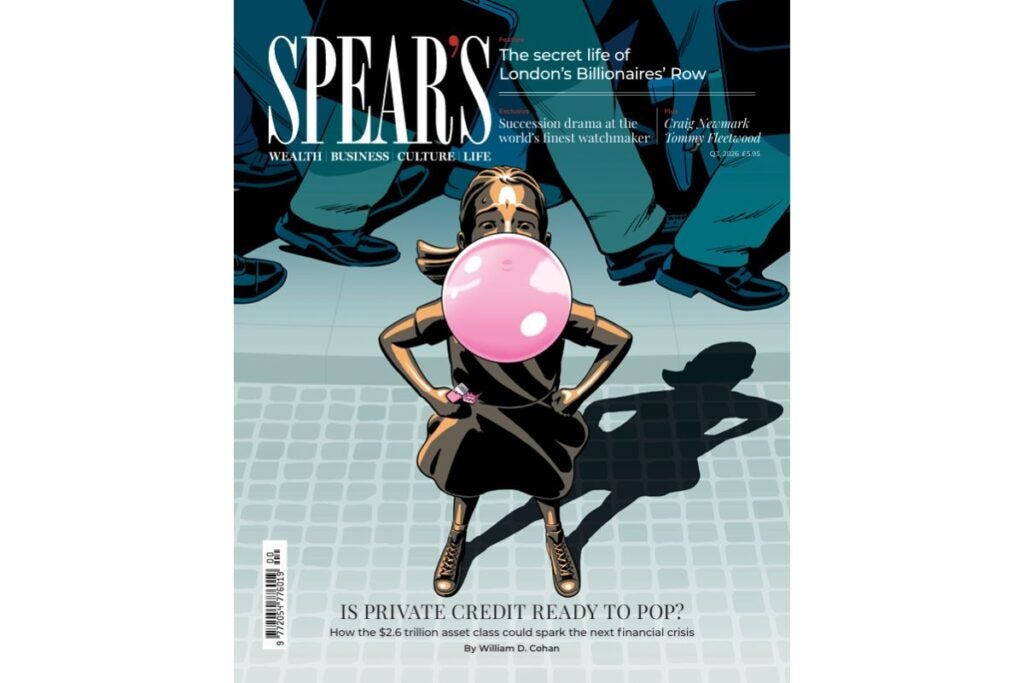
A fierce debate is raging on Wall Street about whether the trillions of dollars in so-called ‘private credit’ that has amassed on balance sheets around the world will lead to the next, and long overdue, financial crisis, or whether the concern is a bunch of overblown fretting and everything is just fine, thank you very much.
The breadcrumbs of a trail leading to a crisis in private credit have been strewn across the landscape since late last year. That’s when the mostly retail investors in a non-tradeable credit fund with the opaque title OBDC II – an affiliate of the Blue Owl Capital, Inc., a publicly traded alternative asset manager – began to ask to get their money out of the fund in increasing numbers.
The fund allowed wealthy individual investors to get exposure to a pool of some $1.6 billion (around £1.2 billion) of mostly senior secured loans, made to a variety of more than 180 middle-market companies. It aimed to give investors an annualised yield approaching 10 per cent, which was very enticing – but that also should have been one indicator of the risk associated with the investment.

[See also: Introducing Spear’s Magazine: Issue 100]
Related


Last November, investors in OBDC II began to get concerned that the fund had made loans to a disproportionate number of software-related companies – exactly the kind of business that might fare poorly in the new AI-driven economy if demand for coders and third-party software in general were to fall.
Even though about 97 per cent of the loans in OBDC II fund were senior secured and should be pretty safe, all things considered, some investors in the fund wanted their money back. The problem for the investors, though, and for Blue Owl as a result, was that quarterly redemptions were capped at 5 per cent of the money in the fund. And, cumulatively, investors had asked to redeem more than that 5 per cent.
What to do? What’s more, since neither the fund, nor its underlying assets, were publicly traded, sufficient liquidity would not necessarily be easy to come by. Forcing the sale of loans in the fund (to get the requested liquidity) could easily have resulted in those loans being sold at a hefty discount.
[See also: Why private capital can help solve ‘world’s most pressing problems’]
Content from our partners



Cash could come from the fund itself; from money paid in by new investors; from interest payments on the loans; from the sale of some of the loans in the portfolio – or from another source.
Blue Owl tried to provide liquidity to the investors who wanted out by proposing a merger with a different, but affiliated, publicly traded credit fund. But that would have required the investors to take as much as a 20 per cent haircut on their investment. Understandably, that idea was rejected. It raised a question, too: why was a discount necessary if the underlying loans were senior secured and the money was good?
The phenomenon of private credit has the feel of a fascinating new Wall Street innovation. But, it’s really not. Banks, insurance companies and other financial institutions, such as GE Capital (before its liquidation), have been making loans and credit available to businesses of every stripe for centuries. There’s nothing new there. What has changed, mostly as a result of the new regulations imposed on the big Wall Street banks in the wake of the 2008 financial crisis, is which financial institutions are taking the lead in making such loans.
Basically, as a result of the so-called Dodd-Frank law, the Federal Reserve, the prudential regulator of Wall Street, has decreed that the big Wall Street banks need to limit the amount of loans they are making to companies big and small, and especially the kinds of riskier loans that are often made to support leveraged buyouts, or are unsecured or subordinated in a given capital structure.
What’s more, even if the big banks feel the need to make these loans, the Federal Reserve doesn’t want them kept on banks’ balance sheets for very long. The Fed wants the banks to sell the loans, or syndicate them – anything, in fact, to reduce risk. As a consequence of the 2008 financial crisis, which some have argued originated on the balance sheets of the Wall Street investment banks, the Federal Reserve has decided it doesn’t want a repeat of the big banks ever again risking depositors’ money. Hence the limitations it has imposed.
Of course, the new rules and regulations on Wall Street created a vacuum in the market that other ‘non-bank financial institutions’, such as Apollo Global Management, led by CEO Marc Rowan, the Blackstone Group, KKR and Brookfield Asset Management rushed in to fill, even though these financial players had mostly been long focused on making private equity investments, not making private loans to businesses across the globe.
[See also: Blackstone outpaces rivals in race for private investors]
But these major players, along with a bunch of new firms, such as Blue Owl Capital, Ares Management, Golub Capital and Sixth Street, among others, also smelled opportunity: they could collectively make loans to businesses, charging relatively high rates of interest that made the loans profitable based on their various costs of capital. These new players began to refer to themselves as ‘alternative asset managers’ and were filling the hole in the market left by the big Wall Street banks and by the exit from the market of other financial institutions such as GE Capital, which was once the third largest financial institution in the country but was dismantled and sold for parts in 2015.
Depending on how you count, the size of the private credit market is either a gargantuan $40 trillion – reportedly the size of most of the loans outstanding these days, including relatively safe senior secured loans – or merely very large, at $1.7 trillion – the amount of the outstanding riskier unsecured, subordinated or so-called ‘junk’ loans made to support highly leveraged companies or leveraged buyouts.
[See also: Goldman boss: Europe on ‘cusp of investment supercycle’]
What started out as a relatively simple matter of firms such as Apollo making senior secured loans to companies like Gannett, the newspaper group (now USA Today Co.), at relatively high rates of interest, has exploded into an $800 billion business for Apollo, comprising the vast majority of the $1.03 trillion of assets the firm now has under management (the remainder being mostly its private equity investments).
Apollo not only buys loans that other banks and financial institutions originate, it also originates some $300 billion of its own loans a year, most of which it then syndicates to others while keeping some 20 per cent of the loans for itself. ‘We want 25 per cent of everything and 100 per cent of nothing,’ Rowan likes to say.
As the market for these private loans continued to grow, the various players got more creative in trying to find investors to buy them. Hence the Blue Owls of the world, who bundled them together in funds that were opened up to retail investors. It seemed like a great idea – until the investors got worried about the safety of the loans and began clamouring for their money back.
In the end, as ever, Wall Street is a confidence game and tends to overshoot the mark, especially with a new product.
When investors start getting nervous about the safety of their money and want it back, even though they technically can’t get it by the rules of engagement, that’s when the confidence is lost. And that’s pretty much where we are now. Investors have suddenly become nervous about the safety of their investment in private credit funds and want some of their money back, beyond what they are entitled to get back. And when that loss of confidence becomes contagious, which is also where we’re at now, the headlines become deleterious and force the fund managers to do backflips in order to calm everyone down.
Things at Blue Owl quieted down for a few months, until February. That’s when the firm, with some $300 billion of private credit assets under management – making it one of the larger alternative asset managers – decided to sell about $1.4 billion of loans from a variety of its credit portfolios to get the cash it might need to meet the ongoing redemption requests from OBDCII investors.
[See also: Blackstone outpaces rivals in race for private investors]
Even though Blue Owl was able to sell the loans at par, or close to par, the sales also signalled some concern to the market. That, of course, led to a vicious circle of more demands for redemptions from the fund. In addition, the headlines at Blue Owl led to a general sense that, once again, retail investors got themselves involved with a product they probably didn’t fully understand. For their part, the industry bigwigs insisted that the investors should have read the fine print, so to speak. ‘Liquidity is not free,’ Michael Arougheti, the CEO of Ares Management, told an investor conference.
Then things got a bit muddled. In mid-February, Blue Owl said that it was not ‘halting investor liquidity’, only that it was ‘restructuring how liquidity is delivered’. Instead of allowing for quarterly redemptions, as had been the case, Blue Owl was going to give investors in OBDC II some 30 per cent of their money back, at book value, over a 45-day period, using the proceeds from loan sales, and that would be the way the redemptions would work for investors in the fund, going forward.
So if your investment in OBDC II was worth, say $10,000 in February, Blue Owl returned $3,000 to you. It was not technically a ‘gating’ of the fund – which would have prevented all future redemptions – but it wasn’t exactly business as usual either.
No surprise, further investor nervousness ensued. Blue Owl stock dropped by more than 35 per cent. It wasn’t alone. In March, Apollo’s stock was down to around a third of its value in early January; Blackstone’s stock price was down 19 per cent. KKR’s stock was down 20 per cent. Ares stock was down 30 per cent. It may have since rallied a little, but the sector has been getting crushed.
Like Blue Owl, Blackstone has had its own problems related to its private credit funds. Its Blackstone Private Credit Fund, or BCRED, has some $82 billion of private loans under management, making it one of the largest around. In the wake of the problems at Blue Owl, investors in BCRED ratcheted up their redemption requests, to some $3.7 billion, in early March. That was around 8 per cent of the fund’s assets under management, materially more than the 5 per cent the fund allows to be redeemed on a quarterly basis.
The funds didn’t have any notable increase in credit defaults; rather the redemptions came as a result of the growing concerns, generally, about getting money back when you wanted it. Blackstone took a different approach with its investors than Blue Owl, choosing to increase the quarterly redemption percentage to 7 per cent, from 5 per cent, and the company and some of its employees injected a fresh $400 million into BCRED to meet the redemptions. Phew.
[See also: HSBC Private Bank gives UHNW clients access to institutional-grade private markets]
A few days after Blackstone averted a fullblown crisis at BCRED, a credit fund managed by BlackRock – HPS Corporate Lending Fund, a $26 billion private-credit fund that lends to midsize companies – was hit with a wave of redemption requests, totalling $1.2 billion.
(BlackRock bought HPS in 2025 for $12 billion.) Collectively, investors sought to redeem some 9.3 per cent of the fund’s shares; nearly double the 5 per cent permissible quarterly share redemption limit. But, unlike Blackstone, BlackRock stuck to the 5 per cent redemption limit for the fund, allowing some $620 million of redemptions, around half of what had been requested.
In sticking to its guns, HPS emphasised that some 96 per cent of the fund, known as HLEND, was invested in first-lien senior secured debt and that the fund had returned 10.7 per cent, net, on an annualised basis to investors since inception.

[See also: Sharp rise in family office plans to shift strategic allocations]
‘HLEND’s intentionally designed liquidity framework, specifically the recurring 5 per cent quarterly share repurchase feature, is foundational to enabling these return outcomes,’ HPS posted on its website. ‘Without it, there would be a structural mismatch between investor capital and the expected duration of the private credit loans in which HLEND invests.’ In other words: the product only works because it’s largely illiquid.
Even so, the three incidents – at Blue Owl, Blackstone and BlackRock – had dented confidence in the private credit market.
In any event, the caution flags were flapping wildly. Jamie Dimon, the chairman and CEO of JPMorgan Chase, got people further riled up by referring to the existence of ‘cockroaches’ among a variety of companies that received private credit. In other words, Dimon was implying, if there are problems among overlevered companies already out in the open (First Brands and Tricolor were two examples in the press) there will likely be more problems still hidden from view.
[See also: Why British wealth management is taking on an American accent]
On 1 March, at JPMorgan Chase’s annual investor day, he elaborated (‘I see a couple of people doing some dumb things’) and drew a comparison with the way people behaved in the years leading up to the 2008 financial crisis. ‘Unfortunately, we did see this in ’05, ’06, ’07, almost the same thing,’ he said. ‘The rising tide lifting all boats, everyone was making a lot of money, people leveraging to the hilt. The sky was the limit … My own view is people are getting a little comfortable that this is real – these high asset prices and high volumes and that we won’t have any kind of problem whatsoever. So we’re quite cautious about that.’
(In mid-March, JPMorgan Chase marked down the value of some loans in some portfolios of private credit lenders – loans that were used as collateral for loans from the bank to the private credit firms.)
Boaz Weinstein, a hedge fund manager at Saba Capital Management, said at an investor conference in early March: ‘All you need is the snowball to start going down the hill, and it’s started. Blue Owl is right in the middle of that. I think we are in the super-early innings of the wheels coming off the car.’
[See also: Mind the wealth gap: the secret entry points of private banking]
He declined my request to elaborate on what he said at the conference in Miami, but he has been tweeting such bon mots as: ‘The retail investor in private credit brings to mind one of my favourite quotes: “No snowflake in an avalanche ever feels responsible.”’
That seemed to open the floodgates of concern. David Rosen, a hedge fund manager at Rubric Capital, who used to be a fund manager at Steve Cohen’s Point72, wrote to his investors saying that he was worried about ‘systemic risk in our financial system that merits discussion’, adding that ‘we are concerned about the risks inherent in levered private assets, specifically levered private credit and private equity’.
He wrote that he believes ‘poor incentives led to an industry that grew too fast and began marketing assets to the wrong investors. Irresponsible industry executives pitched a notion of a better credit mouse trap (while having some merit in its early days) that became nothing more than a way of avoiding mark-to-market exposure’.
[See also: Goldman Sachs: Millennials are the ‘alts generation’]
He accused some purveyors of private credit, especially a Cliffwater Corporate Lending Fund, with $33 billion under management, of ‘playing Enron-like accounting games’.
In March, redemption requests from the Cliffwater fund exceeded 14 per cent, above the 5 per cent quarterly redemption threshold; Cliffwater agreed to cap redemptions at 7 per cent of the money requested. Weinstein called the Cliffwater fund a ‘turducken’ (a chicken stuffed inside a duck, stuffed inside a turkey) on CNBC and tweeted that each quarter the fund ‘falls further behind’.
He added: ‘That’s not market sentiment. That’s a queue.’ Also in March, another private credit fund, North Haven Private Income Fund, an affiliate of Morgan Stanley, reported that it had received redemption requests totalling nearly 11 per cent of the fund, but would only fulfil them to the required 5 per cent. The fund agreed to return $169 million to investors, or about 46 per cent of what they requested.
‘While uncertainty remains a feature of the current market environment, we believe [the fund] is well positioned and anchored primarily in first-lien senior secured loans,’ the fund managers wrote to its investors.
Part of the problem is the use of the word ‘private’, which implies that there is not much of a market for the loans or the securities involved and there is very little financial information about the companies on file with securities regulators. It should also be remembered that liquidity in the debt markets, which we often take for granted these days, is still a relatively recent development.
It largely emerged in the last 40 years or so, in the aftermath of the creation of the junk-bond market and various securitisation techniques. Without a public trading market, these loans and securities in private credit funds have to be evaluated occasionally by third parties based on whatever valuation method they may be using, adding to the imprecision of how they are valued at any given time and to the impression that something is rotten in the state of Denmark.
In fact, the job of the valuer itself is not clear. If I have a private credit fund, how am I supposed to value the loan or the bond in that fund? At what I can sell $1 million worth of bonds for? Or what I can sell $100 million worth of bonds for? Or more? It’s far easier to sell a small number of usually illiquid bonds at a better price than it would be to sell a big bundle of usually illiquid bonds. In the end, it’s all more art than science, and a stampede to the exits doesn’t exactly help.
Richard Christopher Whalen, chairman of Whalen Global Advisors and the editor of The Institutional Risk Analyst, a respected weekly newsletter covering financial markets and public policy, wrote in March: ‘Not only are the private markets now big enough to threaten the stability of public markets, but the messy action of the past week in private credit suggests that a major correction is inevitable.’
He likened BlackRock’s decision to suspend redemptions, which is consistent with the terms under which the investments were made initially, to the gating of the two Bear Stearns hedge funds in 2007, which then failed and precipitated what led to the failure of Bear Stearns, in its entirety, and then Lehman Brothers.
[See also: What are hedge funds betting on in 2026?]
Bob Sloan, the founder and managing partner of S3 Partners, a data analytics firm, said on Bloomberg TV that he’s seeing a fair amount of short interest in Blue Owl. ‘What are short interests saying about private credit?’ he said. ‘We don’t believe the marks. So if you want to draw an analogy to 2008, you say, “The business model is suspect. Who’s Bear Stearns?” Now we’re not saying that they’re Bear Stearns. This is what the data is saying. The data is saying that Blue Owl is potentially Bear Stearns because we don’t believe the marks and the collateral underneath supporting these loans is suspect.’
Christian Stracke, the president of PIMCO, the $2.3 trillion asset manager, said on a March podcast with a colleague that ‘there is a reckoning going on right now [in private credit]. It’s not just a crisis of confidence, it’s a crisis of really bad underwriting’.
Not surprisingly, the architects of the private credit boom don’t agree with the doomsayers. They concede there may be a bit of a shakeout underway in the industry because there are always better underwriters and worse underwriters. ‘We can’t legislate out of existence stupidity,’ Rowan, the Apollo CEO, told Bloomberg recently. But he says pretty much the same thing to whoever will listen, including to me for my new book about Apollo. He has become the Johnny Appleseed of private credit.
[See also: The end of overcharging? New low-cost wealth advisory seeks to rival the establishment]
In the Bloomberg interview, Rowan conceded that we’re at the end of a ‘very long accommodative cycle in credit’, where there are people ‘who move out on the risk curve, who ignore things that are obvious’ and that while it ‘all feels good while it’s happening’, it ‘doesn’t feel so good once it arrives’. Well, he continued: ‘Some of those changes have arrived.’ (By the way, it’s not just Rowan making the case for private credit; the co-president of Apollo’s asset management division, Scott Kleinman, has also appeared on a podcast recently making the same arguments. The firm’s president, Jim Zelter, has said that investors have overreacted to the supposed problems in the private credit market and have ‘lost the plot’ as a result of ‘a skirmish on the sidelines’.)
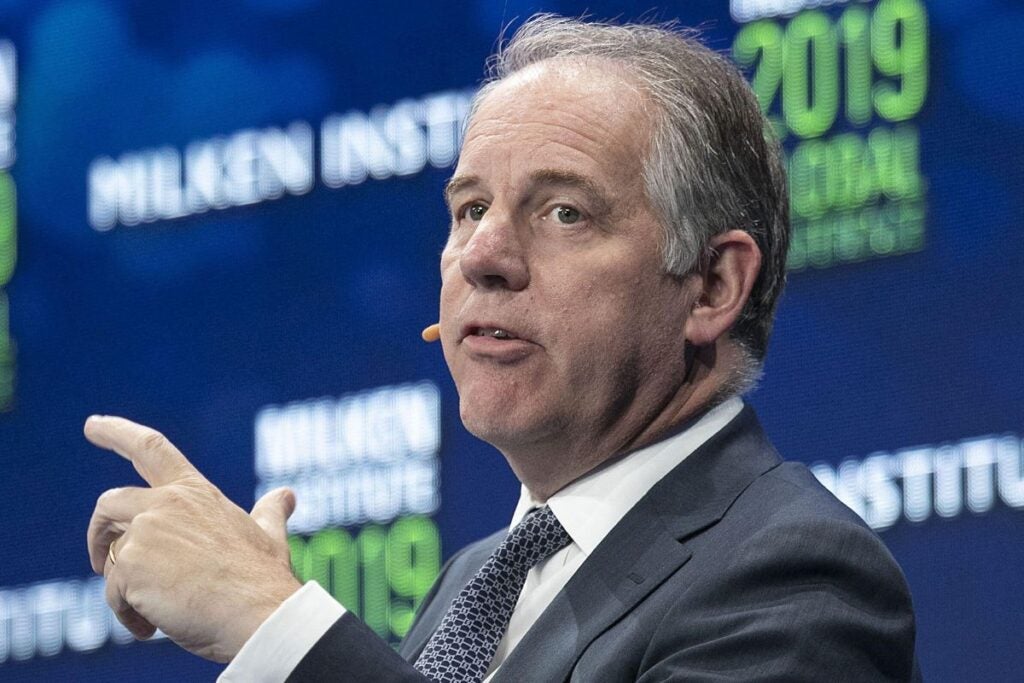
On CNBC, in April, Rowan took his criticism of the investor panic a bit further, when he said that ‘you’re an idiot’ if you have a private credit fund that can’t meet the 5 per cent redemption requests. ‘It’s not that hard to do,’ he said.
Rowan also suggested that you were asking for trouble, as a private credit fund manager, if you larded up the fund with software-related credits in the midst of the AI boom. Even so, he made the important point that a lot would have to go wrong in a company’s business for the senior secured debt to become distressed, even at software companies.
[See also: Fortune telling: What the wealth industry sees coming]
‘I remind people that software first-lien [debt] is senior to high-yield bonds and is senior to equity,’ Rowan continued. ‘So, if you’re going to have a problem in software lending, you’re going to have a problem in equity, you’re going to have a problem in high-yield, you’re going to have a problem in bank lending and broadly syndicated and everywhere else … Credit is just credit.
There are good underwriters of credit and there are bad underwriters of credit.’ In effect, Rowan is saying to anyone who will listen: ‘These are not the droids you’re looking for.’ Private credit is safe. The vast majority of it is senior and secured and at the top of the capital structure and other investors, in the equity, in the high-yield bonds, are going to lose their money long before the senior secured lenders will lose their money.
Everyone should just calm down. ‘We have this habit of throwing the baby out with the bath water,’ he said. ‘All the press is focused on this levered lending portion of the market … On the other hand, the vast majority of the market is private investment grade, which is also called private credit, and has almost nothing to do with what we’re talking about today.’
Jon Gray, the president and chief operating officer at Blackstone, has also been out on the stump defending private credit. He has acknowledged the change in investor sentiment when it comes to the private credit sector but that nervousness has probably helped make underwriters of private credit more vigilant and more cautious.
In a CNBC interview in early March, after rattling off how well the BCRED fund had performed for investors since it was created six years ago, he, too, suggested the crack in investor sentiment has been overblown. He said that in addition to the redemption requests, which Blackstone had met – unlike other firms – institutional investors had invested another $2 billion into BCRED.
‘We’ve had a ton of noise,’ he said. ‘As you guys know better than anybody in the press, this has become a story. It started with Tricolor and First Brands, which were bank-originated credits. There’s a constant spin cycle. And so when that’s happening, it’s not a surprise that investors can get nervous.’
[See also: A voyage around the history of private equity: from profits and power to public scandals]
Howard Marks, the co-founder of Oaktree Capital Management (now part of Brookfield Asset Management) and one of the wise men of the credit markets, told CNBC in April that the investor concerns about private credit have been way overblown.

‘Often the wrong product gets sold to the wrong people,’ he said, ‘and so some people probably invested in private credit funds, not understanding the limitations on liquidity, and then when they decided and they turned negative, they couldn’t easily get out like they can in the stock market or a mutual fund. And they’re shocked, like the guy in Casablanca, who was shocked to find gambling in the bar. They are shocked to find out that their money wasn’t available daily on request. This will always happen because things are sold to the wrong people. But that doesn’t mean that the underlying product is wrong.’
By late spring, things seemed to have settled down. But by early summer, there was a fresh batch of unhelpful developments. In the space of a few days in early June it was revealed that Cliffwater had seen redemption requests equal to 17 per cent of the value of its $32 billion flagship private credit fund in the second quarter; Swiss firm Partners Group announced it would cap withdrawals in its $16 billion US private equity fund as volatility in private credit had ‘spilled over to private equity’; and Blackstone revealed that it would restrict redemptions from its BCRED fund for the first time. Instead of finding a creative solution that helped people to take their money out, as it had done earlier in the year, the firm blocked redemptions above the stated limit of five per cent of the fund’s $45 billion value, even though investors wanted to take back twice that amount in the second quarter.
What’s unknown still is what the ultimate denouement of private credit will look like. Will it be a full-blown financial crisis – that we are more than overdue – or will it be just a blip when this bit of investor panic subsides and cooler heads prevail with the realisation that Rowan and Marks are right, and the vast majority of private credit is senior-secured, first-lien loans to a wide variety of companies in a wide variety of industries?
[See also: The best wealth managers in Switzerland in 2026]
One big difference between what happened in 2007 and 2008 and what is happening now is that Bear Stearns, Lehman Brothers, Merrill Lynch and Morgan Stanley, et al, were in the right ventricle of capitalism. They weren’t depository institutions, it’s true, but they were at the white-hot centre of Wall Street. For them to disappear, what seemed like overnight, as both creditors and investors lost confidence in the firms as a whole – well, that was not only utterly unexpected but also created a panic across the economy that was nearly unprecedented. Nowadays, the risk that used to be on the balance sheets of the big Wall Street banks has been largely pushed to the edges of the financial system, thanks to Dodd-Frank.
If one or two private credit funds go down the tubes at firms that no one has heard of, such as Cliffwater or North Haven, will that be enough to bring the financial system to its knees again? That’s doubtful. Even if Blackstone or Apollo were potentially to go belly up – a highly unlikely event, given how diversified they are – would that be enough to cause a widespread panic? It wouldn’t be great for the financial system obviously. But it’s so unlikely to happen at the moment that it’s not worth losing sleep over.
In short, I don’t think the recent kerfuffle in the private credit universe is enough to be a catalyst for a full-blown financial crisis. I could be wrong, of course. But we will, for sure, know the answer soon enough.
This article first appeared in Spear’s Magazine Issue 100. Click here to subscribe