Writing about music, some one once said, is like dancing about architecture.
The observation comes to mind during my conversation with Igor Tulchinsky, the Belarusian-born, US-based billionaire who made his fortune harnessing the power of hundreds of thousands of algorithms that his hedge fund, WorldQuant, uses to predict the movement of financial instruments.
His business, which was spun out of Israel Englander’s hedge fund Millennium in 2007, has $10 billion in AUM in its own right, as well as $20 billion through a joint venture: WorldQuant Millennium Advisors.

Tulchinsky, whose net worth is estimated to be £1.7 billion, says the firm is already deploying generative AI extensively and anticipating a 100-fold productivity increase from the technology. He is also thinking about the possible implications of the quantum computing revolution.
Related



[See also: The best art advisers]
Our discussion – which takes place in a large meeting room at Claridge’s, where we’re joined by two of Tulchinsky’s bodyguards and a PR – is interesting, edifying, occasionally humorous, but also quite hard work. This may be because the complexity of his thinking doesn’t always map neatly onto what we have all now learned to call ‘natural language’ – or at least not when he is talking to a mathematical layperson, on the record, and while trying to cover a fair amount of ground in the 60 minutes allotted to our wide-ranging interview.
Tulchinsky, who will be 60 this year, moved to the States when he was 11, but the Belarusian influence on his accent is still stronger than the American.
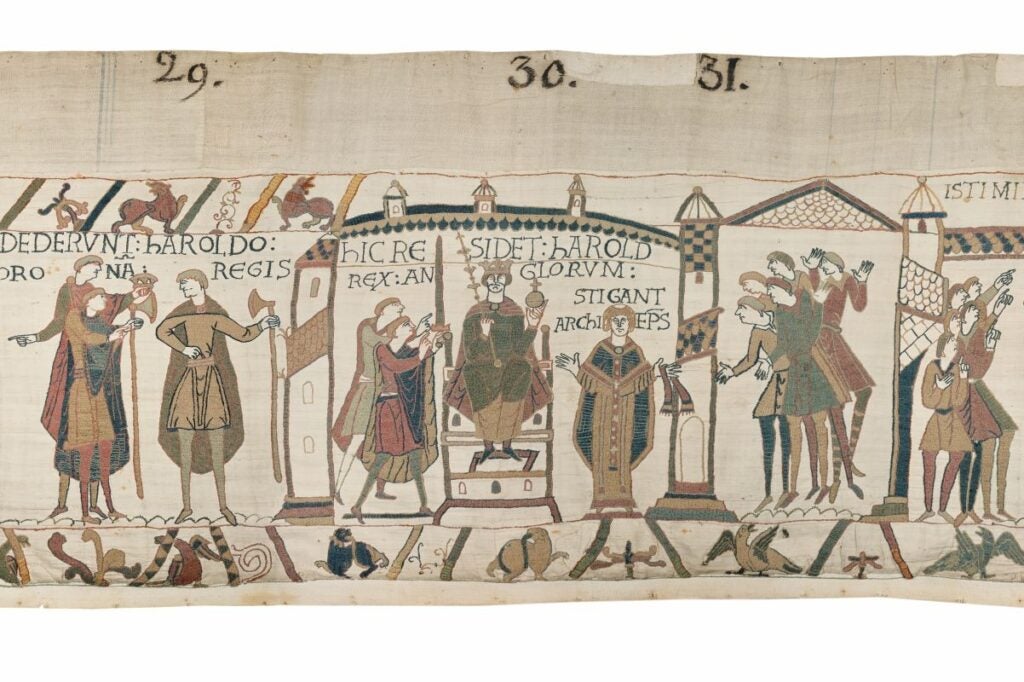
The reason for our meeting today reveals another layer to Tulchinsky’s character. He is personally sponsoring the British Museum’s highly anticipated and somewhat controversial exhibition of the Bayeux Tapestry.
Content from our partners


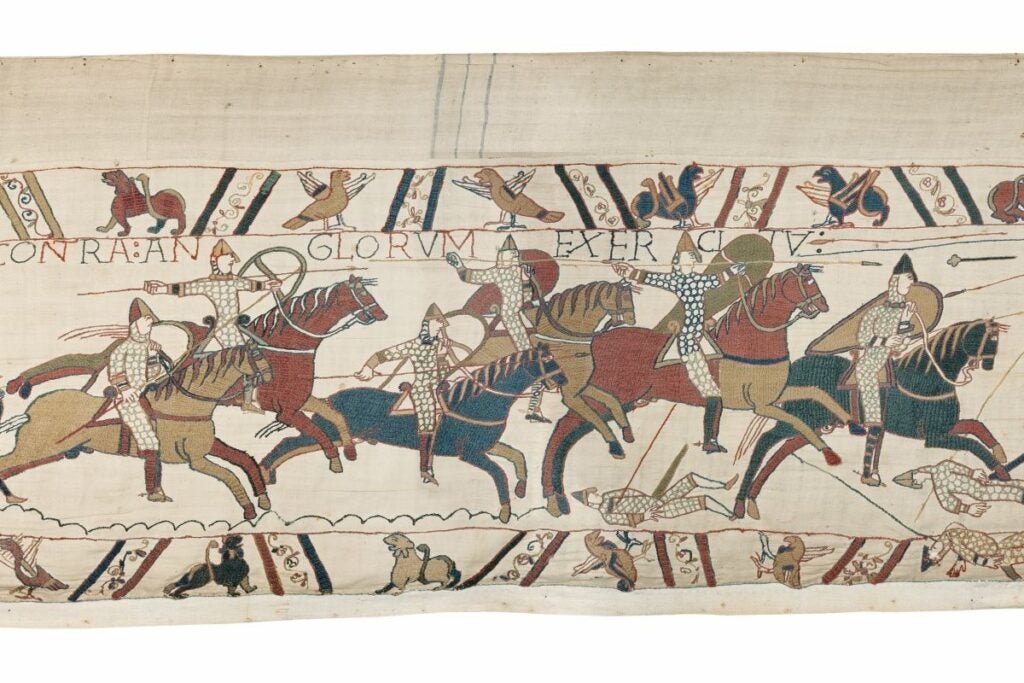
Comparisons have already been drawn with the institution’s famous Tutankhamun spectacular of 1972.
Tulchinsky’s contribution, thought to be in the region of £5 million, has made it possible to transport the ancient, delicate 70m-long tapestry (which is not technically a tapestry, but an embroidery) from its home in the Bayeux Museum in Normandy to London for what historians believe is only the second time it has crossed the channel since it was crafted in Canterbury in the 1070s under the orders of William the Conqueror’s half-brother Odo.
[See also: Art Basel CEO shows careful confidence in global art market]
Not everyone is pleased with this development. More than 40,000 people have signed a French petition against sending the artefact to Britain, saying the risks associated with its transportation constitute a ‘true crime against heritage’.
Interestingly, Tulchinsky didn’t know much about the tapestry – which depicts the battle of Hastings and events either side of it – until the opportunity to support the exhibition was put in front of him. ‘I think I may have heard about it before because it looked kind of familiar,’ he says. ‘But it was the first time I was made aware of what it is, its historical significance and all the details. I thought about it for a while, and I thought… it would result in millions of kids seeing something ancient that can’t be replicated, which is more and more rare in the modern world.’
In a column for the Independent, Tulchinsky wrote that ‘the embroidery demonstrates such a mastery of craft, including in mathematics. The symmetries and proportions show careful calculation […] Its chronological structure reveals something equally sophisticated: a modern sense of causality and sequence. Events build on one another, constrained by what came before. It is “systems thinking”, long before we had the language for it.’
[See also: Art market shows signs of recovery after sales slump]
This sponsorship is not his only philanthropic endeavour. In 2015 he set up WorldQuant University, on the premise that ‘talent is evenly distributed around the world, but opportunity is not’. It offers tuition-free postgraduate education, including a flagship two year MSc in financial engineering, to students all over the world. The October 2025 intake had 2,500 students from 115 countries.
‘What’s the biggest gift you can give?’ he asks. ‘It’s an education. It lasts forever and, in good cases, changes the trajectory of the life of the person who receives it.’
Tulchinsky also sponsors chess tournaments. A competitive player in his youth, in adulthood he has played exhibition matches against the game’s rock star five-time world champion, Magnus Carlsen. ‘I’ve played him many times. He remembers games years apart; every move of every game.’
What’s Tulchinsky’s ranking now? ‘Most of my chess playing these days is promotional,’ he says, somewhat wistfully. ‘Put me against the world champion and then it’s not a question of winning, but how many moves I can last.’ Last time out against Carlsen it was ‘18, or something like that’.
[See also: Monet to Mondrian: why these three paintings sold for over $40 million in 2025]
Following the 7 October attack in Israel, Tulchinsky, who is of Jewish descent, also paid for the families of the hostages to travel to Washington so they could meet with members of Congress.
Born into Soviet Belarus in 1966, Tulchinsky had an itinerant childhood, to say the least; the family lived in several places in four different states and he reckons he has moved at least 30 times. ‘It was all a positive experience,’ he says of that peripatetic upbringing. ‘Every step was a step up. And, yeah, certainly moving around so much has some kind of cost in
terms of being uprooted all the time, but it has its benefits too. You see more.’
His parents were both professional musicians; his mother played the piano and his father made violins, but Tulchinsky says he isn’t musical. In middle school he got into computer programming and was coding his own computer games at 17.
He received a bachelor’s and master’s degree in computer science from the University of Texas before an MBA from Wharton and started his career at AT&T Bell Laboratories (the telecoms company’s now-shuttered R&D division). His first job in finance was at Timber Hill, an options trading firm set up by Hungarian refugee Thomas Peterffy, who went on to build a $60 billion fortune. Now in his 80s, he recently told Forbes that he remembered Tulchinsky as ‘a deep thinker’. He added: ‘He reminded me of myself in my younger years as he some times seemed to have gotten completely lost in his thoughts and looked like he was unaware of his surroundings.’
[See also: Is football financier Amanda Staveley preparing a bid for West Ham?]
In 1995, Tulchinsky left Timber Hill and began working at Millennium alongside its founder Englander, where he earned a reputation as a quant superstar. In time, he was given the freedom to spin out his own business, doubling down on the strategy of creating myriad ‘alphas’ – the predictive algorithms that power the firm’s trades.
WorldQuant now has 1,100 employees across 28 offices scattered around the globe – another nod to Tulchinsky’s view about the distribution of talent and opportunity.
He hasn’t been back to Belarus since he left. ‘The system worked so bad it’s even hard to describe it,’ he says, remembering that you could only buy bananas in the summer. ‘I look at it through Google Earth and everything looks exactly the same. [Only] one more building was built – in 50 years.’
Has that experience shaped his political views, I wonder? What does he think of proposals to introduce wealth taxes? ‘I think I’m very capitalist by nature, so I think there should be progressive taxes, and that could include wealth taxes, but there really should be minimum resistance to creating wealth, so that there is something to tax at the end.’
[See also: Goldman boss: Europe on ‘cusp of investment supercycle’]
In a 2017 paper, Tulchinsky described technology as a ‘Quantasaurus’ – creating more and more data that can be structured and therefore used to create alphas. Today, he tells me, WorldQuant is ‘basically inserting AI into everything. There are two ways to deploy it. You can insert it into what you have and you can build new things; completely new workflows. We’re doing both’.
He estimates that around four-fifths of the data out there is unstructured – and LLMs can quickly and easily structure it. ‘It’s like a free lunch,’ he has said.
‘We’re making a very, very big investment of money and effort in AI,’ he tells me now. ‘The expectation is that productivity will go up shortly, at least 100 times.’
The arrival of quantum computing will push things on further still. ‘Once quantum truly comes, everything will be turned on its head [because] you can be 100 million times faster in many things [in terms of computation]. If every code becomes breakable […] it’s going to all be about security.’
[See also: Why Latin America’s wealthy heirs look overseas before returning to family empires]
Against this context, Tulchinsky’s goal for the business – he plans to increase WorldQuant’s AUM to $100 billion – doesn’t seem as outlandish as it might first sound. But, then, he has always been a little different, according to a current colleague.
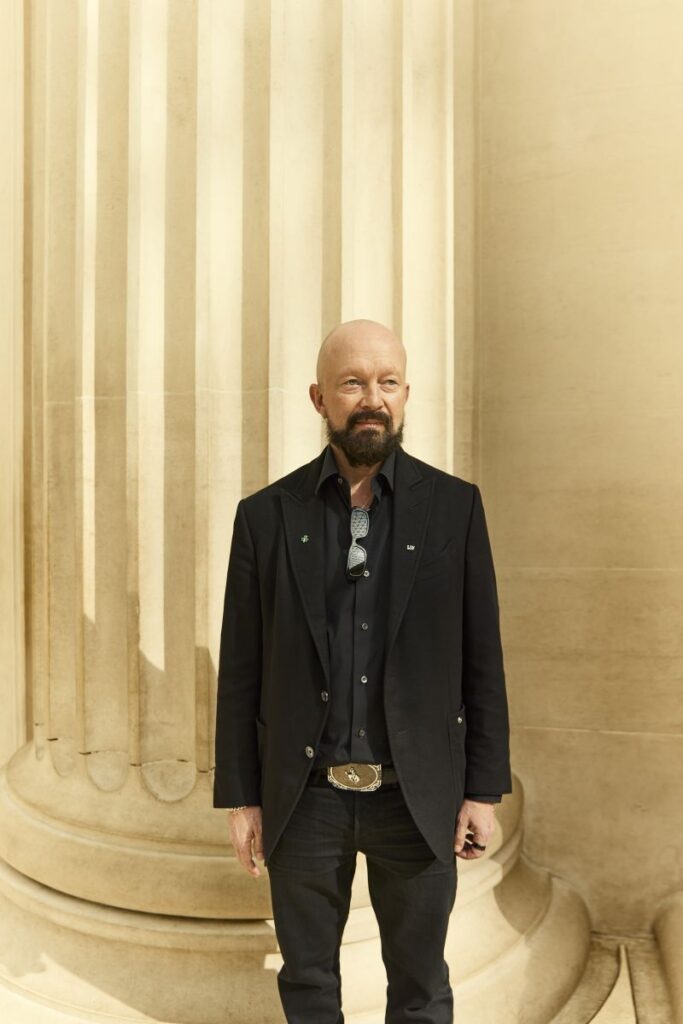
Andreas Kreuz was at Credit Suisse when he was invited to interview for a role at WorldQuant back in 2014. ‘It was probably the most unusual interview I’ve ever participated in,’ says Kreuz. ‘Igor came in, wearing his standard outfit of all black, with his sun glasses tucked into his shirt. He didn’t say a word. He just looked down at my resumé.
‘Finally, after this long silence, he said: “What do you want to do here?” I explained what I thought it was we could work on and what we could achieve. He looked back down at my resumé again, stood up and left the room.’
[See also: Why more family offices are closing or downsizing despite rising wealth]
Just two hours later, Kreuz received a call and was told, simply, ‘Igor would like to proceed.’ It might be an unusual MO, but it works, says Kreuz. ‘He’s relentless in pursuit of these audacious goals, taking incremental steps that help people to believe.’
Aside from the day job and his philanthropic projects, Tulchinsky invests in and supports a range of companies through his incubator-cum-family office, the Foundry. He’s also writing a fourth book, inspired by Englander, based on the thesis that human nature prevents most people from cutting their losses as much as they should.
He has several children, some of whom live in London. But Tulchinsky and his team prefer not to say much more than that about his private life. His PR won’t even confirm whether he is married.
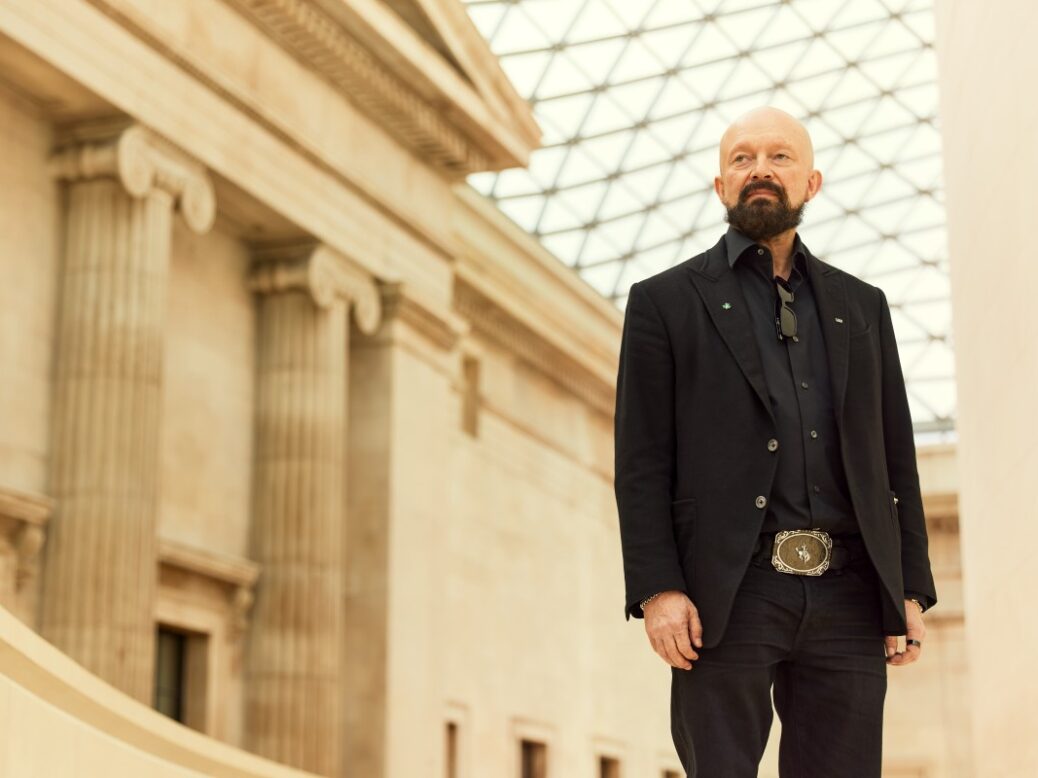
At the end of our interview, we make our way to the British Museum so that Tulchinsky can be photographed in the building that will house the exhibition he has made possible.
Once we arrive, we wait for the last of the day’s visitors to leave so the photographer can begin directing Tulchinsky to take up his position for the photographs, while his security detail watches on.
No one seems to recognise him as, dressed in his customary black, with sunglasses tucked into his shirtfront, he goes to stand next to the vast, 15m-tall fluted columns that were part of Sir Robert Smirke’s original 1823 design inspired by the templeof Athena Polias at Priene.
Opposite him, out of shot but hanging proudly from the newer Norman Foster-designed part of the building, a banner bears an image of the Bayeux Tapestry and, of course, the name of the museum’s latest major benefactor.
Tickets to see the Bayeux Tapestry exhibition at the British Museum go on sale from 1 July 2026
This article first appeared in Spear’s Magazine Issue 100. Click here to subscribe