
There’s a definitive analysis waiting to be written about private equity in the modern world.
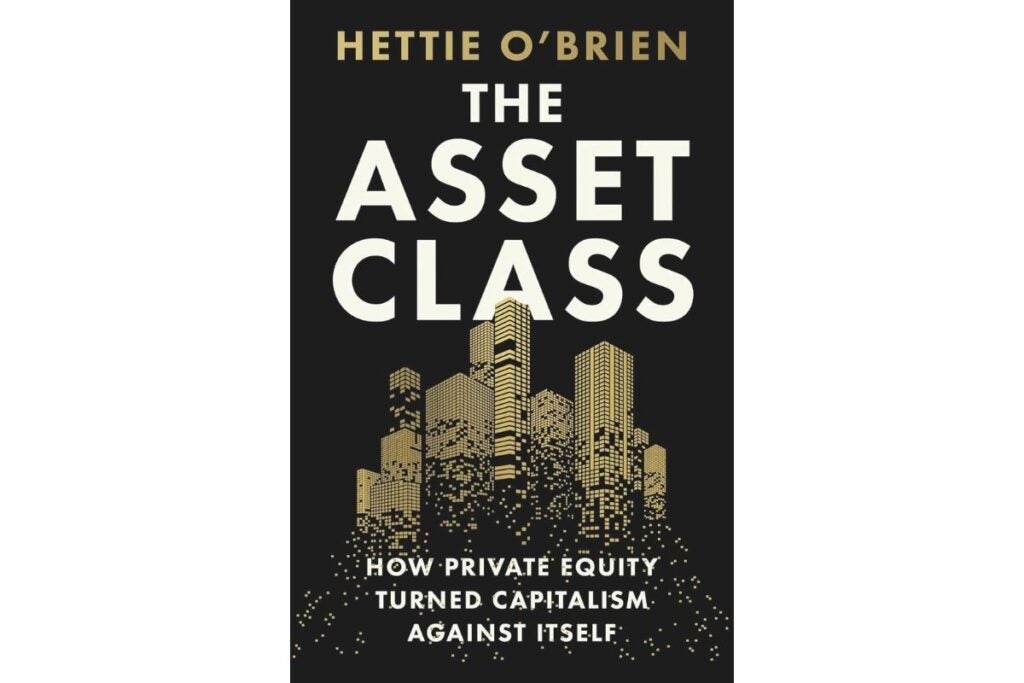
Is it a potent rocket-boost for high-growth businesses or a debt-fuelled device to extract profits from other people’s entrepreneurial efforts? What of the accusations that it provides cover for businesses to shun their environmental and social responsibilities, that it is unfit to own public utilities and has provoked an undemocratic shrinkage of public equity markets? In short, has it stained the reputation of capitalism as an engine of prosperity and progress – or even, as the subtitle of The Asset Class proclaims, ‘turned capitalism against itself’?
We might hope that Hettie O’Brien’s voyage around the history and growth of private equity provides answers to all these questions and more. Given her background as a journalist for the Guardian and the left-leaning New Statesman, we wouldn’t expect her to pull her punches. As the Labour politician Shami Chakrabarti says in a generous cover quote, ‘When Hettie O’Brien investigates, the apex predators of the global economy should rest a little less easy in their Learjets.’

[See also: The best private equity and alternative asset advisers]
Related



The Asset Class is certainly a lively read. It presents a cast of rogues and a catalogue of sinister investment vehicles from the past half-century, sufficient to make a multi-episode Netflix conspiracy drama. And it is written from the heart, hammering home its author’s view that private capital markets operate to make the rich richer at the expense of the poor and disadvantaged. In that respect, The Asset Class will find a place in bien pensant bookcases alongside Thomas Piketty’s bestselling (but allegedly often unread) mega-polemic on the inequality of wealth, Capital in the Twenty-First Century.
In its overall impact, however, O’Brien’s work is more of a sight-seeing tour of the private equity safari park than a deep study of the issues. And she sometimes seems to point her binoculars at the wrong creatures.
We learn surprisingly little about, say, the politically connected Carlyle partnership and its interests in the US defence sector, or the notorious ruthlessness of Kohlberg Kravis Roberts – forever associated with Barbarians at the Gate by Bryan Burrough and John Helyar, about the 1989 KKR-led buyout of RJR Nabisco.
[See also: The murkier side of private markets]
Content from our partners



And there’s a very tangential chapter on the ‘mighty jungle beast’ that was Sir James Goldsmith, an egomaniac Anglo-French entrepreneur who built a conglomerate empire in the Seventies, founded the Referendum Party to promote UK withdrawal from the EU, and eventually retreated to a private kingdom in Mexico. All very entertaining, but would this one-off maverick have recognised himself as an exponent of what we now call ‘private equity’? Probably not.
On the positive side, the Goldsmith chapter offers examples of O’Brien’s magpie eye for unexpected details that light up the narrative. Here is William Simon on Goldsmith as a dinner guest: ‘I had a bet over whether he would come with his English wife or his French mistress. Instead, he came with an attractive and charming woman from Connecticut.’
Arguably also in the wrong-end-of-the-stick category is a lengthy passage devoted to sovereign wealth funds as providers of private equity.
[See also: Private investors: the catalyst in the commercial real estate recovery]
With the honourable exception of Norway, these national treasure chests – O’Brien argues – are ‘a must-have accessory for aspiring autocrats’ and a channel for foreign despots to buy influence in Western democracies. Is that really so? We might respond that every sensible nation should aim to hold a sovereign fund if it can, and to invest it wherever there are attractive, ethically acceptable returns. If only the UK had set aside some of its Eighties North Sea oil wealth and privatisation proceeds to pay for infrastructure and renewable projects today, we’d all be better off.
The strongest chapters of The Asset Class address scandals relating to private-equity-owned care homes and UK water companies.
The saga of the care home group Southern Cross is particularly shocking: acquired by Blackstone in 2004, its properties were sold off to separate landlord companies (one of them backed by the Qatar Investment Authority) and leased back at rising rents – an unsustainable business model which collapsed in 2011. The idea that the financial discipline of private equity could ‘make everything it touched more efficient’, even care homes, was made to look like ‘a darkly ironic joke’.
[See also: Weathering the billionaire backlash]
As for the UK water industry, there’s an in-depth study waiting to be written as to why the regional companies privatised in 1989 failed to thrive under public shareholder ownership and have never raised sufficient new capital to meet their obligations to invest in pipe repairs and reservoirs – but this isn’t it.
‘Infiltrated and quietly sabotaged’ by financiers, sovereign wealth and foreign pensions funds, the companies were laden with debt and gouged for dividends until most of the industry was effectively bust. The Australian investment bank Macquarie rightly takes a caning from O’Brien for its role in the fate of Thames Water. But a balanced assessment would also have looked at the failures of regulation and the short-termism of vote-chasing politicians who worried more about keeping consumers’ water bills low than about essential infrastructure renewal.
O’Brien reaches her peroration by way of an account of Donald Trump and Elon Musk slashing costs and staff out of US federal government as though it were a company they were turning round for quick profit – a kind of apotheosis of the private equity model. She throws in a last domestic example: the Isle of Wight ferry service Wightlink, ‘bought and sold by a number of investors including Macquarie’, on which a last-minute return crossing, 15 minutes each way, can cost as much as £400, while its chief executive collects a salary of £377,000.
How, she wonders, can private equity have been hailed as a golden economic solution when in reality ‘it had grown so destructive’. That’s a one-sided view from a writer who evidently has little love for any manifestation of capitalism. Those who do love it for all its faults need to keep restating the opposite case.
The Asset Class: How Private Equity Turned Capitalism Against Itself, Hettie O’Brien (Weidenfeld & Nicolson, £25) will be on sale on 9 April in the UK.