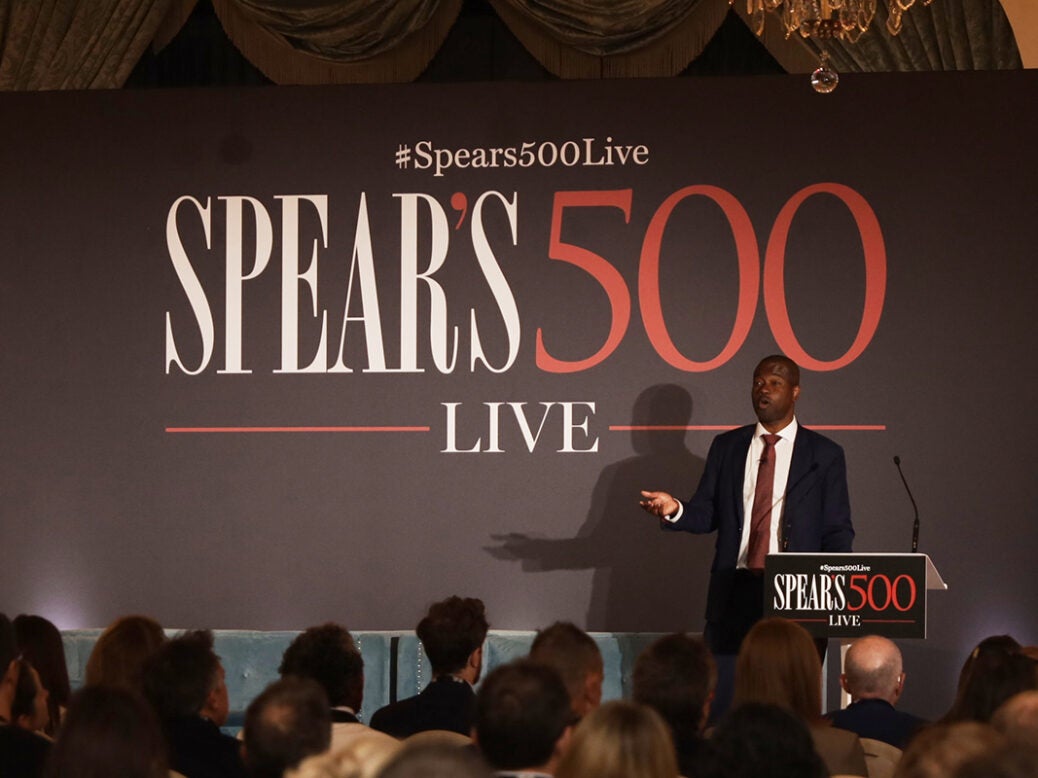
For Justin Onuekwusi, volatile conditions require resilient decisions.
Onuekwusi is the chief investment officer at St. James’s Place, the wealth manager with £220 billion in funds under management.
At Spear’s 500 Live, the premier live event for private client professionals, held on 6 May at The Savoy, he acknowledged the challenges facing investors but offered a reassuring evaluation of the current environment.

‘War, inflation, recession, political instability, AI. Uncertainty and fear continue and will continue to make markets volatile. We may not be able to predict what is going to happen in terms of geopolitics, but we can make our portfolios more diversified and more resilient,’ Onuekwusi said.
Related
[See also: Bernard Arnault latest billionaire to comment publicly on Iran conflict]
According to SJP’s 12-to-18-month projection, there is only a 5 per cent probability of a deep recession in the next 12 to 18 months – and their ‘base case’ is a soft landing.
‘One thing that does give me positivity is that given the reasonably high levels of growth, we do have a decent cushion,’ Onuekwusi said. ‘It’s really hard to get to a deep recession without a significant exogenous shock bigger than what we see today.
‘And even the mild recession scenario is talking about a few quarters of negative returns.’
Content from our partners



Onuekwusi, who has also held roles at Legal & General Investment Management, Aviva Investors, Merrill Lynch/Bank of America and Aon Consulting, noted the ‘new political paradigm’, including the dismantling of post-war institutions such as the UN, WTO and the EU.
He also acknowledged the fact that we are currently late in the economic cycle, a dynamic that can last between two and seven years, and, while ‘it’s actually the second-best time to invest from an economic perspective’ (early cycle being the best), it does tend to be volatile.
‘Reacting in the height of uncertainty typically doesn’t work. Moreover, making changes at times of great volatility can destroy the long-term performance of your portfolio.’
So what can investors do to build resilience into a portfolio? Understand the risks driving asset performance, and diversify portfolios accordingly.
First, interest rate risk – and the impact on government bonds. In Onuekwusi’s view, bonds are ‘under-owned by investors’, following a significant drop-off in global bond holdings in 2022.
However, he explained, bonds have historically provided protection relative to equities, and while they are likely to be more volatile going forward, ‘the way to navigate that is by diversifying your bond portfolio, not within gilts, not within US treasuries, but around different governments around the world, so you’re not at the whim of a government increasing debt spend.’
[See also: The tax trap waiting for rich expats leaving Dubai]
Inflation is also a perennial concern – Onuekwusi called it ‘the worst nightmare for a multi-asset investor’.
‘What we’ve seen is that the stagflation scenario has started to bubble up: 5 per cent to 10 per cent, now to 15 per cent. This is the worst nightmare for an investor, right? Inflation going up and growth going down. Pretty much in that scenario, there’s no real place to hide.’
US treasury inflation-protected securities (TIPs) can offer some protection against inflation: mapping TIPs against US treasuries since 2014, Onuekwusi demonstrated, shows that as inflation expectations change, investors receive greater protection from the TIP portfolios.
[See also: AI fuels fortunes of world’s growing billionaire class]
Investors should also be aware of how much sterling is in their portfolios: ‘This is the second largest risk and often overlooked risk for investors.’ Looking back to 2005, the Japanese yen has outperformed the S&P, Onuekwusi showed, providing ‘decent diversification’.
Perhaps most importantly Onuekwusi stressed the importance of looking at geopolitical shocks in context.
[See also: Tina Fordham: Geopolitical tension is the new normal]
Examining a range of significant geopolitical shocks dating to 1940, and how the S&P 500 performed, SJP found that in the short term there was an underperformance of the average. However, ‘actually, in the longer term, after geopolitical shocks, six months, 12 months … on average, the market in the US, which is 70 per cent of global emphasis, delivers a stronger return overall’.
In the end, Onuekwusi said, ‘economics is only one piece of the puzzle’; other inputs include fundamental trends, investor sentiment, tail risks (the known unknowns) and valuations.
Valuations are ‘the anchor’ he explained. ‘Tilting towards cheaper asset classes and away from more expensive asset classes will generate the strongest risk-adjusted returns over the medium term.’
Watch the full keynote speech
Find out more
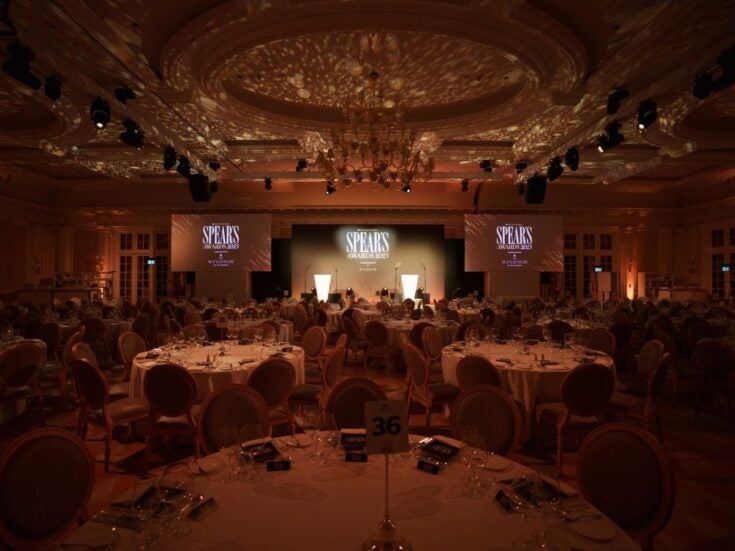
Spear’s 500 Live is the premier live event for private client professionals and leading figures from the private wealth and family office ecosystem. The 2026 edition took place on 6 May at The Savoy in London.
Spear’s 500 Live was presented in association with our partners the Charities Aid Foundation, CMB Monaco, Guernsey Finance, HCA Healthcare UK, Payne Hicks Beach, Riverstone, Scott Dunn Private and Stewardship.
For commercial enquiries concerning Spear’s events, contact shady.elkholy@spearswms.com.