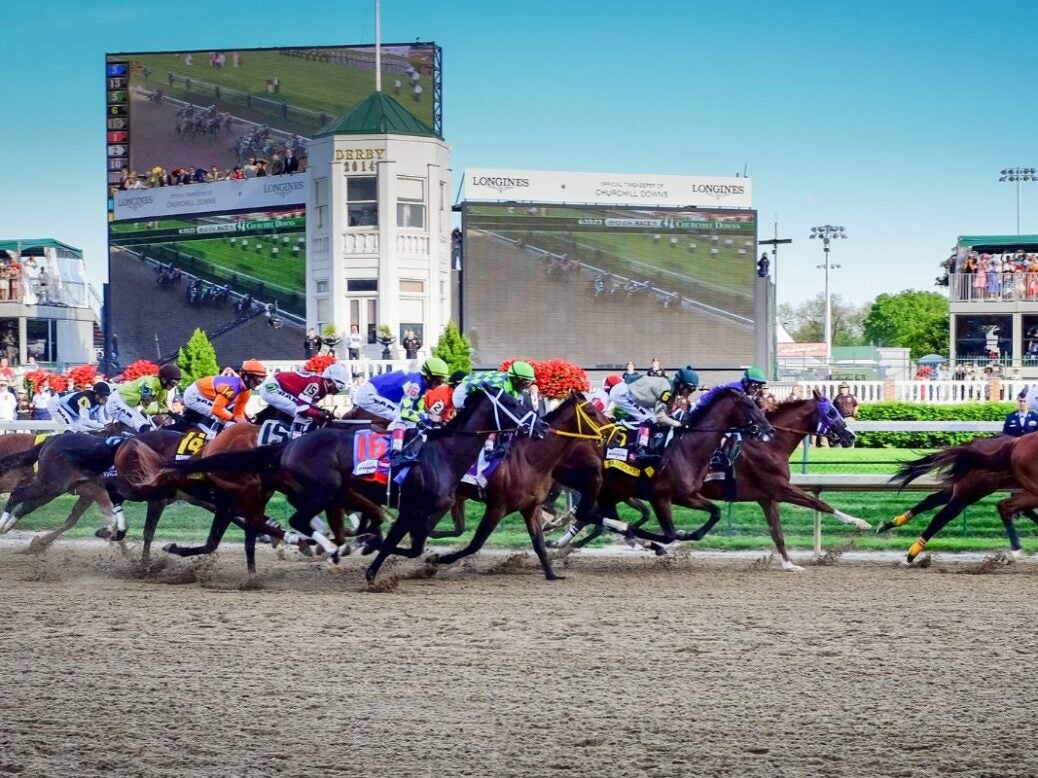
On 2 May, for the 152nd time since 1875, the Kentucky Derby, ‘the most exciting two minutes in sport’, blasts into life in a thunder of hooves and a blur of silks. While crowds at the Epsom Derby have declined, those at Kentucky continue to swell. Around 150,000 people will pack Churchill Downs, in a corresponding blur of six-figure fascinators and bespoke Loro Piana. Last year, some $234 million was wagered on this one race alone.
It is a source of great national pride. ‘First thing you need to know,’ said one racing insider, ‘is how to pronounce the name correctly. It’s the Kentucky Deeeerby. Rhymes with “Herbie”. If you say it like [pained wince] “Barbie” [as a Brit might], you may be escorted off the track.’
The mile-and-a-quarter race for three-year-olds is the first leg of the US Triple Crown, the other limbs being the Preakness Stakes and the Belmont Stakes (run this year at Saratoga). In truth, these races are after-parties. As Chauncey Morris of the Kentucky Thoroughbred Association puts it, ‘The Derby absolutely soaks up all the oxygen for American racing.’

[See also: Big things are happening in the wild world of yearling sales]
Related

Great champions have defined the race. Secretariat’s 1973 record of 1:59.4 still stands, with only Monarchos (2001) getting close with 1.59.97. While winners tend to spring from elite bloodlines, other variables weigh in too. ‘In a twenty-horse field on an oval track, the result is hugely dependent on the ride,’ says Morris. About once each decade, a long-shot romps home, notably Donerail at 91–1 in 1913 and Rich Strike at 80–1 in 2022.
Despite 69 countries taking part in thoroughbred racing, the Kentucky Derby remains a curiously home-grown affair. Most runners are locally bred. Why? The surface. Ironically for the ‘Bluegrass State’, the race is run on dirt, uncommon outside the US and controversial among some owners due to injury risk. Yet the rewards are immense. The $3 million winning purse will be dwarfed by the winner’s immediate uplift in breeding value through stud fees and syndication.
Other members of the bloodline can become significantly more valuable too. Take the sire of 2025 Derby winner Sovereignty, Into Mischief, which stands in Kentucky for $250,000. In 2024, he covered 193 mares, meaning that his potential covering revenue at list price is now approaching $50 million per year.
[See also: Unravelling the secrecy and politics of England’s most exclusive fly-fishing club]
Content from our partners


Perhaps the best example of the Derby’s capacity to reprice a horse is Fusaichi Pegasus. Bought for $4 million as a yearling at Keeneland, he won the 2000 Derby and was later valued at around $60 million as a stallion prospect.
Kentucky is not only home to the Derby but also America’s bloodstock bastion. Nearly 70 per cent of North American Grade 1 winners in 2025 were bred here. ‘Kentucky has always been the centre,’ says Julian Dollar, formerly of Castleton Lyons farm, now General Manager of Newsells Park Stud in England. ‘Mares follow stallions – and the stallions are in Kentucky.’
The epicentre of the US bloodstock market is in Lexington, an hour from Churchill Downs. Here, thoroughbred breeding wraps aristocratic tradition with modern capital. Power is defined not simply by wealth but by control of land, bloodlines and stallions. There is no formal ranking; influence ripples out from the pedigree of your bloodstock, the scale of your operations and your sustained support of key sales, notably the Keeneland September Yearling Sale.
[See also: Does Lamborghini’s newest supercar live up to its forebears?]
Among the historic ‘blue-blood’ farms, Claiborne stands proud.
Owned by the Hancock family since 1910, it is associated with Danzig and Mr Prospector, two of the most influential sires in modern breeding. Calumet Farm, founded in 1924, has produced ten Derby winners and five Triple Crown champions. It survived financial collapse thanks to the deep pockets and bloodstock passion of Henryk de Kwiatkowski, the aerospace tycoon. Mill Ridge, a smaller but deeply connected farm, continues a family lineage stretching back to Keeneland’s founding.
This Bluegrass idyll was disrupted in the late 1970s by European investors. Working with Vincent O’Brien the legendary Irish trainer, Robert Sangster and John Magnier transformed the Keeneland yearling sales into an international marketplace. By aggressively buying impeccable horses – particularly those descended from Northern Dancer – they drove prices to new heights and shifted valuation decisively toward pedigree.
[See also: Aiming for the future: how shooting balances tradition and modernity]
Their strategy was part of a broader novel commercial model involving breeding, syndication and resale. Thoroughbreds became not only sporting prospects but also speculative assets, forcing competitors to adapt to a more global, capital-intensive market.
In the 1980s, Sheikh Mohammed bin Rashid Al Maktoum, ruler of Dubai, expanded this transformation. Acting via what later became Darley Stud, he brought unrivalled financial firepower and continuity, embedding the new economics.
What Sangster and Magnier ignited, Sheikh Mohammed globalised, ensuring that rising prices and elite pedigrees became structural features of the market. Sangster died in 2004, but Magnier is still in the game via Coolmore, his family’s bloodstock business which owns Ashford farm near Versailles (pronounced ‘Ver-sales’).
[See also: Who are the UAE Royal Families?]
Today, alongside Kentucky’s historic farms sit billionaire-backed enterprises operating on explicitly commercial lines. Spendthrift Farm, revived by Public Storage founder B. Wayne Hughes, exemplifies this shift. Now run by his daughter Tamara, it deploys innovative syndication models to spread risk and generate liquidity.
In the same category, you find Gainesway, which was bought by the late South African coal and wine magnate, Graham Beck. (Gainesway is now run by his son Antony.) Another fine example, Castleton Lyons, was acquired by Ryanair founder Tony Ryan. These farms integrate global capital with elite breeding programmes. Stallions, whose stud fees generate recurring income, are their core assets.
A third model involves investment syndicates. Groups such as SF Racing and SF Bloodstock, which are backed by George Soros’s Soros Fund Management, as well as Starlight Racing pool capital from multiple investors, spreading risk across bloodstock portfolios. In an approach which echoes venture capital: individual horses are bets within a broader strategy.
Indeed, the bloodstock world increasingly mirrors private equity. Stallions are yield-generating assets; broodmares are pipelines of future inventory; and the yearling sales provide exit events. Control of elite bloodlines confers both income and influence.
Not everyone subscribes to the same financialised model. Richard Rigney, a Louisville-based entrepreneur (beverage flavourings), plays the game differently. Rather than investing in pedigree, he prioritises ‘the physical’, focusing on conformation (skeletal structure), gait and muscle definition. He often buys fillies, which are cheaper and retain their breeding value.
‘There’s a lot of people out there buying colts and dreaming of the Derby,’ he says. ‘They’re paying a premium. We do something different.’ His strategy has yielded success while keeping the sport personal. ‘I own about 100 horses. For me, it has very little to do with money. It’s about growing, moving in the right direction, and involving my family. This is a big part of our life.’
[See also: Land of the rising ash: a journey through Japan’s volcanoes]
Bloodstock investment offers high potential returns but equally high risk. A successful horse on the track may become a lucrative stallion in the breeding shed, generating millions in stud fees and elevating the value of related bloodlines. More likely, he will prove a dud. Costs are high; liquidity is limited. Fashions in pedigree shift quickly.
Yet the eco-system continues to grow. Annual US bloodstock sales exceed $1 billion with Keeneland’s Yearling Sale accounting for more than half that sum. According to Rigney, prices of bloodstock have risen 20 per cent in the last two years, driven by both domestic and international buyers. Participants come from more than 50 countries.
[See also: ‘A big name with a big back story’: how Richard Mille built a €200,000 bike]
Not that the US market needs foreign investment. Julian Dollar recalls attending the Breeders’ Cup at Keeneland and looking out over Blue Grass Airport. ‘There were about 40 private jets parked up, as well as the two jumbo jets of the Dubai ruling family,’ he says. ‘In Europe, you’d just see the two jumbo jets. That’s the difference. America has a depth of wealth that Europe cannot answer.’
And each spring, for two fleeting minutes, all that wealth, ambition and tradition converge, thundering along the dirt at Churchill Downs.