Considering that supercars are all about fashion and buying the latest shiny new thing, some models enjoy a ridiculously long shelf life. The Lamborghini Countach was built from 1974 until 1990; the Pagani Zonda made its debut in 1999 and every year they reveal another ‘final edition’. It simply refuses to die.
Usually these cars survive because the tiny, boutique manufacturer can’t afford a replacement; but sometimes it’s because the model is just too good to kill off. Like the Lamborghini Huracán. Launched in 2014, over the next 11 years it became the brand’s best-selling supercar of all time, beaten only by its Urus SUV. More than 25,000 were built (compared to just 2,000 examples of the legendary Countach).
The Huracán was such a long-lasting hit because it was reliable (it was co-developed with Lamborghini’s owner, Audi); it looked great, with a kinetic tension in the arched roofline; and it had one of the best engines ever, a V10 of such earth-shaking magnificence, it was like an anvil-headed supercell storm bursting over Oklahoma.

So when a successful supercar like the Huracán is finally replaced, the automotive world takes notice. Family hatchbacks come and go like politicians, but Italian supercars are like royalty – the succession is a historic moment.
Related



Enter the new Lamborghini Temerario. And… oh dear.
The new Temerario follows on from the 2023 launch of the Lamborghini Revuelto, which is such a bullseye hit I reckon they’ll still be making it in the year 2060. The Revuelto combines a big, beefy V12 with a battery and electric motors, and at launch it was Lamborghini’s first ever hybrid. The looks, the engineering and the handling are all outstanding.
[See also: CEO of ultra high-tech car company Lukas Czinger on 3D printing, AI and Enlightenment]
So the new Temerario is full of promise. At around £260,000, it sits beneath the £500,000 Revuelto in the Lambo line-up and has a 4.0-litre twin-turbo V8 instead of the V12. It does borrow much of the hybrid system from the Revuelto, meaning a 3.8kWh battery and three electric motors, one in the gearbox and two more driving the front wheels.
Content from our partners



It’s made of aluminium rather than the Revuelto’s carbon, but the new spaceframe is stiffer and offers more interior space than the Huracán. And the headline figures – a total output of 907bhp and 538lb ft of torque – are outrageous, promising 0-62mph in 2.7 seconds and a top speed of 213mph. It may be the Revuelto’s kid brother and half the price, but it’s practically alongside in terms of performance.
And then there’s another number, one that comes to define this car: the Temerario’s V8 revs to 10,000rpm. That’s ridiculous – most cars rev to 7,000, a supercar might rev to 8000, usually only Japanese superbikes and F1 cars go higher.
So, the specification is amazing. But can the Temerario follow the Revuelto and deliver a knock-out driving experience? I thought I’d head to Puglia in Italy to find out.
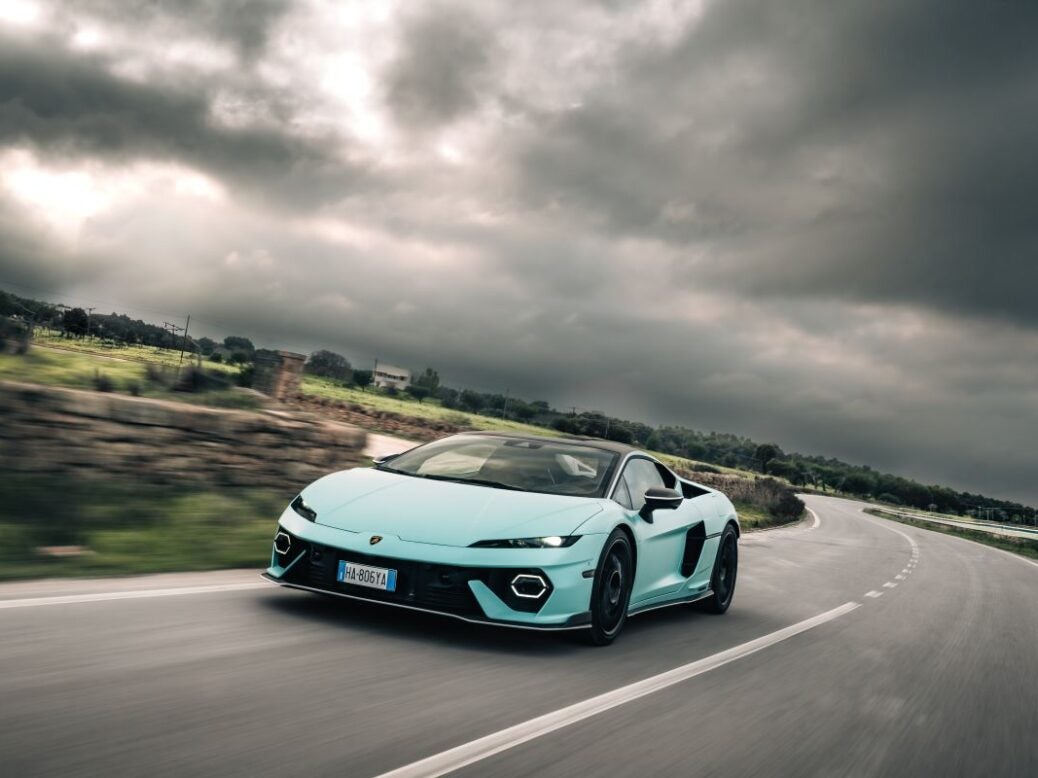
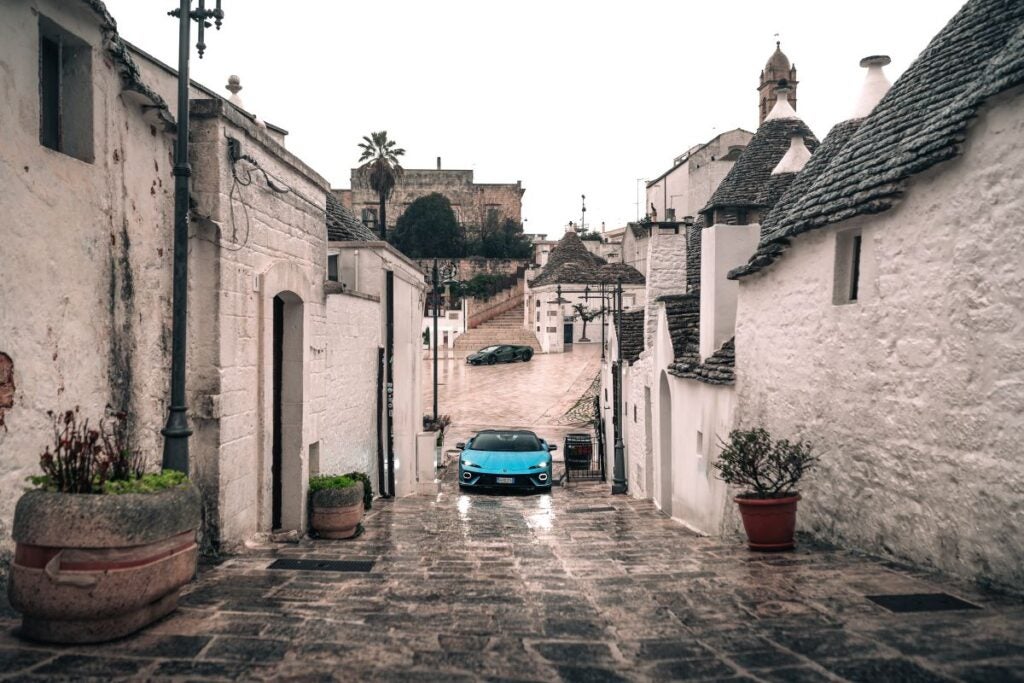
After shaking hands with about ten members of the Bari dealership team and signing 45 pieces of paper, I’m shown the Temerario out the back. The example we’re driving is so blue it almost hurts your eyes. The shade is called Celeste Fedra and it glows like an irradiated Smurf. Our model also has the Alleggerita (lightweight) package, which means extra carbon aero parts, cutting weight and adding downforce.
In the metal, I have contradictory feelings about the styling. On the one hand, it’s a Lamborghini wedge, so low to the ground you could use the roof as a coffee table… so it’s stunning, of course. But at the same time the design is curiously plain – a collection of vents and slopes and curves, without any real defining character. It’s amazing… but also strangely meh at the same time.
[See also: The best classic car advisers]
I keep this cognitive dissonance to myself as I wave goodbye and drive the ice-blue missile away. Within minutes, it’s impossible to avoid another snap judgement – the V8 sounds terrible at low revs. After the mighty Huracán, it’s a shock: the V8 has a rattly, industrial chunter around town, almost like a diesel truck, which is bewildering – the sound must have been agreed, signed off, chosen? I guess the Lamborghini engineers felt it sounded raw and mechanical – which it does – but it’s not spine-tingling at all.
Which is a shame, because there’s so much to love about the new car. The cockpit is as wedge-shaped as the exterior, with a steeply slanted windscreen and a layered, space-age dashboard. There’s good visibility, better headroom than the Huracán, and the chunky steering wheel makes you feel like you have a firm grip on the car.
The ride is good at low speeds too – in fact, the whole thing is so docile and obliging in the Bari traffic, it’s barely like a Lamborghini at all.
[See also: The classic race car dilemma: to drive or not to drive?]
But then there’s the speed. Out of town, the Temerario reveals itself as a rocket, an old-school Lambo in its ability to shock and stupefy. My god, this is a fast car – press the accelerator and the battery gives an instant shove before the turbos spool up and the monster V8 takes over. This happens seamlessly – all you feel is a gravitational forcefield trying to suck the driver’s seat through your spine.
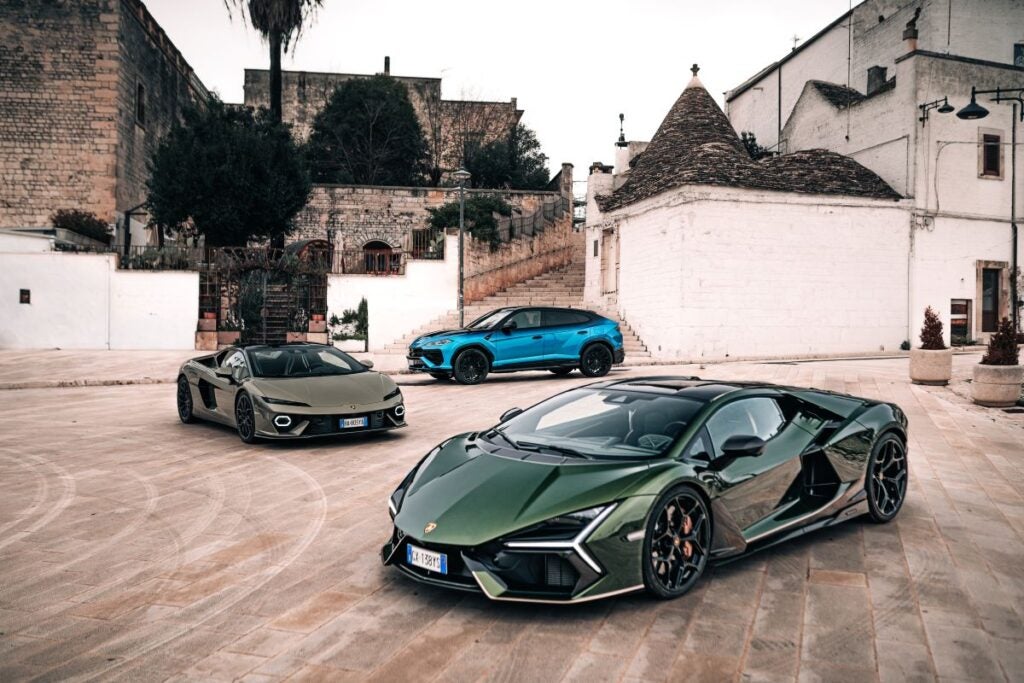
I head inland to Fasano, and a cafe in the limestone-paved piazza. Over an espresso and a pasticciotto (the local pastry filled with custard), I mull things over. Despite trying hard, I haven’t touched the 10,000rpm redline yet. It’s challenging. Every time you accelerate, it’s like hitting an ejector seat button – the car takes off and it’s hard to resist the urge to change up at 7,000. I feel like I’m failing. I need to try harder.
So back in the car, up into the Apulian hills. Nothing stands in this car’s way – it’s absolutely devastating when it comes to overtaking. There are four modes: City, Strada, Sport and Corsa. I’m in Sport, which is more road-biased, and I’m surprised how playful it is. Get on the throttle and all that power and torque will make any surface feel greasy, so even with traction control on, it slides and squirms out of corners. It’s fantastic fun.
But still I’m not reaching that rev limit. So I change down and run in a lower gear than feels comfortable, the engine revving like a maniac, my gut urging me to up-shift. But now I’m ready, and as I exit a corner and hit a short straight, I flatten the pedal and go all the way.
Suddenly, the Temerario reveals another side of its character: instead of that docile, every-day supercar, when you cross the magic threshold to that last 2,000rpm and the 10,000rpm limit, the car goes feral, unhinged, psychotic. It’s so manic, so savagely unrestrained, your nervous system screams at you – sirens go off in your head. You have to really, really want it – but when you get there, it’s as thrilling as any supercar I’ve ever driven. For about three seconds.
[See also: Will Mercedes’ superyacht members’ club sink or swim?]
Because you can’t maintain it. Maybe on a race track you could keep it at such a boiling point, but on the road? You can’t drive round in second gear waiting to wring its neck. Not least because the Temerario doesn’t need it – the low-rev muscularity of the drivetrain means 7,000rpm is satisfying enough.
So… cue more cognitive dissonance. As I return to Bari after spending several hours in the car, I have mixed feelings about the Temerario. One the one hand, it’s unique – a high-revving monster V8 in a civilised supercar that you can drive every day. It’s like nothing else, and that alone is an achievement.
But the ghost of the Huracán hangs over the Temerario. You never had to mull over a Huracán; its appeal was bone-deep – big engine, big noise, big engagement.
So while I’m sure the Temerario will find plenty of customers – it is the latest, shiny new thing, after all – it feels like a flawed concept. Few customers will ever reach 10,000rpm, meaning they’ll miss out on its party trick – its full-throttle secret. Instead, they’ll drive around listening to that low-rev mechanical clatter. Some supercars enjoy a ridiculously long shelf life. The Temerario won’t be one of them.
This article first appeared in Spear’s Magazine Issue 99. Click here to subscribe