In the minds of many international visitors, there are perhaps four iconic images of Japan that loom largest: Tokyo’s neon-and-concrete jungle; the Zen discipline of the temples and gardens of Kyoto; Mount Fuji’s silhouette; and the ‘Siberian express’ – the 45 days of seasonal fresh powder that make Hokkaido the new ski Mecca.
This familiar vision of the Land of the Rising Sun, however, belies its geographical and cultural richness. Adventurous tourists are increasingly looking to go farther and deeper, and there are luxury travel companies out there eager to assist them. One of these is Powder Byrne, which has a brochure stuffed with opportunities for its clients to scale snowy peaks in the French Alps and conquer Costa Rican trails. To that offering it now adds the geological splendour of Kyushu Island in southern Japan, and particularly the volcanic highlands of Mount Aso in the prefecture of Kumamoto. A new week-long itinerary here promises something rare in our exhaustively documented world: the thrill of genuine discovery.
It has been designed for people who, having breakfasted in the concrete jungle, lunched among cherry blossom in Yoshino and dined by a sanctuary in Kyoto, crave something differently Japanese; a place where an ancient agrarian way of life meets one of the world’s largest active volcanoes with earth-shattering intensity.

The company’s choice to send clients to the highlands of Mount Aso speak to a shift in how the ultra-affluent now define exclusivity. Where once ‘exclusive’ meant expensive or prestigious, it is increasingly found in geographical and cultural remoteness. The new luxury is not the five-star suites seen all over social media; it is the valley that most people will never reach, the silence and stillness that money (alone) cannot buy.
Related



[See also: Introducing Spear’s Magazine: Issue 99]
Before I departed, I was at peace with the risks presented by the tectonic activity in the region. But something on my vol-cation itinerary snagged my wife’s attention. ‘Helicopter ride over the crater of Mount Aso?’ She asked. ‘Promise me you won’t do that.’ Her words were still whirring round my head as I sped along the tarmac at Heathrow.
It takes a certain determination to get to Mount Aso from London. I flew via Shanghai to Fukuoka on Kyushu Island, paused in the Hakata area by Fukuoka railway station to grab a bowl of ramen, the cult noodle soup that was invented here, and proceeded by Shinkansen train to Kumamoto, capital of Kumamoto prefecture; the bullet train covered the 118km to Kumamoto in 45 minutes. A further 90-minute commuter-train ride took me to Aso City – actually more of a village – where the ‘Fairfield by Marriott Kumamoto Aso’ hotel stood a short taxi ride from the station. Twenty-seven hours after leaving London, I had arrived at my destination 900km south-west of Tokyo, far from the tourist corridors and urban sprawl.
My first surprise was meeting my travelling companions, a pair of young journalists from Mexico City. When one earthquake-prone nation tries to sell itself to another, an interesting dynamic arises. At times, the trip swayed and swung between a bragging match (‘Call that an earthquake? Back home, 7.1 means Tuesday’) and a support group (‘We don’t say “if”. We say “when”. It helps.’).
Content from our partners



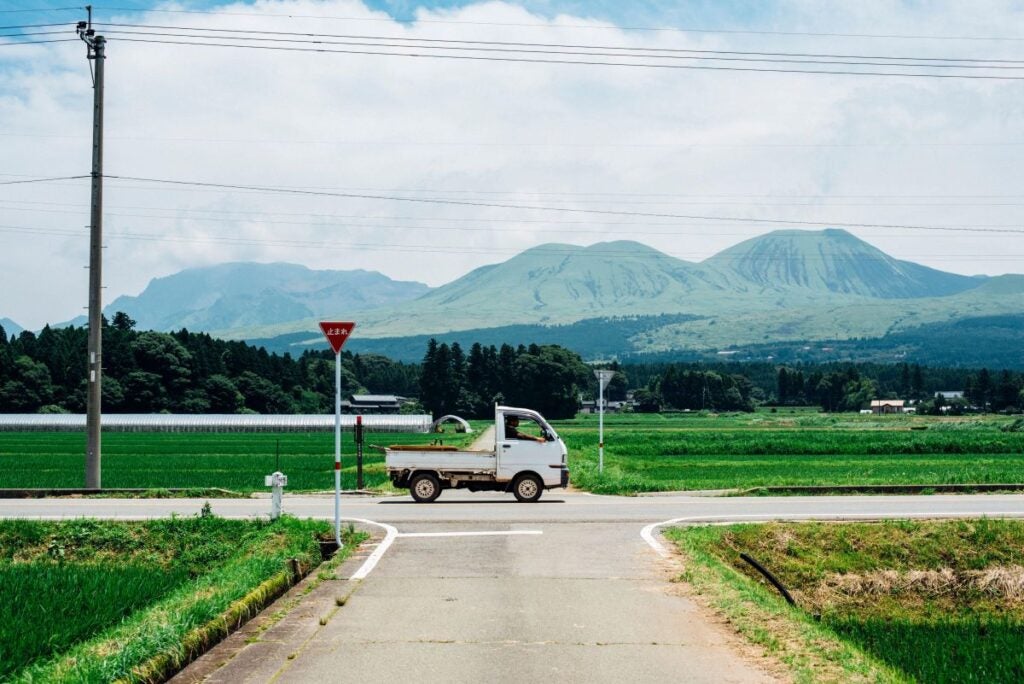
The geographic and psychological distance from Tokyo has preserved a way of life in the Aso region that is largely unchanged in generations. You’ll find an unhurried and peaceful landscape of craggy peaks, fertile plains and rolling hills. The slow wain of the agricultural cycle dictates the rhythms of life here. Or do they? Seismically, this is one of the most dangerous and least predictable spots on the planet.
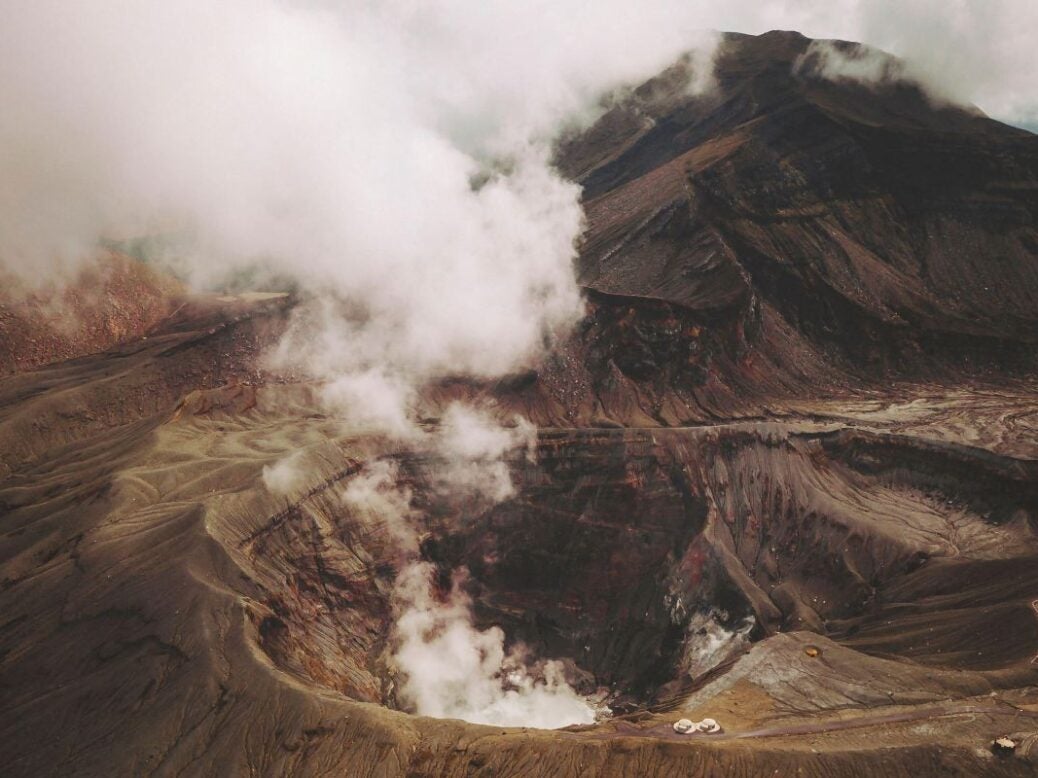
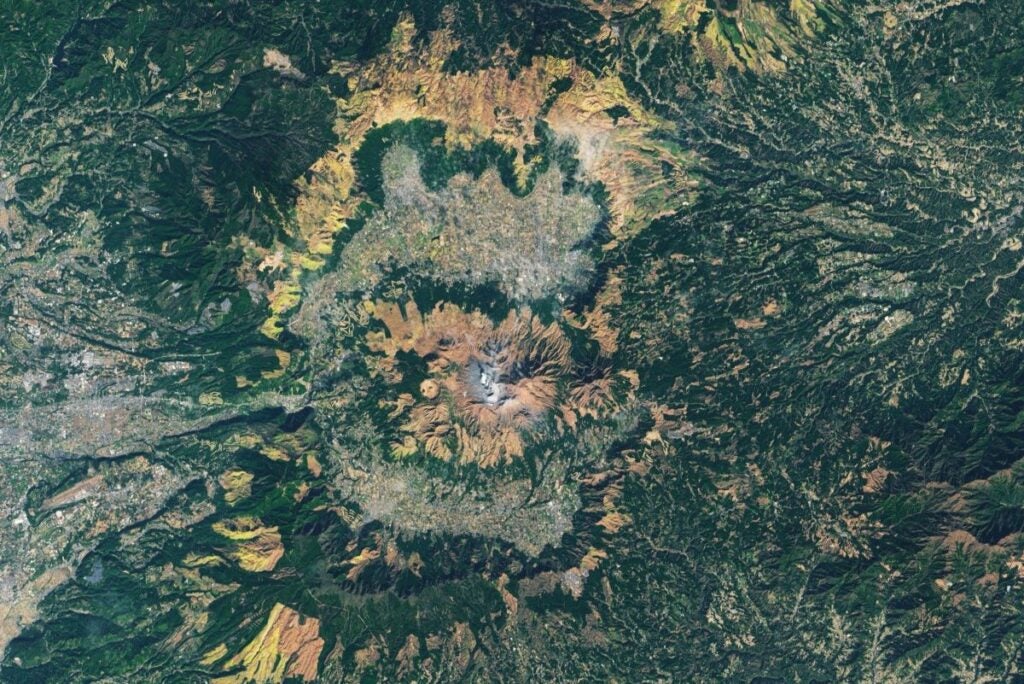
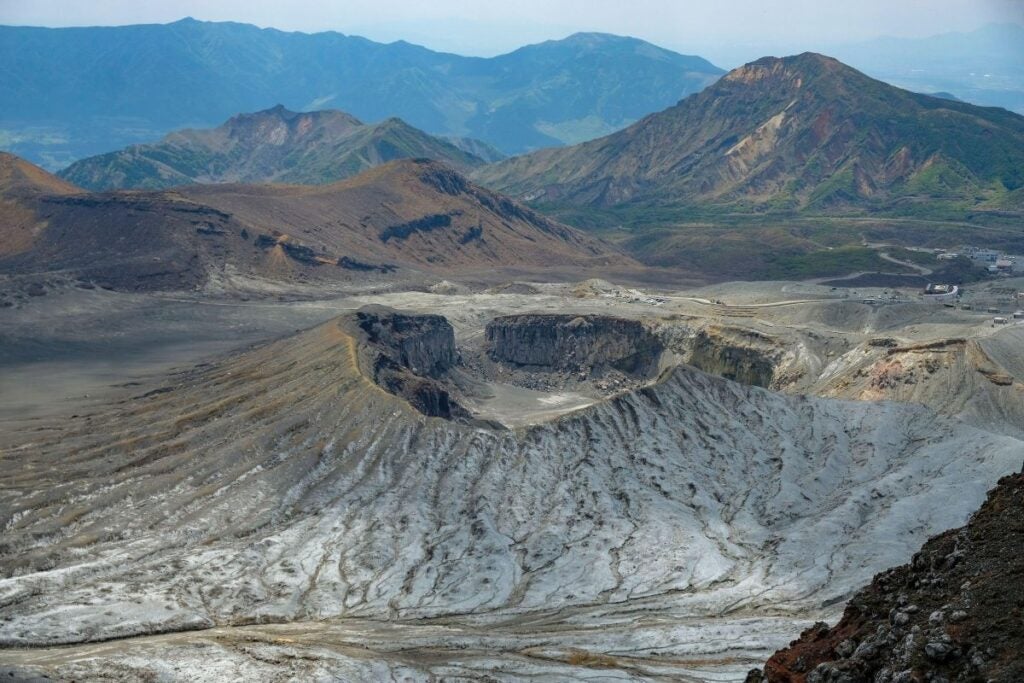
Rising to 1,592m above sea level, Mount Aso, the great landmark of Kumamoto prefecture, is a rare thing: an active, spluttering volcano that you can peer into. Confusingly, Mount Aso is formed from a cluster of five volcanic cones, which are each ‘mounts’ in their own right. To reach the rim of Mount Nakadake, the most active of the five cones, you can drive or hike. The thick grasslands that mantle the lower slopes resemble parts of Scotland.
In early spring, these grasslands are subject to a 1,100-year-old ritual of incineration known as Noyaki: the grass is burnt to prevent trees and bushes, which would spring up in the volcanic soil, from taking over. The practice is intended to preserve the land for grazing and agriculture, and it clearly works. In May, the slopes of Mount Aso are ablaze with wild pink azaleas.
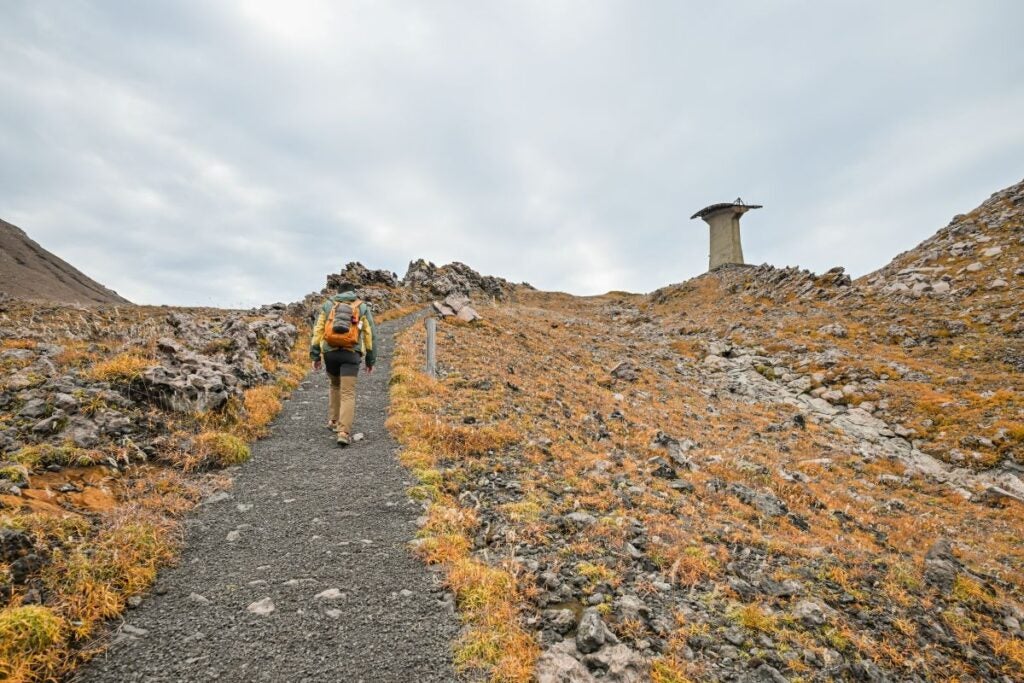
Climbing to the crater of Mount Nakadake, our eyes were peeled for local wildlife: fox, Japanese badger, raccoon, ferret, hare, deer and boar. ‘If a wild boar charges you,’ our guide intoned calmly, ‘just remember that it can only run in a straight line.’
[See also: From Gstaad Guy to Supersnake: how social media finally went ultra-high-net-worth]
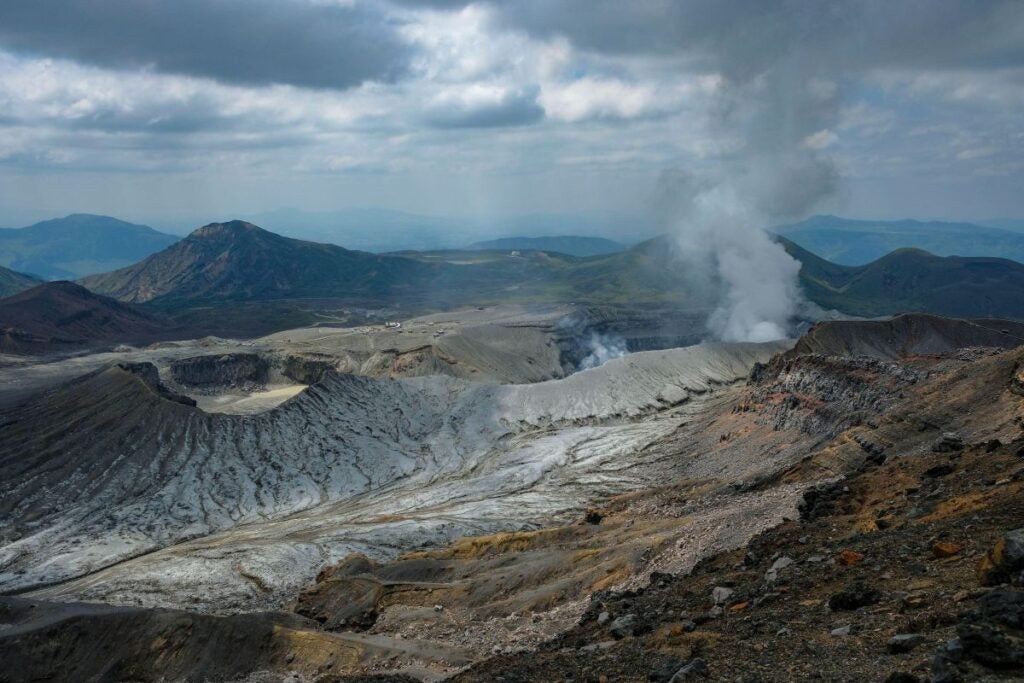
As we approached the steaming crater of Mount Nakadake (undisturbed by wild boar), the greenery gave way to what looked like a cataclysmic geological aftermath: boulders strewn everywhere, chaotic rock formations, crater basins, gullies scored into the mountainside and a general windswept feeling of utter desolation. The Nakadake crater hissed with sulphurous vapours.
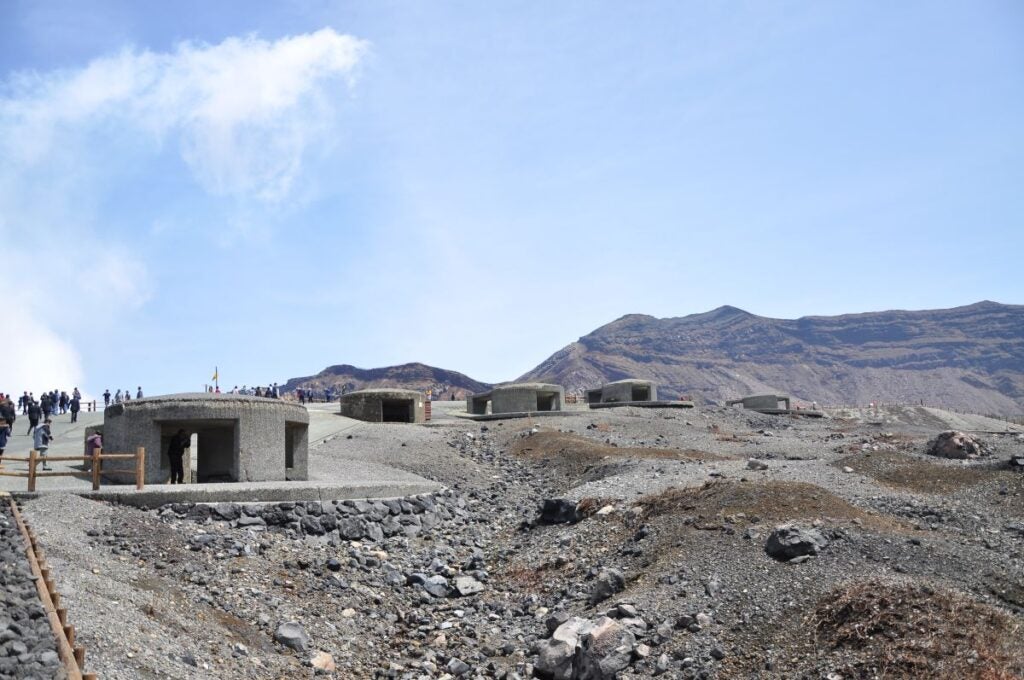
Mount Aso is one of 111 active volcanoes in Japan (‘active’ means ‘erupted within the last 10,000 years’). Aso last exploded in 2021, and before that in 2016. It has been continually and violently active ever since records began. If it happens to jolt into life while you are close to the top, you have the option to shelter in one of the (I thought) optimistically placed concrete bunkers near the rim.
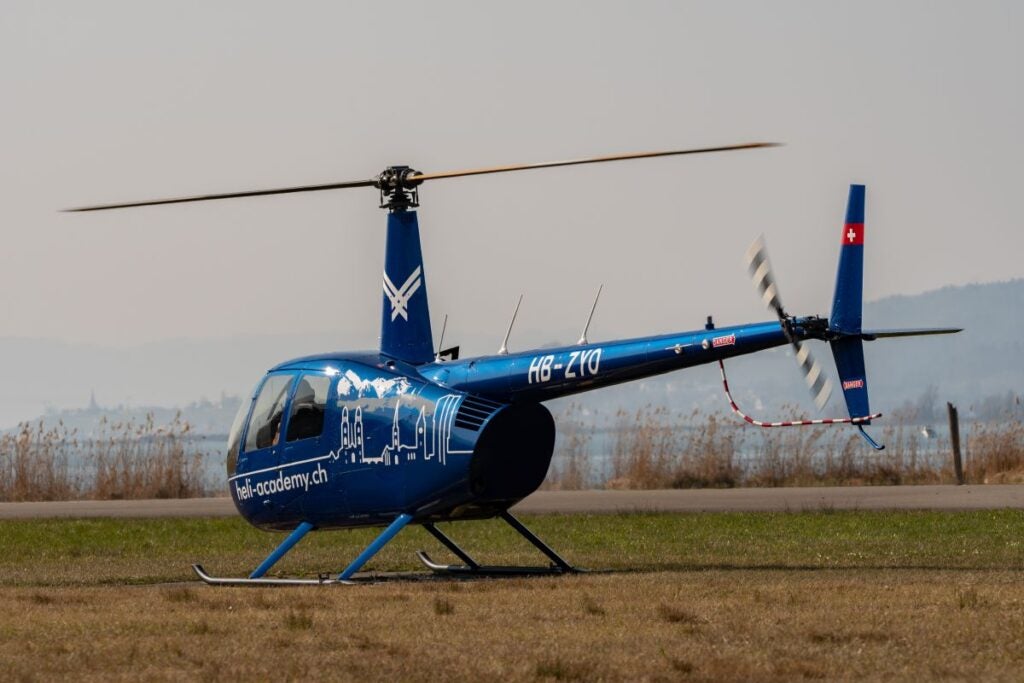
If you don’t feel like walking or driving, there is a quicker way of seeing the craters. Returning to the foot of Mount Aso, we were driven to a helipad at the back of Aso Cuddly Dominion, as Kumamoto Zoo is rather curiously called. Here, a local company runs heli-tours to Aso’s craters. We joined a small queue of tourists and watched as a Robinson R44 Raven II, an American-built four-seater, swooped in, landed, disgorged two grinning tourists, took on two fresh tourists, flew off, returned 15 minutes later, and so on. Not only was my wife’s injunction still ringing in my ears, but so were the words of an aviator friend: ‘The problem with helicopters is that, mechanically speaking, they are trying to tear themselves apart’.
One of the ground staff approached with a clipboard and waiver forms. ‘How much you weigh?’
‘94kg,’ I replied, ‘But I think I’ll pass on this.’ I could have sworn he looked relieved.
As I waved off my Mexican friends into the skies, my mind instinctively reached for its darkest literary furniture. In a fleeting and irrational moment, I thought of Under the Volcano, Malcolm Lowry’s classic novel set against the Mexican volcano Popocatépetl. In Lowry’s novel, the volcano symbolises doom, dissolution and the abyss.
Don’t worry. Twenty minutes later, my Mexican friends returned safely.
However, on 20 January this year, one tourist helicopter failed to return. According to the Japan Times, a few minutes after the chopper had taken off, fire authorities received an emergency signal from a passenger’s smartphone indicating ‘strong impact’. Later that day, wreckage was spotted on the north side of the crater of Mount Nakadake, 50 metres below the rim. Thick volcanic gases hindered the search. It took nearly four weeks of combing the area by drones to find the bodies of two Taiwanese tourists and the pilot. This helicopter had different tail markings from the one that flew my Mexican friends; however, I had noticed an identical Robinson R44 Raven II standing in a nearby hangar.
[See also: The best luxury travel advisers in 2026]
The Japanese response to risk of natural disasters is characterised by extraordinary preparedness – earthquake drills, tsunami-warning infrastructure, building codes that are among the strictest in the world. While they accept the risk of the uncontrollable, the Japanese rigorously mitigate against the controllable. The helicopter crash on this icon of Kyushu was therefore shocking.
Volcanoes are one of the uncontrollable risks here, but the locals hardly seem to care. During my visit, my wife sent me news in the British press about Sakurajima volcano erupting 240km to the south of Mount Aso; the 4.4km ash plume was disrupting flights. Not even a mention in Kumamoto. When asked, one local laughed: ‘It would be a news story if Sakurajima wasn’t erupting.’
Volcanoes are just one of many lethal natural forces at work here. The coastline was struck by several typhoons in 2025, according to my guide, Nathalie Chauveau from Belgium, who came to Japan in 2011 and stayed, marrying a local hairdresser-cum-barista. ‘Tsunamis are a persistent threat. The region is on the brink of seismic and geomorphic collapse.’
Earthquakes are one uncontrollable risk the Japanese do take seriously. At 9.26pm on 14 April 2016, Kumamoto was rocked by a quake of magnitude 6.2. Kana Illig, our guide at the Kumamoto Earthquake Disaster Museum, shared her memories. ‘It lasted six hours: big waves every ten minutes,’ she said. ‘Like being on a ship.’ Just over a day later, at 1.25am, a second quake struck: magnitude 7.0. In 2010, a quake that size in Haiti killed more than 200,000.
I asked Kana to describe what it felt like. ‘I opened the windows and doors to prevent being trapped, and reached down to pick up my sleeping son,’ she said, ‘but the shaking was so violent that it threw me against the bedroom wall two metres away.’
‘Terrifying, no?’ I said.
Kana, unfazed, gave a faintly dismissive look of ‘We don’t do fear. We do Zen’. ‘Much scarier was the panic,’ she deadpanned.
The death toll of 277 made the Kumamoto quakes the deadliest here since the Tōhoku disaster of 2011. The majority of casualties arose not from the immediate impact but from aggravated injuries or illness during evacuation. Across Kumamoto prefecture, 8,657 houses were wiped out, 34,491 were partially destroyed and 155,000 damaged. The Kyushu Shinkansen was derailed. A national disaster was declared: at peak crisis, 10 per cent of Kumamoto’s population – 180,000 people – were sheltering at evacuation sites. The physical damage is still visible today.
‘Life doesn’t have to be perfect to be wonderful,’ shrugged Kana Illig. ‘We have learnt to live in harmony with nature.’ Nathalie Chauveau compared the seismic risks as ‘like having a violently abusive member of a family that is otherwise very well organised, very well behaved and very tidy, who periodically tries to blow the whole thing up’.
Between 300m and 500m deep, and extending 25km north-south by 18km east-west, the Aso caldera is the result of four massive volcanic eruptions. The last explosion, 90,000 years ago, was so powerful that it flung ash as far as Hokkaido Island, 1,450km away. The caldera was originally filled with water, until an earthquake 8,000 years ago pulled the plug. Within this mighty fertile basin, an entire human geography has developed: thousands of hectares of cultivated land, a city, several towns and villages, and a population of 70,000 all connected by road and rail. You have to admire the sheer audacity of a society that has chosen to live, farm, worship and raise cattle inside a caldera that has erupted catastrophically four times and shows every sign of doing so again. One shift in the tectonic plates and the whole lot is toast.
The region is a rich source of rice; beef from ‘kindly raised’ Akaushi red cattle, whose marbled meat rivals Wagyu; takana mustard leaves; tomatoes; asparagus; and strawberries. To take a closer look, we climbed out of the caldera and cycled along a disused railway line that threaded its way through tunnels, over bridges and across a countryside of forests punctuated with traditional thatched farmhouses set in smallholdings bordered by neat drainage channels. The folkloric feeling of environmental harmony almost made me forget untameable natural forces that lurk below.
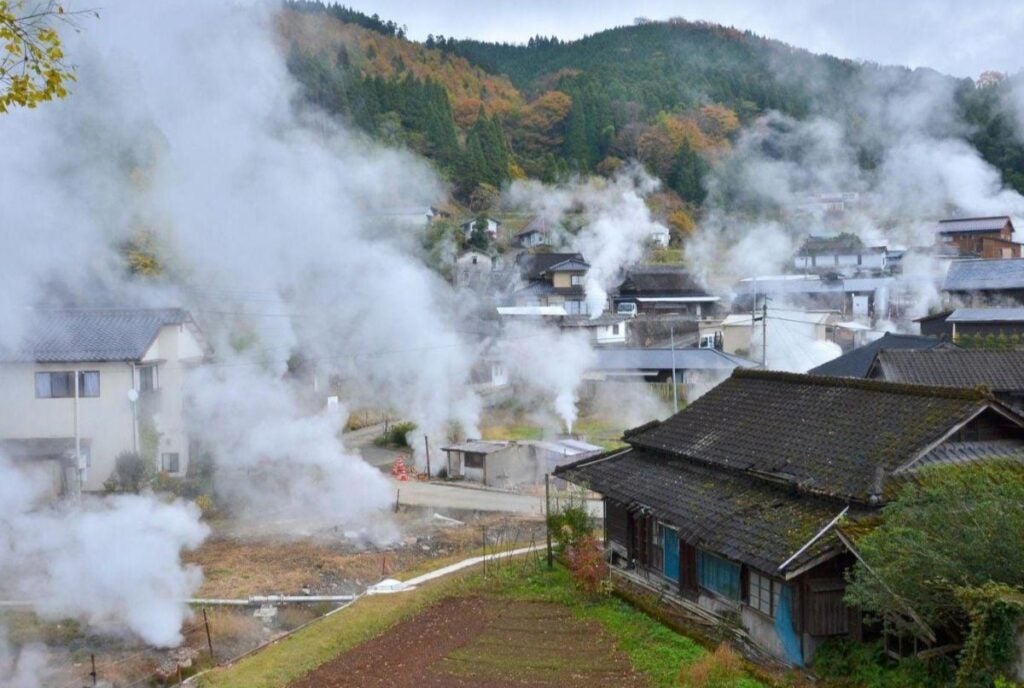
We arrived at the hamlet of Waita Onsen. Architecturally, this hamlet looks like any other in Kumamoto prefecture: a cluster of simple houses with tiny gardens built up the side of a hill. ‘What is all that smoke?’ I asked, pointing to the small clouds that wreathed the hamlet.
‘That’s not smoke,’ said yet another guide, Kenzo Minami, who runs the Kumamoto tourist office. ‘It is steam.’
Waita Onsen sits atop mineral-rich thermal springs that jet steam from holes in the soil, pipes in the ground and puddles and streams of boiling water. You could be in an avant garde stage set of Wagner’s Das Rheingold. ‘Waita’ means ‘to have been boiled’.
[See also: Revealed: the luxury travel trends set to shape 2026]
The local speciality is food steamed by the hot springs, a style called jigoku-mushi. We each grabbed large handfuls of raw vegetables, put them in colanders, placed them in a giant communal steamer, and closed the lid. Twenty minutes later, we ate a delicious Kyushu picnic with Yuzu kosho condiment (fermented citrus and chillies).
‘If you talk about food to Japanese people, they will love you,’ said Nathalie Chauveau. ‘The Japanese relationship with their stomach is far more important than that with their brain. Two things that matter most are good food and onsens. This region is ideally suited to provide them.’
The traditional ryokans reflect these priorities. In Sakura-no-Yado ryokan located near the walls of the Mount Aso caldera, I stayed in a comfortable family-sized timbered farmhouse warmed by wood-burner, where you sleep either on a futon or a Western bed. Dinner, a real highlight, was an extraordinary ten-course feast served by a silent woman with no English. The very memory of ‘seasonal Kumamoto fruits with lightly smoked rainbow trout’ via ‘rich cream pasta with snow crab and porcini mushrooms’ to ‘clay-pot matsutake rice with farm-grown koshihikari’ creates an internal seismology all of its own. I’d gladly return.
Before dawn the following morning, we drove to a point just beneath Aso Daikanbo, the highest point on the caldera rim at 936m. As the sun broke over the horizon, the great bowl of the caldera, its chequerboard fields and the volcanic grandeur of Mount Aso were revealed in what many consider the definitive view of the region.
That night, we stayed at the 100-year-old Yamaboushi ryokan, which sits on its own thermal spring. My suite, a timbered, paper-walled labyrinth, was exquisitely uncomfortable: no chairs, no desk, nowhere to plug a USB cable, no headroom, and mirrors far too low for anyone even approaching 6ft. It was nonetheless an authentic Kumamoto experience. Indoor and outdoor onsens partly made up for the bruises and tortured knee joints. Thankfully there was again a choice of Western bed and futon.
Sitting at an irori, a traditional sunken hearth, we dined on grilled Akaushi beef raised on the volcanic grasslands, and skewered grilled, flapping (still alive) fish, a sort of Japanese surf ’n’ turf. The experience was both fascinating and delicious.
Over breakfast the next morning, we engaged our host via a Japanese-English translation app. I was amused when, in the spirit of omotenashi – the philosophy of selfless hospitality that the Tokyo Olympics promoted – our host enthused about local culture, but possibly went too far when he launched into a tirade against Chinese tourists.
Japanese culture has aestheticised co-existence with mortal danger in a way that Western cultures, which tend to pathologise and litigate these things, largely have not. Inns and villages built over volcanic fissures, farming communities existing in the shadow of a belching volcano, and sightseeing flights over active craters all reflect a worldview in which proximity to natural power is sought rather than shunned. Ancient patterns persist here in defiance of some of the most violent and unpredictable natural forces; it is a form of seismophilia that anywhere but Japan would represent a health and safety nightmare.
I came away, still nursing a few aches and pains from the many miles of walking, with a sense that this would be a good trip to bolt on to the back of a visit to the bright lights of Honshu Island or a ski trip on Hokkaido. It presents Japan not as a museum, theme park or shopping mall, but as a living culture adapted to extraordinary geography. Like the Toto washlet commonplace in Japanese bathrooms, a visit to Kyushu feels cleansing, if not always entirely comfortable.
Fairfield by Marriott Kumamoto Aso marriott.com/en-gb/hotels / Sakura-no-Yado ryokan hpdsp.jp/sakuranoyado/en / Powder Byrne powderbyrne.com
This article first appeared in Spear’s Magazine Issue 99. Click here to subscribe