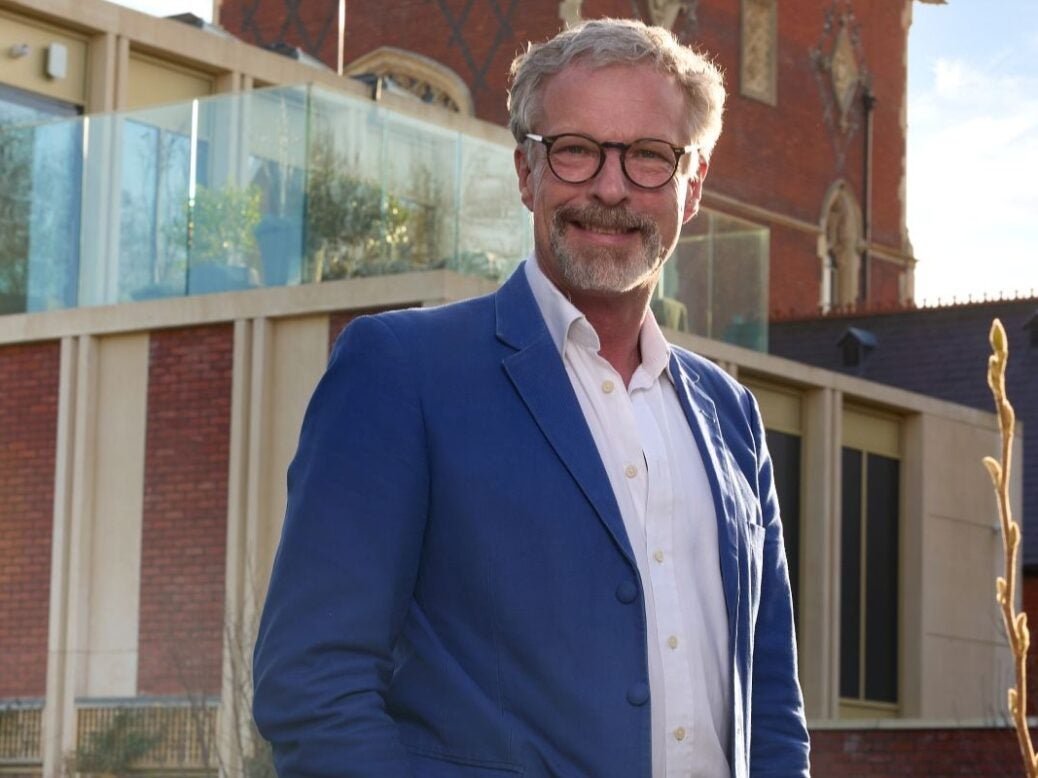
Hugo Burnand caught up with Spear’s to discuss his introduction to portraiture, his relationship with the royals and his favourite photograph.
‘When I was seven, my grandmother bought me a camera from the local chemist. I used up one roll of black and white film and showed it to my family. Looking at a portrait of a horse and a landscape of a bicycle leaning against a stable, the adults started acting in a strange, positive way I had never witnessed before. They encouraged me to pursue photography – just sadly not professionally, instead wanting me to have an interest before I became a captain of industry or a field marshal.
Much to their disappointment, at 17 I told them I wanted to be a photographer for the rest of my life. Their arguments persisted and I spent 10 years after that trying to do things to keep them happy. By the age of 27, I said: ‘You know what, I’ll do it, I’ll become a photographer.’

It is funny how one thing leads to another. I was commissioned by the art dealer Duncan McLaren to photograph his family, after bumping into him at a couple of parties. Only, he did not have a wife and children. Instead, his family consisted of the 10 most important people in his life, including his chauffeur, his landlord, his dentist, his doctor, his antique dealer, his Swiss banker, his favourite godchild and his best friend, a woman named Annabel Elliott. After I took her photograph, she said I should take a photo of her sister. After asking again, she said: ‘You don’t know who my sister is, do you? She’s Camilla Parker Bowles.’
Related

[See also: Art Basel CEO shows careful confidence in global art market ]
Of course I said yes, but it took more convincing from Camilla’s end. She later heard my name through her hairdresser and then, bizarrely, a Sicilian hotelier mentioned my name to her too, so she invited me to meet her. I arrived without a camera in my hand and we drank rosé, ate ice cream birthday cake and made each other laugh. Through that, I got my first commission with her, which later led to more work with the royal family.
To balance royalty with modernity, I trust my instinct. The photographs I have taken are modern because they contain no artifice; they are documents showing what happened then and there.
Meanwhile, one can still photograph in a way which gives an image symbolism, or a sense of royalty. I like the picture I took of the line of succession at King Charles’s coronation, with him, William and George. I also like the picture I took at Prince William and Princess Catherine’s wedding of them with their bridesmaids and page boys. It was such a natural shot taken on the spur of the moment amid the rigmarole.
Content from our partners


[See also: The best photographers and creative service providers in 2025]
Portraiture doesn’t have to just be of people. I may be taking a series of photographs of St Paul’s Cathedral next year to coincide with the restoration of its dome. It will be a collection of portraits, and they even want me to photograph the mice that run between the library’s bookshelves.
My favourite picture that I have ever taken is one of my family. One of my children had fallen seriously ill and we could have easily lost her. While she was recovering we went on holiday to Ischia. I was lying on the beach with my children piled on top of me, and my wife took a picture of us. I thought it was unfair that she was not in the photograph, so when we were back home we retook it in a studio.
We tried replicating it with our swimming trunks and costumes from the beach, but it looked very odd in the studio, so we took all our clothes off. It was not in a silly, jokey way. To me, the photograph represents triumph over adversity and a family that survived.’
This article first appeared in Spear’s Magazine Issue 99. Click here to subscribe