For many of the world’s super-successful and super-rich, being a member of the right club is of paramount importance. Fortunately, there is no shortage of exclusive organisations to choose from.
Take Tiger21, the network for HNW investors and entrepreneurs to compare notes on preserving their fortunes, where members must have at least $20 million in investable assets or qualifying net worth to join. Or R360, which runs on a similar principle, but sets the bar higher: it’s only for those who have accrued $100 million or more. Gratifyingly, there is even a clique reserved for those who have not just amassed a great fortune, but who have committed to giving at least half of it away. Welcome to The Giving Pledge.
Conceived in 2010, The Giving Pledge grew out of a series of discussions between Bill Gates, Melinda French Gates and Warren Buffett about the role of wealth and what should be expected of those who possess it in abundance. It has attracted a broad swathe of the planet’s best-known and most selfless plutocrats, but, in 2026, it finds itself at a crossroads: growing more slowly than in previous years and facing criticism even from within the ranks of the three-comma club.

[See also: How the AI mega-IPOs could reshape philanthropy]
Related

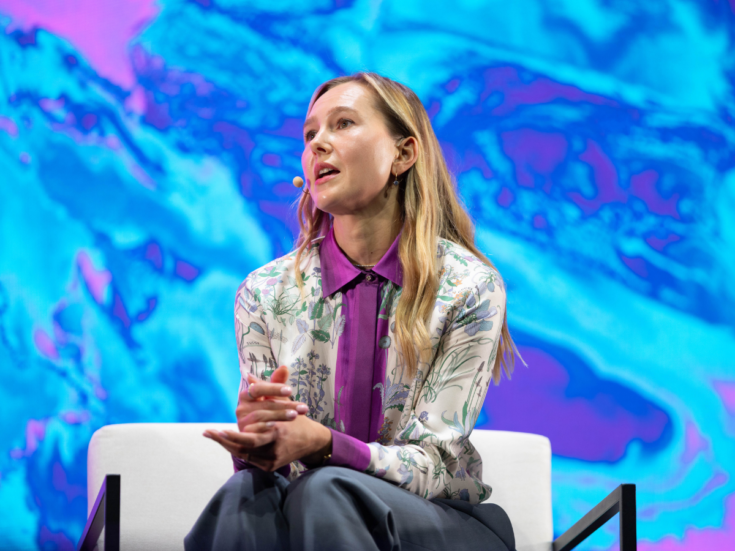
Olivia Leland, brought on board by the billionaire founders to be The Giving Pledge’s founding director, can still remember the sense of excitement among the trio as they considered how to bring people together ‘under an umbrella of a commitment that could be broad enough that anybody could take it’.

The commitment, she tells me now, was simple: to give away at least half of one’s wealth during a lifetime or in a will. But there was also a wider purpose: to establish ‘a global norm around giving and encourage conversations around the role of philanthropy in society’.
The Giving Pledge officially launched in June 2010, and two months later, its first 40 signatories were unveiled en masse. It was a formidable line-up, bastions of American wealth and influence: George Lucas of Star Wars fame; then-mayor of New York Michael Bloomberg; Oracle’s Larry Ellison; David Rockefeller, banker and heir to one of America’s greatest fortunes; Paul Allen, co-founder of Microsoft; Barron Hilton of the Hilton hotel dynasty; and CNN founder Ted Turner, among others.
[See also: UHNW philanthropy hits $250 billion, as ultra-wealthy fill public funding gaps]
Content from our partners



Within six months, the Pledge grew from 40 signatories to 57, roughly one in seven of America’s billionaires at the time. Business magazine Fortune declared that The Giving Pledge ‘could change the face of philanthropy’.
Since the Pledge’s inception, signatories have been invited to explain in a personal letter why they have chosen to make the commitment.
Barry Diller, co-founder of Fox Broadcasting Company, and his fashion designer wife Diane von Furstenberg, addressed the Gateses and Buffett: ‘I don’t know if you contemplated at the beginning, beyond the initial pledge, what benefits and inspiration you would be bringing to all these fairly isolated individuals in their own castles, but I can tell you that Diane and I are lucky and grateful you’ve stepped outside your own glorious philanthropy to give us a forum for so very much more than we could ever accomplish on our own.’
[See also: Philanthropy: how younger UHNWs should give their money away]
Echoing the sentiment, Bloomberg wrote in his letter: ‘I am thrilled that my friends Bill Gates and Warren Buffett are bringing together this group, which could have an unprecedented impact on what philanthropy can achieve.’

Sixteen years on, that philosophy has remained central to the Pledge’s purpose. Jill Rademacher, who now sits at its helm as head after serving almost a decade at the World Economic Forum, tells Spear’s in an exclusive interview – and the first one since taking the role – that while ‘the more people who join, the better’, the Pledge exists above all to be a ‘dot connector, facilitator and convenor’ for its community of philanthropists.
In practice, that means creating a network in which some of the world’s wealthiest people can exchange ideas, discuss the challenges they encounter in their philanthropic journeys and find opportunities to collaborate.
[See also: Craig Newmark on being the ‘Forrest Gump of the internet’]
Once a member has signed the Pledge and written their letter, they are welcomed into the community through a private website and app, where they can chat to other signatories and contribute to conversations, alongside invitations to a global programme of events and conferences.
One session, for instance, convened around Ray Dalio’s ocean conservation work; another explored the idea of ‘patriotic philanthropy’ with financier David Rubenstein. ‘In my view, it’s a learning community and peer network like no other,’ says Rademacher. The extent to which a signatory engages with the wider community is up to them, but, according to Rademacher, 25 per cent of pledgers have collaborated on a philanthropic project together. ‘That’s the success of the community and it’s not always the piece that is reported on.’
But not everyone is an admirer. In March this year, Peter Thiel described the Pledge in an interview with the New York Times as an ‘Epstein-adjacent, fake boomer club’, amid a raft of other criticisms.
His crusade included encouraging wealthy individuals not to sign, and in some cases even to retract their commitment. Thiel, by his own account, went so far as to tell Elon Musk, a signatory of the Pledge, that his wealth would end up with ‘left-wing non-profits that will be chosen by Bill Gates’.

Last year saw the publication of a report by the Charity Reform Initiative at the Institute for Policy Studies (IPS), The Giving Pledge at 15, in which the authors concluded that the initiative is ‘unfulfilled, unfulfillable and not our ticket to a fairer, better future’.
As well as arguing that the Pledge provided ‘great press and a rosy reputational glow’, the report emphasised that signatories’ own net worth had generally swelled since they had signed up. According to IPS’s estimates, only one living couple among the original US signatories – Laura and John Arnold – had technically fulfilled their pledge. Perhaps more surprisingly, out of 22 deceased US signatories evaluated, only eight had actually fulfilled the pledge to leave at least half of their wealth to charity.
The Giving Pledge has disputed the report’s methodology, saying it relied on incomplete data and excluded ‘significant forms of charitable giving’, including gifts to foundations and other intermediaries, which it said painted a misleading picture of signatories’ giving.
The extent to which Thiel’s campaign and the report have prompted anyone to reconsider their commitment is difficult to discern. One known defection is crypto billionaire Brian Armstrong, whose name was removed from the list of signatories in 2024, six years after he joined. While Armstrong hasn’t commented specifically on his withdrawal from the Pledge, he made headlines in September 2026 when he argued that ‘a lot of charities and philanthropies are actually net negative on the world’.
John Caudwell, the first British billionaire to sign the Pledge, tells Spear’s that Thiel’s remarks haven’t deterred him. ‘I don’t know [Thiel] and I don’t know if this is a fair comment but I know a lot of people use this excuse for not pledging,’ he says. ‘People use the excuse of Bill Gates or that they want to give silently, for not doing what they find uncomfortable.
‘If he for whatever reason doesn’t want to support the Gates and Buffett Giving Pledge, then he could do the same as I did and just say: “I’m going to change my will and give 50 per cent away.” They can still remain the richest men on Earth until after they die and then they become a hero. They don’t seem to want to be a hero in the humanitarian sense.’

Of course, being a signatory is not a prerequisite for being philanthropic. Take Hungarian-American business magnate George Soros, who has given away an estimated 76 per cent of his wealth, according to Forbes, despite never having signed. The Bloomberg Billionaires Index estimates his remaining fortune at $9.7 billion.
Then there’s Dmitry Bukhman, who co-founded mobile games developer Playrix with his brother Igor; the pair ranked 10th on the Sunday Times Rich List with a combined fortune of £14.26 billion. Dmitry’s wife, Daria, has led their philanthropic efforts since the couple established their foundation in 2025, and they have since committed nearly $100 million in multi-year grants.
‘I’ve met a lot of wonderful people committed to The Giving Pledge and I respect the initiative a lot,’ she explains. ‘But right now I want to focus on doing rather than making public pledges about things.’
Rademacher, just six weeks into the job when she speaks to Spear’s, has found herself having to address criticisms and what she sees as misconceptions. ‘The funds do not come to the Gates Foundation,’ she explains. ‘We are not directing people’s philanthropy.’
As for the question of accountability – whether signatories are held to their commitments – Rademacher is clear about the limits of the organisation’s remit. ‘We certainly receive updates from people on where they are in their giving and any large gifts they recently made, but we see our role as creating the space for peers to encourage one another.’
[See also: Jessica de Rothschild on a female-centric approach to philanthropy]
One person who stands behind the Pledge’s scope is Emirati billionaire businessman and the UAE’s special envoy for business and philanthropy Badr Jafar, who describes The Giving Pledge as ‘a community and a public promise, not an oversight body’.
Accountability, he says, ‘should go far enough to distinguish intention, activity and impact, but not so far that we pretend complex social change can be reduced to a neat dashboard’. He applies that principle to his own giving: he and his wife, Razan, hold progress reviews every three years, examining the lessons they have learned and course-correcting along the way.
Another recent signatory is Craigslist founder Craig Newmark, whose philanthropic interests have ranged from supporting Wikipedia and veterans’ causes to journalism and, rather unexpectedly, pigeon rescue.
[See also: Why UHNW donors are turning to unrestricted trust]
‘Someone once said something about selling one’s possessions and feeding the poor. How literally do you take that? That’s a problem for me since, as a nerd, I’m very literal. I’m a rule follower,’ he tells Spear’s. ‘The problem is that a lot of people become very successful, particularly in the dot-com world, and they should stand for something, and it should be something that helps people.’
The Giving Pledge now counts 262 pledges across more than 30 countries, a marked expansion from its original focus on American billionaires.
But the rate of new recruits has slowed. While 113 signed in the Pledge’s first five years, 72 joined in the next five and just 43 in the five after that, including only four in 2024. There was something of a rebound in 2025, when the Pledge announced 11 new signatories, its largest cohort since 2021. By comparison, Forbes counted a record 3,428 billionaires worldwide in 2026.
As the rate of new signatories has slowed, the organisation is increasingly turning its attention to the next generation: the heirs who will inherit these fortunes and decide what to do with them.
Leading that effort is Katherine Lorenz, whose grandfather, the Texan oil and gas billionaire George Mitchell, was an early signatory. Mitchell signed the Pledge in 2010, and the following year Lorenz took over as president of the family’s philanthropic foundation, a position she holds today. ‘It became clear that in many of these cases, while the signatory makes the pledge, it’s their children and grandchildren who ultimately end up doing the bulk of the philanthropy,’ she explains.
So she began approaching fellow next-generation inheritors whose parents or grandparents had signed, to ask whether they would be interested in forming a group of their own under The Giving Pledge umbrella.
‘It’s not a social group or a self-help group. It’s very much a group focused on how we carry out our family’s philanthropy in the most responsible and impactful way possible.’
Now a network of more than 300 people simply titled Giving Pledge Next Gen, its members are bound by a commitment they inherited as much as the one they made themselves. ‘One of the things that ties us together is just this idea that we want to carry out the Pledge that our parents and grandparents made and carry out that legacy.’
It’s an opinion that resonates with fellow next-generation member Vimbai Masiyiwa, whose father Strive is a signatory and one of Africa’s wealthiest men, with an estimated net worth of $2.1 billion. ‘The Giving Pledge has encouraged me to think more deeply about the responsibility that comes with having the ability to give,’ she tells Spear’s. ‘There’s a real openness to sharing experiences and it’s helped me become more intentional about how I approach philanthropy.’
In Lorenz’s view, the Pledge has lost none of its relevance. ‘Bill, Melinda and Warren have created an expectation that if you have this amount of wealth, it’s an expectation that you give. Twenty years ago, that was probably different, but to me, and maybe I’m biased, but if you’re a billionaire and you’re not signing The Giving Pledge, I think the question is why not?’
A question for the organisation itself is how it can or should develop further. ‘I think that commitment [to give 50 per cent or more of one’s wealth] will remain at the heart of it, but the opportunity isn’t necessarily to reinvent the Pledge,’ Rademacher says. ‘It’s to build on that strong foundation, make sure our offerings meet the needs of as many people as possible, and attract new voices and new people.’
[See also: What extreme wealth means for power, responsibility and society]
Some of that, of course, is likely to happen organically. Towards the end of his video call with Spear’s, taken from his office in Monaco, Caudwell bounces his two young children on each knee as he talks about the values he hopes to pass on.
‘Right from an early age, I’ve said to my children that there are only two things I really want them to achieve in life,’ he explains. ‘One is to be happy, and the second is to leave the world a better place than they found it.’