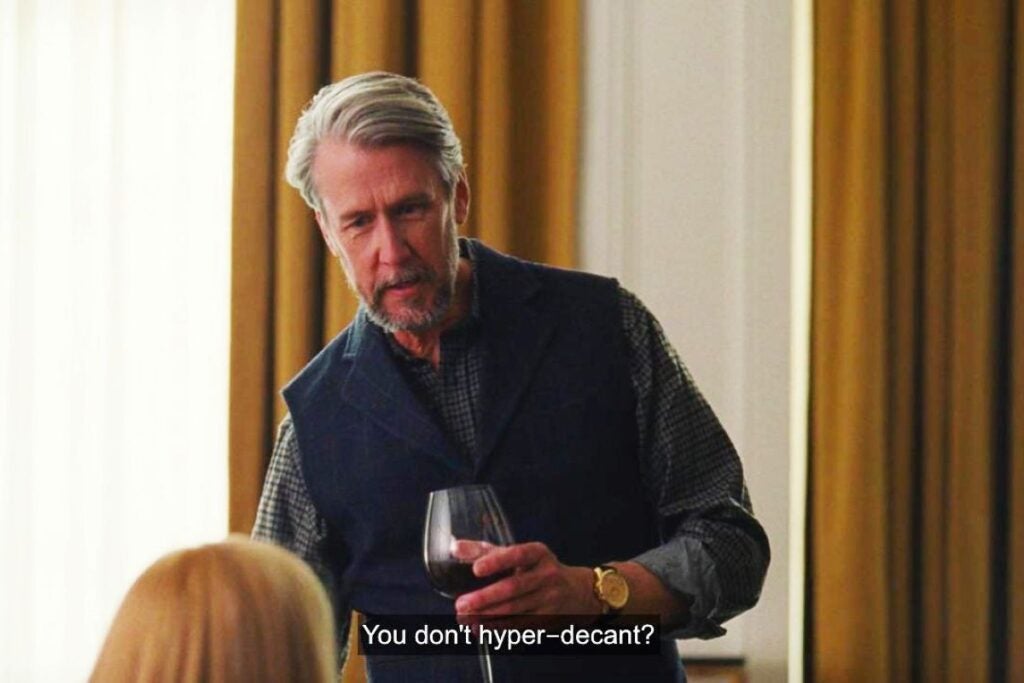
The rich are different from you and me,’ F. Scott Fitzgerald is supposed to have said in the 1920s. ‘Yes,’ shot back Ernest Hemingway. ‘They have more money.’ One hundred years later, the writers of Succession put it slightly differently. ‘I hyper-decant,’ proclaims Roy family trustafarian Connor of his red burgundy. ‘You don’t hyper-decant? You’re just doing regular decanting?!’
Well, are you? Until very recently, perhaps, one would have had to say yes. For almost all of cultural history, our access to the world, mores, conventions, dialects, oddities and decanting habits of the 0.01 per cent was limited to the few intermittent dispatches that fluttered down from on high; romantic, beguiling images and narratives, filtered through the prisms of art, culture and gossip and into our shared consciousness. Gatsby on his dock; Charles Foster Kane and his sled; the Monopoly Man in his spats.
Then came social media, that cacophonous town square. Except the 0.01 per cent – the UHNWs, the super-rich, the haves and the have yachts – don’t live in town squares. They dwell high up in the mountains or deep beneath the earth (perhaps in a nuclear bunker); somewhere off the coast of St Barts or swaddled in the cashmere cabin of a private jet. All places, essentially, that social media historically couldn’t penetrate, or wasn’t permitted.

[See also: Introducing Spear’s Magazine: Issue 99]
Related


There was, in effect, a self-enforced omertà; the digital equivalent of the Bilderberg Group’s Chatham House Rule. You can’t open the doors at 30,000 feet. And when they’re yelling ‘eat the rich’, don’t give them a trail of breadcrumbs.
On the few occasions wealthy influencers did stick their heads above the parapet, they were either lampooned by the masses or decried by the also-rich. Think of the rapid deflation of the gun-toting, hot-tub-dwelling multimillionaire Dan Bilzerian in the mid-2010s.
But, over the past few years, something has changed. Succession had a lot to do with it. The show’s genius was always in its marriage of universal, Shakespearean themes – family, love, belonging, resentment, power – with completely un-universal detail: its dense machine-gun spray of snobberies, name-drops and gilets; of buzzwords, code words, swearwords – all drawn from close study of real-life billionaire dynasties and, Spear’s understands, the whispered testimony of those who had been brought into their confidence. The show became instantly meme-able and virally compelling – a rare social media darling that backed up the hype with its heft and brilliance.
And then the word was out. In the eight years since Succession first aired, a small handful of ‘creators’ have performed a trick previously thought impossible by lifting the lid on the world of the ultra-rich. Crucially, the most successful have managed to achieve this feat in a way that leaves their subjects feeling not exposed – but seen. Talking the language of the 0.1 per cent – but in such a way that somehow allows everyone else to be in on the joke, too. They are the outsiders’ insiders. Suddenly everyone is invited. Buckle up, fuckleheads, as Succession’s Tom Wambsgans might say.
Content from our partners



Take the case of Gstaad Guy. The social creator’s content began literally as an inside joke – and has since grown to one shared by two million followers. Gstaad Guy’s first viral video was an affectionate skewering of a friend who lived a specific kind of Euro-aristo lifestyle; an exaggerated impression that was shared with a few people he thought would recognise the plummy intonation, the patrician frown, the aloof sweep of hair. It was soon shared widely among a certain jetsetty crowd, and within weeks Gstaad Guy – then an employee at Apple – was being stopped on the street by those who recognised him from his clips.
In the five years since, he has become a beguiling figure in the social media sphere, and one that performs a nifty dual trick: holding a funhouse mirror to the ultra-rich, who love him for it; but also acting as a lifestyle guide and arbiter elegantiarum to the legions of ‘temporarily embarrassed billionaires’ who one day hope to be like them, too. This is the classic foot-in-each-camp knack of the best social chroniclers, from Evelyn Waugh to Mickey Down and Konrad Kay, the writers of hit TV series Industry. (It’s telling that at the time Gstaad Guy posted his first video, he had never even set foot in Gstaad.)
Luxury brands have now begun properly to recognise this potent double audience; the ears of both the arrivistes and the already arrived. Loro Piana – the buttery bastion of quiet luxury and the de facto outfitters of Succession’s Roys – made Gstaad Guy its first ever official ambassador a few years ago.
[See also: Welcome to Scarsdale, New York – America’s wealthiest suburb]
His MO is soft in other ways, too. When I interviewed him last year for Gentleman’s Journal, we discussed how his warm, kind on-screen demeanour (which is genuine, I assure you) enables a sense of personal connection with his followers. His own luxury company, Poubel, which makes little bracelet charms that evoke insidery baubles – a padel bat; a black card; a tiny model of the Palace Hotel in Gstaad – is yet another inside joke, hewn in metal and ceramic. (‘A luxury is a trivial thing,’ he told me. ‘That’s why it’s called a luxury.’)
Others have found similar success in this pinpointing and collecting of minutiae and mores, like status lepidopterists. ‘Cheveux De Riches’ is a delightful curation of that gently waved, lightly silvered hairstyle of the fiftysomething Euro. Slick at the front, twin exhausts at the back – like an old Porsche 911. ‘Trust Fund Terry’ and ‘Wall Street Oasis’ are two longtime meme accounts for the Submarinered classes and the finance bros (‘Just a 1% kid trying to become a .01% adult’, according to Terry’s bio). ‘The International Kid’ presents himself as a foreign exchange student and the son of Alibaba’s Jack Ma. Litquidity – the supreme ‘finmeme-lord’ – was honoured with his own Lunch with the FT interview in 2023. (He booked the meal under the name of Hank Paulson, US treasury secretary during the 2008 crash.)
The lantern-jawed character ‘The Swiss Chris’ swans somewhere between the worlds of finance and start-ups – at first as a parody of a jargon-rich ‘Goldman Stanley’ VP on the other end of an investment pitch. But his account – categorising itself as ‘High Society Comedy’ – now covers topics such as ‘top three shirt brands for high finance’ and ‘how much does a weekend in St Moritz cost?’ – again bridging the gap between jester and adviser to the upwardly aspirant.
Elsewhere, ‘The Chin Dictionary’ is an exquisitely accurate (and beautifully written) satire of the monied Barbour-and-Aga cohort, while ‘The Rochambeau Club’ fillets the lifestyles of an overly leisured expat tennis set – though, full disclosure, I happen to be behind that one.
[See also: Who is Matt Mahan, the California governor hopeful backed by tech billionaires?]
For the caprices and weirdnesses of the high-end art world, meanwhile, we always had ‘Jerry Gogosian’ – until the account’s founder, Hilde Lynn Helpenstein, shut it down last year despite having around 150,000 followers. The account parodied the absurdity of the art market via the absurdity of the meme, and its scope was more activist than commercial.
‘The art world is a sleight of hand, a glittering illusion,’ its founder told Forbes last year. ‘Within this strange Marvel universe of characters, the stage is crowded with hierarchy, with classism masquerading as taste… I stand with the underdogs. As far as I am concerned, the art world is meant for the weirdos, the eccentric and the daring.’
Kolin Jones’s own vehicle, so to speak, was the private jet. His company, Amalfi Jets, provides private charter services to a particular clientele. It was cruising along just fine, he says, until it posted a video on TikTok a couple of years ago in which Jones fielded a call from an apparent client, and showed the entire booking process warts and all – including mention of a mistress as an accompanying passenger.
@amalfijets Kolin reveals one of his favorite types of client. Is this the new method for a first date? @thekolinjones #FlyAmalfi #ClientDrama #RichParents ♬ original sound – Amalfi Private Jets
Jones, who’s a qualified pilot and self-described aviation geek, had never before considered poking a hole in the careful confidentiality of the private jet world – an industry famous for its discretion and impenetrability. (Perhaps logically: air safety and comedy are not necessarily natural bedfellows). ‘But there’s that old phrase: better known beats best,’ Jones tells me. ‘We get to combine both at Amalfi.’
The ‘better known’ part came with that first video, which nearly instantly went viral in a way more august competitors could only dream of. ‘It got three to five million views,’ he says now, ‘and that same day led to about 175,000 people on our website, and our phone lines blowing up.’
There were 12,000 flight requests, of which his team ended up booking ‘12 or 13 of them’. Meaning one quick video, filmed on an iPhone, brought in more than $850,000 of revenue within a few days. ‘And that’s when I was like, “All right: this is a really good idea.”’
[See also: The best aviation and yacht finance specialists]
Many more clips followed, often lifting the veil on the more outlandish requests and attitudes of the modern jetset. But ultimately, he says, these social clips are just another way to humanise what can sometimes be a fairly clinical business. ‘People buy from people,’ he concludes.
Andreas Metaxa, better known as Supersnake, also fell into the game accidentally. His life as a ‘High Society Meme Artist’ started as a bet with friends – a wager as to who could get the highest number of followers over a three-month period. Metaxa stumbled on the idea of a meme account about the lifestyles of the rich kids he knew. Soon, the rich kids (like Cara Delevingne) began following him, and then everyone else did, too.
The account is now a psychedelic bouillabaisse of highly particular references and complex satire, veering from cartoonish, anthropological caricatures (‘The Miami Padel Bro’; ‘The Wealthy Divorcee’) to talking AI animations of imagined club promoters, supermodels, DJ booth hangers-on.
‘With TV shows like Succession, there’s obviously an increasing intrigue in what the super-rich are up to,’ he tells me. ‘But for a long time there was a discrepancy between what mainstream journalism would cover and what people like me might portray. I see Daily Mail articles now that are supposedly big exposés, writing about how men will invite beautiful women on to yachts at the Cannes Film Festival,’ he laughs. ‘Is that supposed to be breaking news?! I talk very much to a specific set of people in a way that is quite direct, and so they feel like they’re the only ones that are in on the joke.’
The power is all in the authenticity, he says. ‘The difference here is that you’ve got people that are real-life participants, real-life members of the – I hate to say it – the 0.1 per cent. That gives things a real accuracy. It’s very much a mirror of this existence, right? I’m not sugar-coating anything. And this world, as you know, can be quite dirty.’
This sometimes means brand endorsements are not altogether straightforward. There’s a popular Supersnake series that looks, at first glance, like a collection of adverts for high-end products, from Cartier to American Express. But the copy beneath the images skewers the status symbols’ clientele instead of wooing them.
‘Those posts did really well and got incredible numbers and retention,’ Metaxa says. ‘But you could never convince American Express to let me talk about people using their cards to do drugs – even though people found it funny precisely because it’s true.’
Nevertheless, Metaxa has signed deals with Loro Piana, tequila brand Don Julio and hospitality behemoths like the Tao Group. His characters and observation may soon find an even bigger home, however. When we speak, Metaxa – a writer first and foremost – is in Los Angeles, working on a television project about the lives of the people he so often covers on Supersnake. This feels both fitting and telling; an indicator of the modern cultural cut-through of the ultra-rich whisperers. The hyper-decanting of the 0.01 per cent. The habits and idiosyncracies of the next Logan Roy are less likely to be revealed by the Daily Mail than by the mirrorworld of a meme account.
This article first appeared in Spear’s Magazine Issue 99. Click here to subscribe