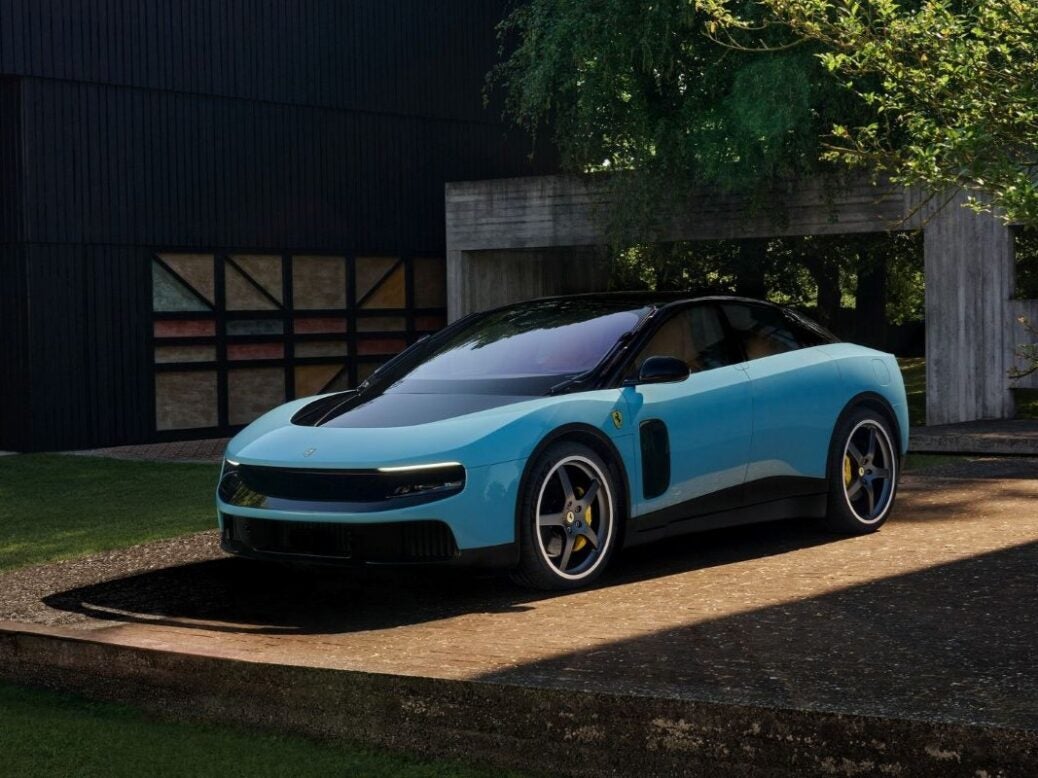
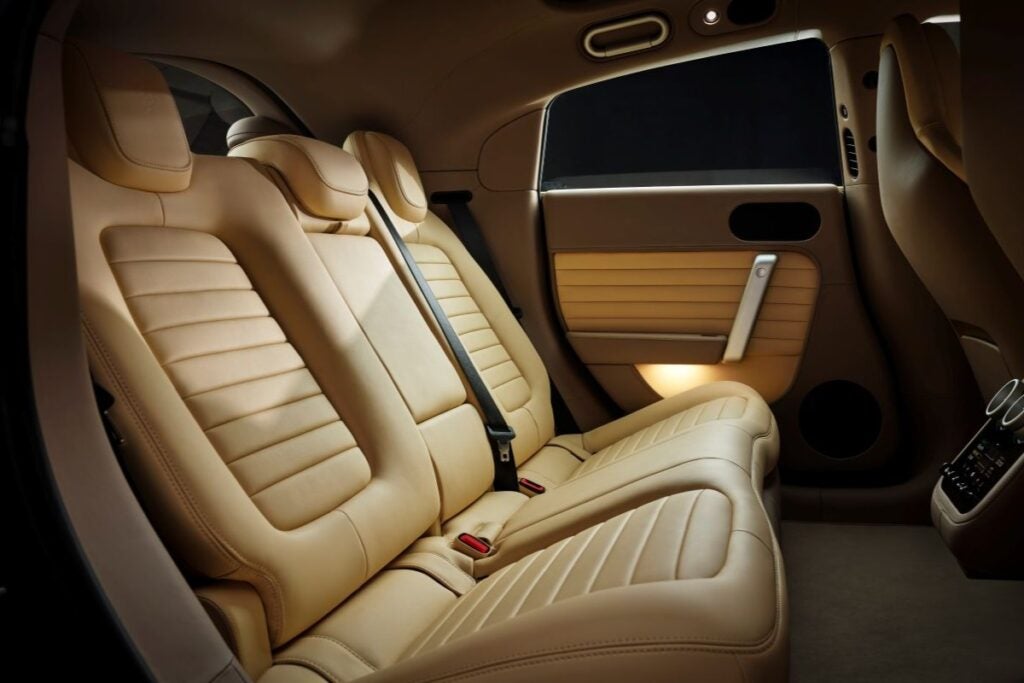
The Ferrari Luce is unlike any Ferrari you’ve seen, heard or driven before. Three reasons why: It’s the first electric vehicle (EV) to bear the prancing horse logo; it’s the first five-seater Ferrari; and, most surprisingly, it’s been designed by people who don’t normally design cars – namely design studio LoveFrom, which is run by Sir Jony Ive and Marc Newson, the two most pivotal product designers of the last 30 years.
Ive changed the world with the iPhone. Might he and Newson change the automotive landscape with this clean, tactile, but strangely suburban Ferrari?
This is set to be the most influential car Ferrari has ever made – and its most controversial.

[See also: The best classic car advisers in 2025]
Related
The Luce (pronounced ‘Loo-Chay’, the Italian for ‘light’) doesn’t look like a Ferrari. It’ll probably be shunned by Ferrari’s traditional clientele and its legion of fans.
Yet there is an audience for it. It’ll cost an eye-popping £440,000 (€550,000), and Ferrari will fill its order books. The customers, I suspect, will be wealthy Tesla, Rivian and Lucid owners looking for a major upgrade in technology and status. California and China seem a natural hunting ground. While this bold and very ballsy experiment could prove an outlier for the Italian manufacturer, it will have huge influence on other EV makers.
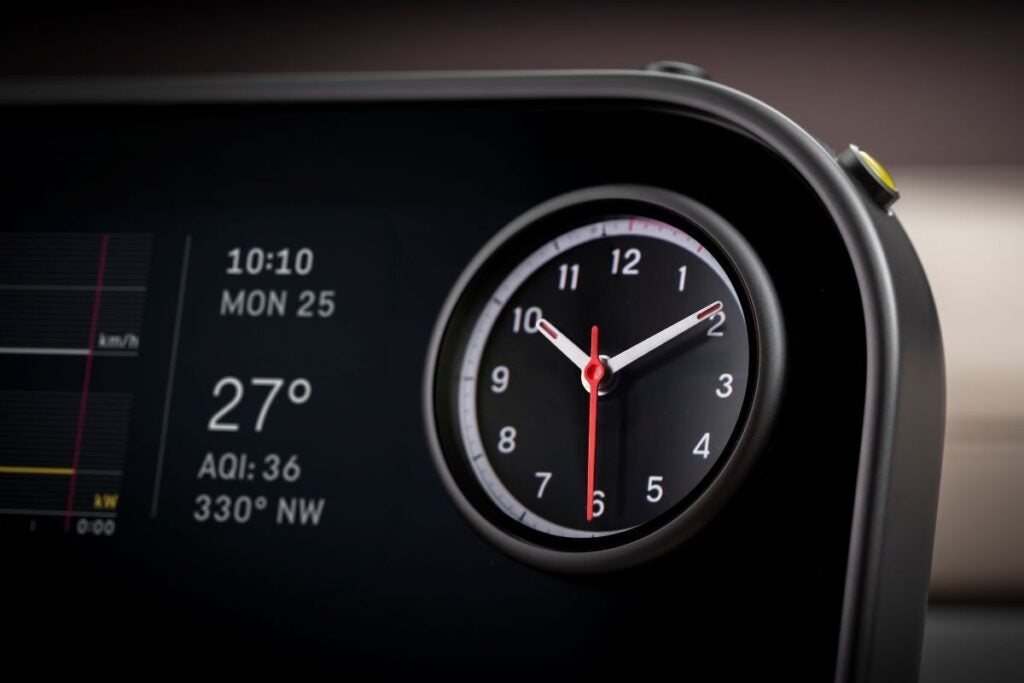
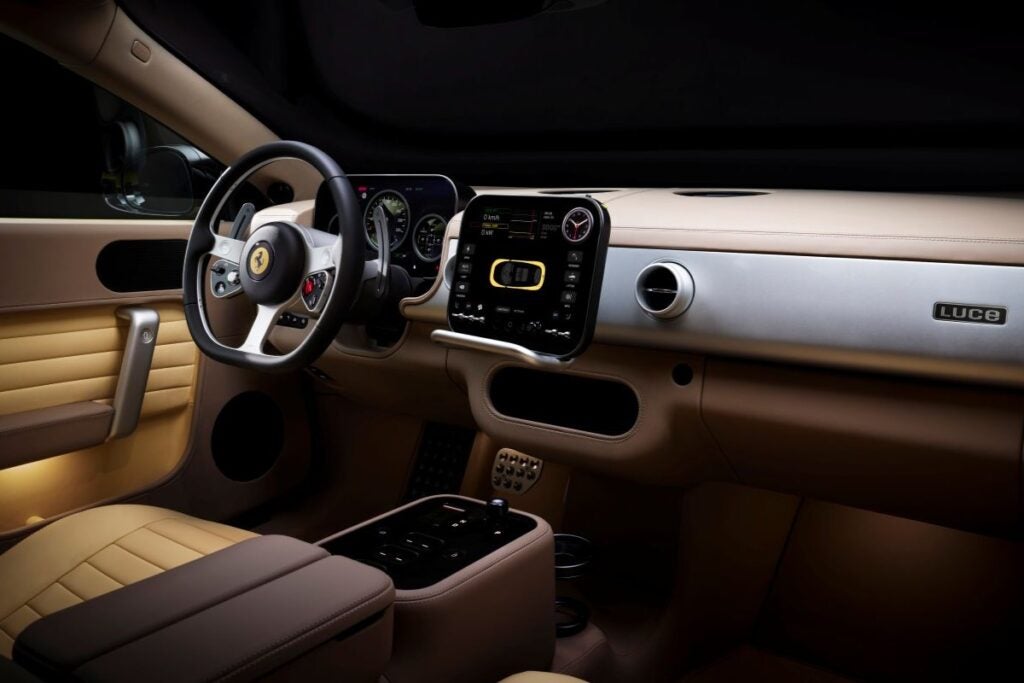
Ever since Maranello announced its multi-energy strategy in 2022, there has been frenzied speculation about what an electric Ferrari would look like, how it would sound, and whether it’d perform to the standards demanded of its adrenalin-thirsty clientele. The interior, which combines elements like a thin three-spoke steering wheel, a moveable central screen with a clock/stopwatch/compass, intuitive toggle switches and round haptic iPhone-style buttons is a peerless example of seamless analogue and digital integration.
This is obviously LoveFrom’s wheelhouse, and an approach I’d like to see expanded throughout Ferrari’s range.
Content from our partners



The exterior, though, is rather newer ground for LoveFrom, and Ferrari has placed a remarkable amount of trust in the San Francisco firm. It wasn’t clear until now that LoveFrom has been given total freedom to design the outside as well as the inside.
The Apple Car was stillborn. Instead, the good lord has delivered unto us the Apple Ferrari. Collaborating with outside designers and coachbuilders is nothing new. Ferrari’s been doing it ever since its debut car, the 125 S, in 1947. Pininfarina, in particular, steered the company’s aesthetics for decades until 2013, when design was brought in-house. But this is the first time they’ve handed responsibility not to car designers but to product visionaries with a completely different eye.
‘We worked hand-in-glove with Ferrari and I think it’s safe to say we exploited each other’s resources to the max,’ Newson told Spear’s at the Luce’s heavily-embargoed media preview in Rome on Sunday.
‘It’s been very, very important for us as designers to have been given the opportunity to work on every aspect of this project: The user interface, the interior and the exterior. We started this collaboration about seven years ago. Jony and I own Ferraris, including old Ferraris, and I’ve driven on the Mille Miglia 14 times, so in a way we already had a longstanding relationship with Ferrari. Interestingly, even though they have a huge amount of in-house experience, they identified very early on that the time had come to experiment. To try and solve problems in a new way, with fresh eyes.’ Ferrari have spoken of a cross-fertilisation of ideas.
[See also: Does Lamborghini’s newest supercar live up to its forebears?]
‘The other thing that’s important to mention is when we started this project, it wasn’t necessarily going to be an EV,’ revealed Newson (Ive was not present at the launch, for the Englishman was recovering from surgery).
‘Ferrari didn’t come to us with an EV platform, it happened the other way around. There were a bunch of objectives that had been identified principally by Ferrari at the beginning. For example: four doors, five seats, fundamental things like that. These conversations happened before the Purosangue (a four door, four seat V12-powered SUV) came to fruition. That’s when, collectively, we decided that an EV was the best way of achieving Ferrari’s goals.’
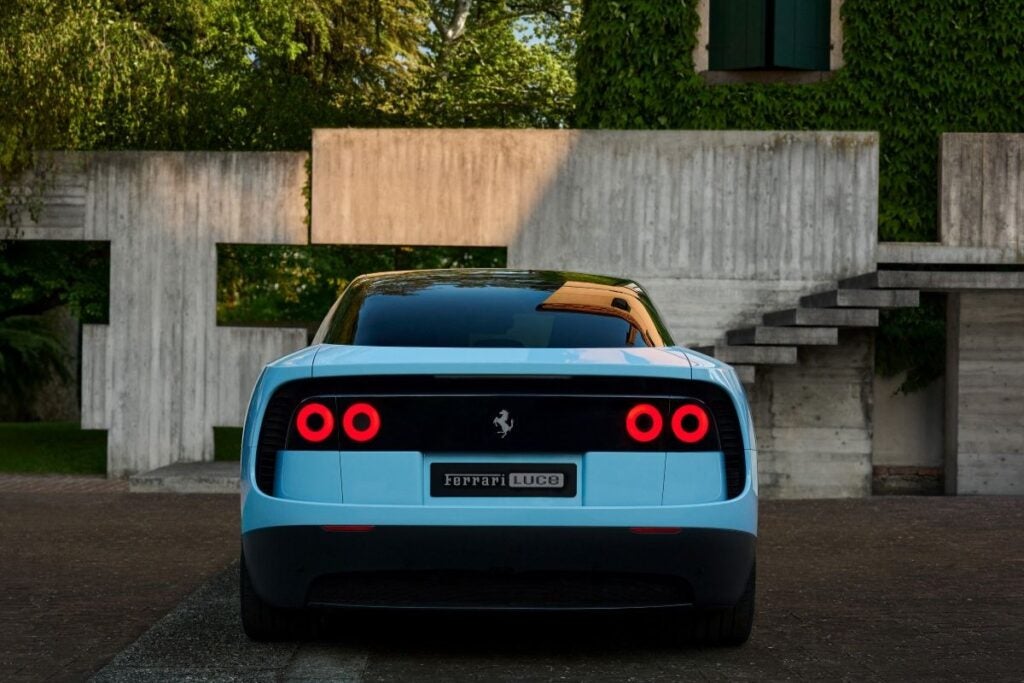
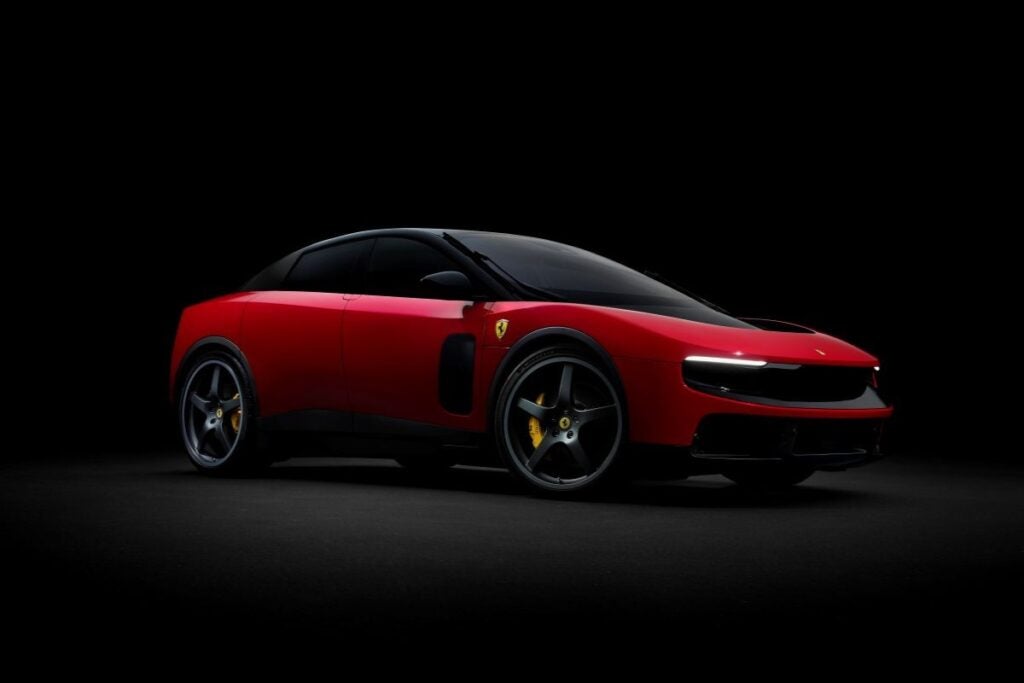
The car has an aerodynamic black glasshouse or, as Newson calls it, passenger cell. A coloured shell rests around its midriff, appearing to float. There are gaps in the nose and tail that guide airflow over the car and provides downforce, though this is a car built for low-drag in order to reach its 330-mile battery range. There are active grille shutters that close when cooling isn’t needed, to help it cut through the air more efficiently.
It has vertical windscreen wipers for the same reason and, unseen, a sealed underbody, as well as front ride height that drops 10mm at cruise. Downforce is similar to that of the Ferrari Amalfi and its predecessor, the Roma, but with 20 per cent less drag. It has the lowest drag coefficient of any Ferrari thus far.
There’s not a lot of Ferrari DNA to be found in the exterior. Perhaps it owes more to Newson’s Ford 021C city car concept – the Australian’s only other stab at car design, which was commissioned in 1999 and was notable for its childlike lines, simple instrumentation and suicide doors, which the Luce – like the Purosangue – uses to dramatic effect.
[See also: ‘A big name with a big back story’: how Richard Mille built a €200,000 bike]
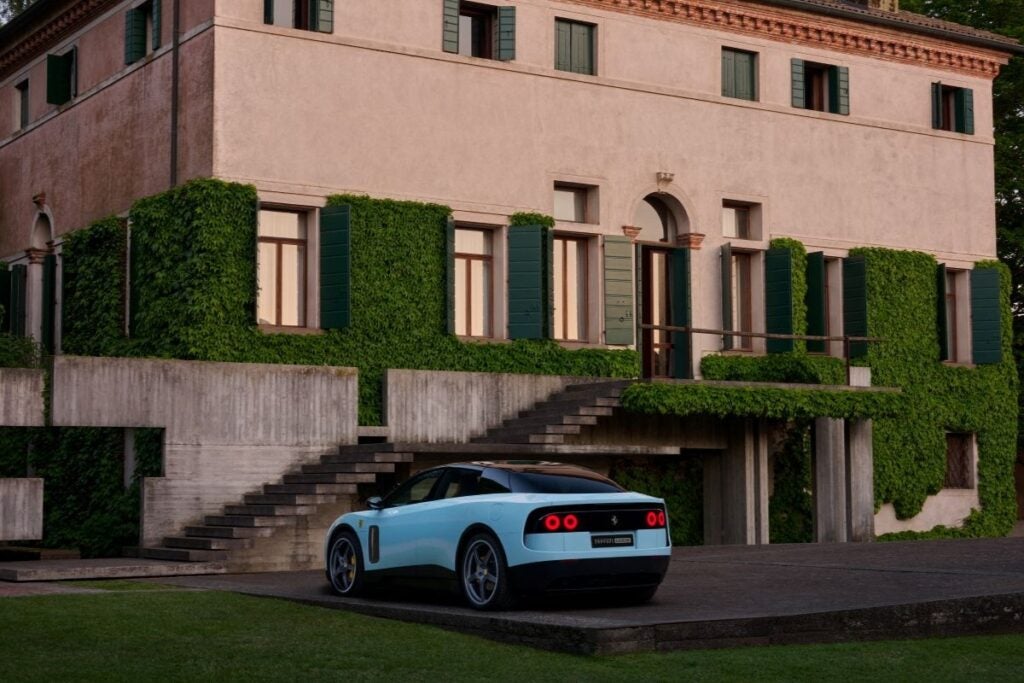
Unveiled in a range of crayon-colours, it is slab-sided, and there are no muscular haunches. The nose is pinched and the derriere is blocky. Its headlights look like those of a Jeep Avenger. I suppose if you want to imagine classic Ferrari inspiration there’s a hint of 365 GTC/4 about its mouth. The four round lamps at the rear are a Ferrari throwback reminiscent of dozens of Maranello past-masters, but with the black background its closest cousin, to my mind, is the 2004 Chevrolet Impala.
There are two choices of aluminium wheels: five spokes, which are generically sporty and show off the huge brake discs and callipers, or monobloc turbine wheels which suit the car’s quirky character. They are more aerodynamic too, although the five-spokes are lighter. A vast 23in on the front axle and 24in on the rear, the wheels should help to make the car look smaller than it actually is (which is five metres long). But because the wheels are grey and the wheel arch surrounds are black, they don’t look like they’re filling the arches.
If you took the Cavallino logos off, you’d think it was a Honda. A nice Honda, but a Honda all the same. It’s shape is more family car than supercar. There is nothing suburban about the technology and performance, however.
The same level of engineering craftsmanship, exotic materials and advanced science goes into this car as every internal combustion-engined (ICE) Ferrari before it. There’s an electric motor on each wheel, with electrically-controlled active suspension and four-wheel steering. Between this and instant torque vectoring, you’ll have more mechanical grip that you ever thought possible. Every component, including the circuitry, is a technical masterpiece. This project has resulted in 60 new patents. The 122kWh battery can be charged from 10 to 80 per in as little as 20 minutes.
[See also: Inside the ‘fastest jet since Concorde’]
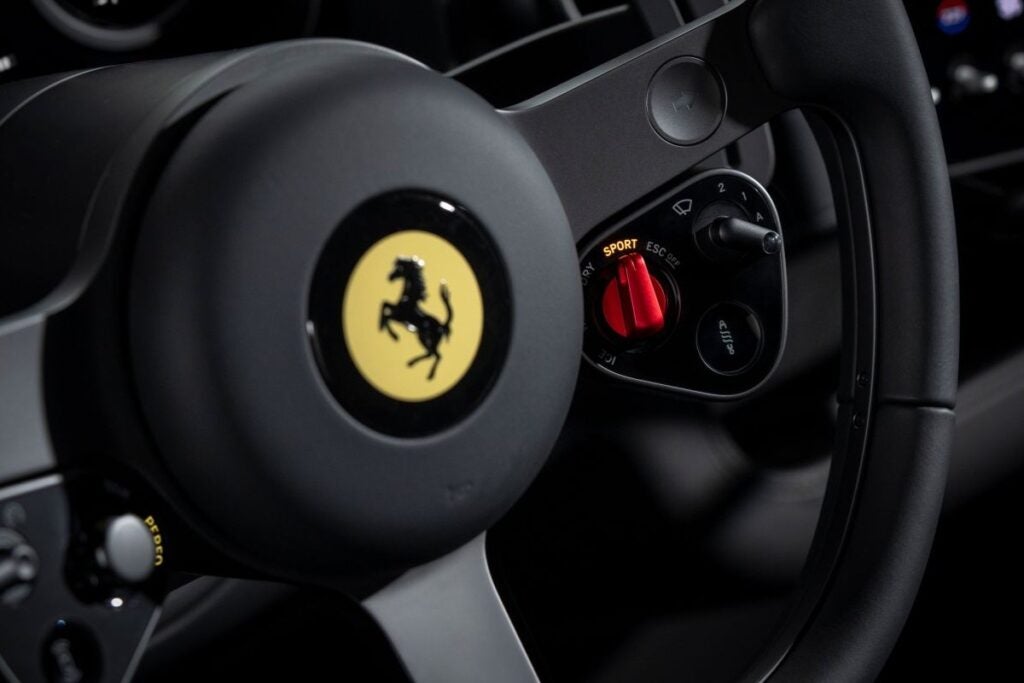
Ferrari drivers will be familiar with the Manettino rotary dial on the steering wheel that selects different drive modes. This car has Manettini plural. The Manettino on the left governs power. Range, Tour and Perf (as in Performance) allow max power of 320, 460 and 725kW respectively. This Manettino also has the buttons for cruise control and ADAS. On the right are the driving dynamics – Ice, Wet, Dry, Sport, ESC Off – as well as the suspension setting and wipers.
In the cockpit there’s an overhead control panel where one pulls a handle down to engage launch control. The binnacle flashes orange, at which point you put both feet on the pedals and release the brake. Zero to 100km/h (62mph) takes 2.5 seconds, 200kmh (124mph) a breathless 6.8 seconds, and it will keep tugging to 310km/h (193mph).
The wheel also has paddle shifters. You can trigger a manual function which allows you to select five different torque and brake regeneration settings via the paddles, giving added control over acceleration and engine braking and providing the effect of driving with gears – including the thump you get from cogs. Add to this the noise, which is activated in Perf mode, and we have a novel rethinking of how to give an EV a thrilling, unique, authentic bridge to the ICE world from which Ferraristi have come.
A precision accelerometer at the centre of the rear axle captures the vibration of the rotating components while the sound waves are moving. The system equalises and amplifies the signal in a way that’s similar to an electric guitar’s pickups and amplifier. This living sound is delivered internally and externally via speakers. The sound that was demonstrated to me was a gravelly hum, which sounds more organic than some of the fake, synthesised aural accompaniments we’ve heard from EVs thus far.
[See also: The best aviation and yacht finance specialists]
It won’t excite like a V12’s bark. It’s not musical in the way 7,000RPM in a 12Cilindri sounds like Pavarotti at full-throttle. But it will at least convey speed and a sense of occasion. When not in the Perf setting, the car is eerily quiet, with road noise significantly reduced thanks to Ferrari’s first elastically-mounted subframe.
The Luce is disruptive yet coherent. Is it a red-blooded Ferrari, though? The performance says yes, but it needs to look fast, sexy and elegant, not just today but 80 years down the line. I’m not sure it fulfils these parameters. The Ferrari brand is so strong, graphically, reputationally and financially, that the Luce will not damage it. But it will go down as an oddity.
I respect the management’s bravery, however. ‘[The] Ferrari Luce is not a response to change,’ said Ferrari chairman John Elkann. ‘It’s a deliberate decision to lead what comes next, with clarity and purpose. What would Ferrari be if we imagined it with a blank sheet? Not just new ideas, but a different perspective. That is why we chose to work with LoveFrom; not to confirm what we already know, but to challenge it. To look at Ferrari from the outside, and to look at what it can become next. [The] Luce is a car of the future, and uniquely Ferrari. It reaffirms what has always defined this company: The courage to redefine the limits of [what’s] possible.’
John Elkann’s grandfather and great grandfather, Gianni and Giovanni Agnelli, were the industrialists behind Fiat. John, now 50, took over the running of the family’s portfolio, which includes Ferrari, nearly two decades ago. The Agnelli-Elkanns are often referred to as the Italian Kennedys. There are also parallels with the TV show Succession, which was, of course, inspired by Rupert Murdoch’s family dramas. Elkann going to Silicon Valley to make friends with the cool kids by offering up the chance to reinvent this major legacy brand, his family’s crown jewel, is a very Kendall Roy move.
Not everyone is going to love the Luce. As a statement, though, it’s made Ferrari’s relevance more profound and it’ll reach audiences Ferrari have never had a relationship with before. It’s also been a learning exercise which will provide Ferrari with valuable intelligence. ‘As industrial designers, there are lots of things in the industry that irritate us, and we want to do things differently,’ Newson explained.
‘Things are often designed in this industry in silos and then you have to shoehorn it all together. Instead, we wanted to do this holistically and we’re very satisfied with the result.’
Ferrari Luce at a glance
- Engine: Quad electric motors, one on each wheel
- Power: 1,035bhp / 772 kW
- Torque: 730 lb ft / 990Nm
- Acceleration: 0-62mph: 2.5s
- Top speed: 193mph
- Battery capacity: 122 kWh
- WLTP range: 330 miles
- Weight: 2,210kg
- Price: £438,406 / 550,000€
- Release date: Spring 2027