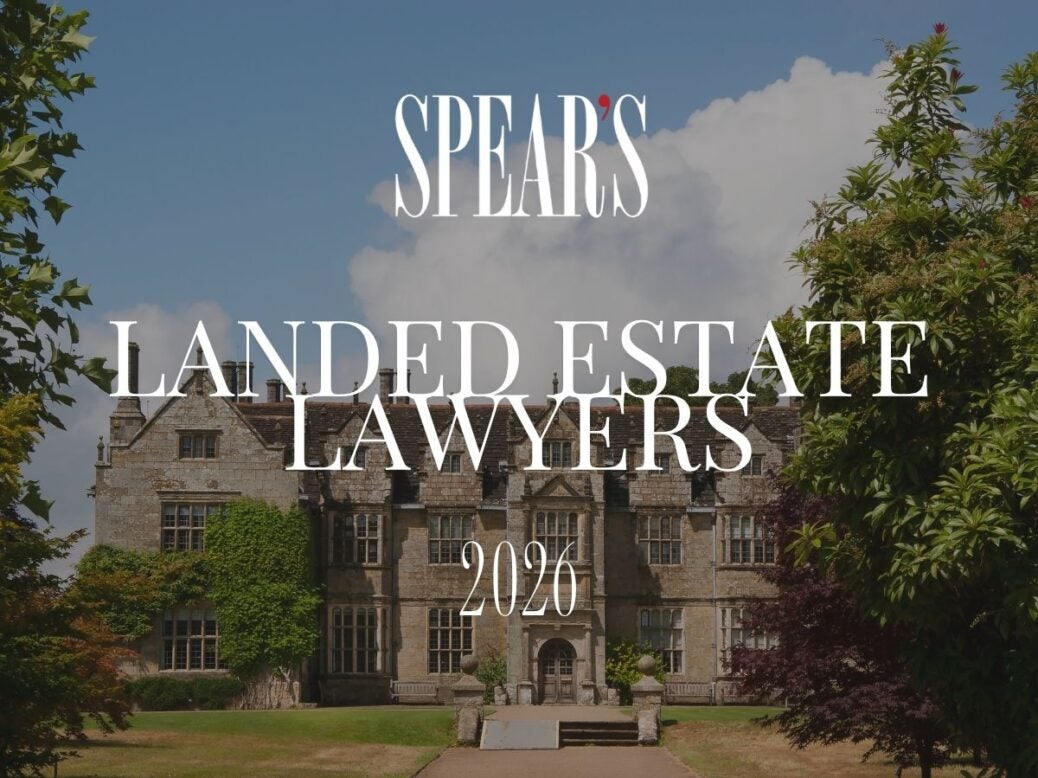
‘Land has ceased to be either a profit or a pleasure. It gives one position and prevents one from keeping it. That’s all that can be said about land.’ Oscar Wilde may have penned those famous lines in 1895, but in 2026, they ring truer than ever before.
Popular culture often paints landed estates in the nostalgic hues of Downton Abbey – an expansive rural holding of grand country houses, agricultural land, tenant cottages, let farms and woodland – where ownership is a relatively passive affair of collecting rental payments from tenants and managing farmers.
In reality, the responsibilities have multiplied and holding thousands of acres in land has become a highly regulated corporate enterprise. Between shifting tax regimes, environmental legislation, planning friction and succession planning, keeping an estate solvent requires adaptation.


Landed estate law centres around solving Oscar Wilde’s modern dilemma: ensuring a historic holding remains a resilient enterprise rather than an overwhelming burden. Navigating that boundary demands lawyers who can provide a steady hand especially when sudden tax or regulatory overhauls threaten to create friction for landowners, and who recognise that managing an estate is a long-term commitment where decisions made today will likely shape the land for generations. As Tristan Ward of Birketts reflects: ‘There’s a saying in farming: live as though you’ll die tomorrow, but farm as though you’ll live forever.’
Related



The 2026 edition of the Spear’s Landed Estate Lawyers Index features the best advisers in the UK who assist with everything from restructuring for the next generation to unlocking value through natural capital. Fundamentally, they are stewards – ensuring that whatever path a landowner chooses, their assets are protected and commercially optimised.
Themes in 2026
The looming tax threat
For decades, landed estates relied on a fiscal safety net: Agricultural Property Relief and Business Property Relief shielded qualifying farmland and trading enterprises from inheritance tax. Most importantly, it allowed succession decisions to be deferred, operating on the assumption that the holding would pass to the next generation intact.
The Labour government’s cap on business and agricultural property relief, in force since April 2026, exposes assets above £2.5m to an effective 20 per cent inheritance tax rate. For multi-thousand-acre estates – where land values are high but annual cash yields are low – a sudden tax liability creates severe exposure to an immediate cash liability on death.

‘The changes to the agricultural and business property relief rules have forced people to actually make decisions, which has forced family discussions and people to really think about what they want to happen with their assets,’ Matthew Woods of Withers explains. He notes that he’s currently advising a family that has owned the estate for 32 generations, helping them navigate how best to engage their children in future governance.
Advisers are now being asked to guide families through active restructuring – evaluating lifetime transfers, trust allocations or strategic land sales to generate liquidity. This shift inevitably brings delicate family dynamics to the surface as senior owners and prospective heirs align on the future. For some heirs, it’s a case of continuing that legacy by holding on to their assets. For others, as Tom Hewitt of Burges Salmon describes it, owning an estate can be ‘an albatross around their necks. It’s a burden that won’t suit them.’
Content from our partners



Re-engineering income
With traditional agricultural yields struggling to service growing tax liabilities, landed estates face an urgent imperative: generating cash flow to defend the asset. Landowners have consequently moved their focus toward commercialisation, advisers tell Spear’s. Hewitt points to solar and wind farms as crucial drivers to build long-term liquidity while Idina Glyn of Mishcon de Reya explains that vineyard acquisitions are attracting momentum, particularly for American buyers.
Historically renting out estate cottages was a reliable way to build a supplementary income stream. But the introduction of the Renters’ Rights Act in 2025 has altered that equation by transforming residential portfolios into compliance-heavy operational burdens. Edmund Fetherston-Dilke of Farrer & Co – whose client book includes the Duchy of Cornwall – explains that the legislative reform has ‘made people think harder about the costs of holding residential property and the administrative expenses’.

On top of this, advisers warn, commercialisation does not always offer an easy exit from the tax system or rising landlord costs. As Polly Montoneri of Forsters observes, estates that are commercialising ‘are now being stung with changes on employment law and [increasing] national insurance’. There lies the dilemma: the very strategies designed to save an estate can create new vulnerabilities.
Volume of change
Underpinning the operational challenges is a deeper, systemic issue facing landed estates: legal and regulatory fatigue. The defining insight that emerged across the advisers featured in this year’s Index is that it is not any single legislative reform that poses the greatest risk, but rather the cumulative friction of constant policy shifts.
Glyn explains that a period of ‘calm and consolidation’ is needed and Iwan Williams of Michelmores says that clients are holding off on making investments until Andy Burnham’s Autumn Budget. ‘We’re going to see what happens,’ he says. ‘It just contributes to an air of uncertainty, which isn’t really conducive to growth.’

The successive changes, advisers note, mean long-term strategy for landowners breaks down. Where capital and vision should be driving environmental stewardship and infrastructure, they are instead diverted into legal restructuring just to stay compliant to evolving regulations.
Closing the gap between the frantic pace of policy reform and the slow, generational movement of family holdings remains the primary task for the legal profession. It is this strategic stewardship – navigating immediate fiscal headwinds while safeguarding centuries of heritage – that unites the leading lawyers ranked in the 2026 edition of the Spear’s Landed Estate Lawyers Index.
Click the links below to jump to a section of this article:
- Methodology
- The best landed estate lawyers: some names to know
- The best landed estate lawyers: the complete list
- Contact us
Methodology
Each year, the Spear’s Research Unit reassesses and refreshes its rankings of the leading providers in each sector by gathering data from and about the advisers and firms themselves, assessing submission forms, collating nominations, carrying out peer reviews, reviewing data from third-party sources, gathering references and recommendations, canvassing experts and conducting hundreds of interviews.
Advisers are evaluated using a proprietary scoring system that assigns different weightings to certain attributes. These scores feed directly into each new set of rankings in the Spear’s Indices. Each of these indices are published first online (according to the research calendar) and then in print. Print publication takes the form of the annual Spear’s 500 directory, which includes the top advisers in every index.
[See also: A guide to the Spear’s 500: Everything you need to know]
Each featured adviser is profiled on spears500.com. The site allows users to search the Spear’s database of more than 4,000 entities to find one (or more) to meet their specific requirements by filtering for specific attributes such as an adviser’s location, their specialist expertise and information about their client base.
The best landed estate lawyers: some names to know
Edmund Fetherston-Dilke
- Focus: Agricultureal, residential and commercial property
- Position: Partner
- Rank: Top Recommended
- Firm: Farrer & Co
One of the UK’s foremost experts on the buying and selling of estates, Farrer & Co partner Edmund Fetherston-Dilke frequently advises on land and country houses worth upwards of £30 million. He is perhaps best known for his work on the Duchy of Cornwall, the Prince of Wales’ landed estate of 130,000 acres spread across 23 counties. ‘His Royal Highness has a strong sense of mission for what the Duchy of Cornwall ought to be doing when it comes to people, the places that it operates in and its impact on the planet,’ he tells Spear’s.

With expertise spanning three decades, he remains humble about his rarefied client book. ‘I wouldn’t blow my own trumpet. But I would blow the trumpet of my team, which I do think is the largest and the best in the country.’
Read Edmund Fetherston-Dilke’s full profile at Spears500.com
Tom Hewitt
- Focus: Trusts, wills, probate and capital tax
- Position: Partner
- Rank: Recommended
- Firm: Burges Salmon
When Tom Hewitt began his career in high-value property, he was wearing a land agent’s hat at Savills. Now a landed estate lawyer at Burges Salmon, he says the old training still shows: ‘I’m prepared to take a view on things which perhaps if I hadn’t had that experience, I wouldn’t be prepared to.’
It’s a different type of challenge but one that Hewitt relishes. ‘We’re the gatekeepers,’ he tells Spear’s, who help to unlock opportunities for landed families looking for lucrative ways to use their land. Battery storage facilities, wind and solar farms, and renewable energy are of increasing interest to his clients. ‘We’re acting as the person sitting at the table and funnelling the work in the right direction.’
A particular specialism is acceptance in lieu, under which an estate transfers a valuable chattel to a public collection in settlement of an inheritance tax bill. ‘It’s an interesting tax route for those who have got some really special things, and it invariably involves working very closely with auction houses like Christie’s or Sotheby’s typically.’
Read Tom Hewitt’s full profile at Spears500.com
Sarah Jordan
- Focus: Country transactions
- Position: Partner
- Rank: Top Recommended
- Firm: Moore Barlow
Moore Barlow partner Sarah Jordan’s diverse client base includes farming businesses, equestrian enterprises, vineyard owners and country house estates. While her day-to-day work is varied, she says her expertise most often falls into three areas: ‘transactional matters, rural asset management and succession planning’.

Looking after estates – including the renowned Cowdray and Grange Hampshire estates – Jordan helps clients navigate the practical and legal issues that can shape rural assets, from renters’ rights legislation to the prospect of implementing electricity substations. ‘I’m not just here for one-off transactions. I’m here to support the smallest piece of work to the largest,’ she tells Spear’s.
Read Sarah Jordan’s full profile on Spears500.com
Idina Glyn
- Focus: Transactional and advisory property matters
- Position: Partner
- Rank: Top Recommended
- Firm: Mishcon de Reya
Mishcon de Reya partner Idina Glyn handles complicated and high-value country estate transactions for buyers who need to move at speed. ‘My clients are interested in securing property quickly because the market is jumpy,’ she tells Spear’s, describing deals that are done ‘in days, not months’ – including transactions of more than £20 million completed within a fortnight.
Her client book is divided between the empire-builders and the escapists, she explains. On one side she works with ‘clients with large estates or trophy estates who want to buy residential property or adjoining agricultural land’; on the other are UHNWs ‘who are buying for privacy and are much less interested in the commercial exploitation of the estate’.
Read Idina Glyn’s full profile on Spears500.com
Luke Callaghan
- Focus: Agricultural and rural estates
- Position: Partner
- Rank: Recommended
- Firm: Winston Taylor
Luke Callaghan is a partner specialising in rural properties and landed estates at Winston Taylor, the firm formed from the merger of Winston & Strawn and Taylor Wessing.
Callaghan joined Taylor Wessing in 2011 and became a partner in 2024. Coming from a farming background himself, he is well placed to advise on prime property, rural estates, farms and development projects.

He tells Spear’s he has seen an increase in a ‘new money’ clientele: foreign investors and family offices acquiring estates in the home counties, south-west England and Wales. His ongoing work involves the agricultural law that underpins rural holdings, manorial and quarrying rights, public rights of way, and investment in natural capital, including regenerative woodland schemes.
Read Luke Callaghan’s full profile on Spears500.com
The best landed estate lawyers: the complete list
Click on the individual names to be directed to more detailed profiles of each adviser on The Spear’s 500 website. The table is ordered by ranking and then alphabetically by surname.
Contact us
- Click here to order a print copy of The Spear’s 500.
- To apply for inclusion in The Spear’s 500, complete our submission form.
- For further information about rankings or entries, please email research@spearswms.com; we aim to respond to all queries within two working days.
- For commercial enquiries and questions relating to enhanced profiles, please contact: salesy@spearswms.com
- To keep up to date with the Spear’s 500, subscribe to our magazine, newsletter and follow Spear’s on LinkedIn and Instagram.
- If you have missed calendar deadlines for our research cycles in 2026, you can still register your interest for updates about upcoming research and rankings.