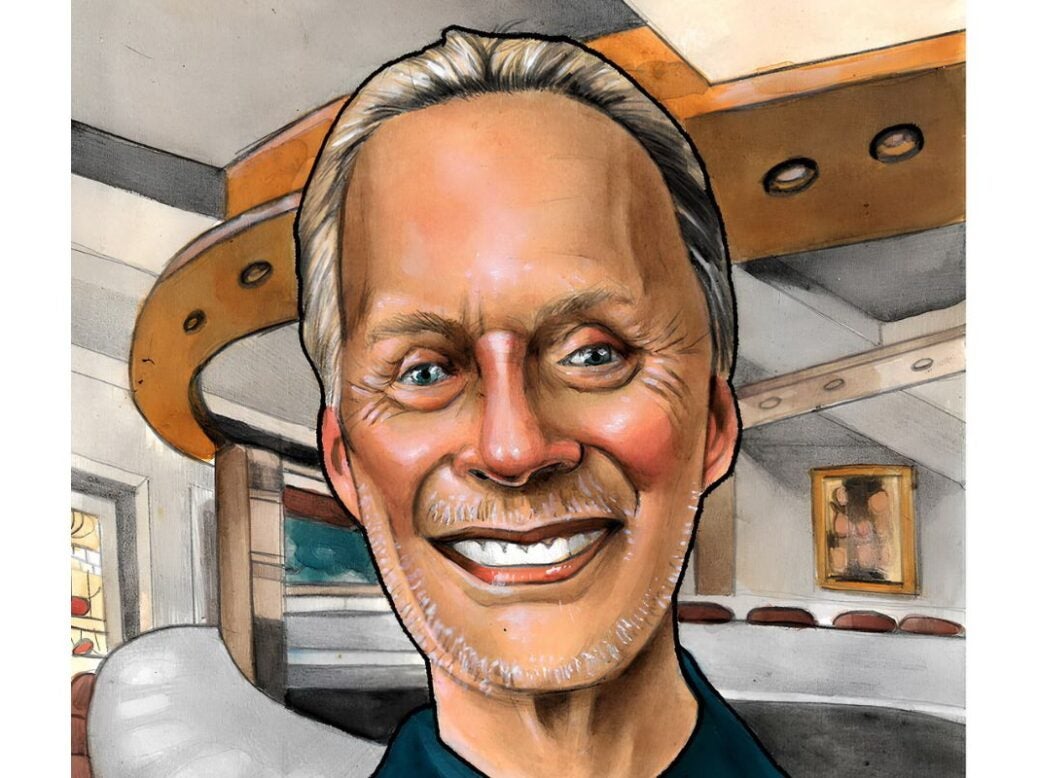
Anthony Thomson has suggested we meet for lunch at the Seashell of Lisson Grove, just around the corner from Marylebone Station.
I’m a few minutes late, so I barely notice the suit of armour by the door, the black-and-white chequerboard flooring or the huge sculpture of squid that appears to be trying to haul the restaurant’s bar down into the briny.
Thomson, 71, is at a banquette, looking relaxed both in demeanour and attire. He wears dark jeans, a jumper and brogues; a camouflage-print rucksack sits beside him. As we chat about a peripatetic life that has seen the marketer and serial banking entrepreneur spend time in Somerset, Sydney and the Middle East in recent years, I glance at the menu and ask if he has any recommendations. ‘Well, it’s 17 years since I’ve been here and I think the place has burned down at least once since then,’ he deadpans, with the lightest hint of a Newcastle accent.

[See also: Why more family offices are closing or downsizing despite rising wealth]
Related

Thomson chose the spot, he explains, as it was where he and Vernon Hill – a colourful American billionaire known for founding Commerce Bank in the US and being accompanied almost everywhere by his Yorkshire terrier named Sir Duffield – decided to partner up and launch Metro Bank in the UK.
Before then Thomson had run the Financial Services Forum, a membership organisation for senior marketers in finance. (His day-to-day involvement ceased long ago but he relinquished the chairmanship as recently as 2019, when the business was sold to Incisive Media.)
We order – a shared plate of whitebait to start, followed by a grilled Dover sole for each of us, accompanied by chips and some vegetables – and Thomson tells me the Metro Bank genesis story.
[See also: UHNW entrepreneurs lag behind in building personal wealth]
Content from our partners



In 2008, having met Hill the previous year, Thomson embarked on a successful (if ‘soul-destroying’) capital roadshow in the US. On Friday 12 September, he and his colleagues flew out of JFK with $126 million of investment committed – only for Lehman Brothers to collapse on the Monday. Many of the commitments were withdrawn but, after the false start, the business eventually got off the ground.
Metro Bank launched in 2010 and went on to win fans for a new approach that included opening branches at weekends and providing bowls and treats for dogs. But by 2012 Thomson had realised change was afoot. ‘I saw the most seismic shift in consumer behaviour I’d seen in 30 years of looking at marketing data – this move from traditional [high-street] banking to digital in general, and mobile in particular.’

He went to the board and laid out a plan to ride the wave. However, he says, ‘They didn’t share that view. Vernon in particular didn’t share that view.’ So he stepped down as chairman and went on to launch Atom Bank, raising $100 million to build the first mobile bank in the UK. More than a decade on, it’s still privately held, ‘but very profitable’. Thomson stepped away from day-to-day involvement in an ‘amicable’ way in 2018, but retains a significant interest as the largest non-institutional shareholder.
[See also: Rise of ‘alternative banking platforms’ poses challenge for established incumbents]
Then another banking startup, 86400, materialised; this time in Australia. There was a healthy exit in 2022, precipitated by a phone call from former RBS CEO Ross McEwan. ‘I sold it to Ross for $440 million [AUD], which is a three-and-a-half-times return for the shareholders in three years. So everybody’s happy.’
However, soon after, a routine health check (prompted by Thomson and his wife being offered residency in Australia) revealed a tumour in his chest that was, concerningly, ‘the size of a softball’.
‘We had three days of, “Oh my god, I’ll be dead by Christmas,”’ he remembers. But the tumour turned out to be operable. It was removed, he came back to the UK to recuperate and ended up spending ‘six months basically in bed’.
[See also: The world’s oldest family-owned bank has appointed a new CEO]
Which pretty much brings us up to his latest venture, and the main reason for our meeting today. Thomson is (surprise!) launching another bank. But this one is geared explicitly to family offices and ultra-high-net-worth individuals. The venture, Velorai, is a response to deep dissatisfaction among family offices with the service provided by their banks.
Making his way through the Dover sole, he explains that in the 72 interviews with single-family office principals, multi-family offices and family office advisers he carried out as research, ‘product-pushing’ (when banks encourage clients to purchase investment products) emerged as ‘the single biggest issue’.
‘Without exception, the number one complaint is: “All my bank wants to do is sell me investment products, and often their own structured investment products. Or, if they show me deals, I’m pretty sure I’m the last person to be seeing the deal”,’ he says.
[See also: Beyond the mortgage: how private banks structure debt for ultra-wealthy clients]
‘What people like about their bank you could fit on the back of a very small postage stamp – which is great if you’re thinking about setting up a competitor.’
The second most common complaint was that the level of service promised when they joined their bank hadn’t been delivered. Many family offices feel as though they are dwarfed by institutional clients and are therefore too small to matter very much to their bank, Thomson explains. ‘If you’re a billion-plus, you probably have some weight. But even if you’re in the hundreds of millions, [the banks] are just not very good.’ Although he does note that there are some ‘honourable exceptions’.
Velorai aims to offer better service by catering to clients’ multi-jurisdictional requirements, setting intelligent incentives for staff and using agentic AI, which Thomson believes will bring significant cost savings.
[See also: The global machine that washes the world’s dirty money]
One of the bank’s co-founders is Paul Pester, the former boss of Virgin Money and TSB. Pester left the latter under a cloud after a mishandled IT upgrade left 1.9 million customers locked out of their accounts in 2018. The other co-founder, Stuart Grimshaw, will serve as CEO. He is a former chief executive of Yorkshire Bank and Clydesdale Bank and has worked in Australia at Commonwealth Bank of Australia and the listed Humm Group. Grimshaw is also chairman of the Melbourne-based family office of the billionaire Roche family.
The team is currently in fund-raising mode, seeking to tap the same UHNWs and family offices that will make up its client base for investment. ‘You don’t have to be a shareholder to be a client,’ says Thomson, ‘but if you are, you will share an economic value that you’re helping to create. And that message seems to have resonated really well.’
Velorai’s current pre-money valuation is $20 million [USD]. The bank is planning to close an initial $20 million investment round in February 2026 and seek an additional $80 million ahead of its official launch, which is slated for September this year. Thomson’s goal is to get to a $10 billion [£7.5 billion] balance sheet within five years, which would require $500 million of capital in all, with the additional $400 million raised over the intervening years.
[See also: Family offices chase AI but governance and infrastructure lag]
‘We’d probably have about 500 family offices and about 2,000 ultra-high-net-worth individuals,’ he says. ‘It’s not a big market share.’ There are currently 510,810 UHNWs globally, with the number projected to grow to nearly 677,000 by 2030, according to Altrata.
Jersey, where Velorai now has in-principle approval for a banking licence, was chosen as the location for its headquarters and is also where it will book assets. But other jurisdictions, including Singapore, Luxembourg and the UAE, were considered.

Both ADGM and DIFC, the financial centres of Abu Dhabi and Dubai, respectively, were possibilities at one stage, but were eventually discounted. Thomson describes both as ‘good centres’ but adds: ‘When I spoke to family offices in the UAE, they said, “Any assets we’ve got offshore – i.e. out of the UAE – we want to keep them out of the UAE.” If the [ruler] decided to change the rules tomorrow, the rules would change.’
[See also: Succession planning in the GCC: Experts warn families can no longer afford to delay]
Thomson seems to relish the challenge of creating the bank of the future and raising an extra $480 million. But after Metro Bank, Atom and 86400 in Australia, why do it again – for a fourth time?
‘My kind of flippant answer is, “Well, I don’t play golf.” But the real reason is I just love working with bright people on interesting projects,’ says Thomson. He reveals that after his tumour scare, he decided to think about what he wanted the next 10 years of his life to be and ended up writing a list of maxims on a piece of paper – which he now carries everywhere, along with a copy of Marcus Aurelius’s Meditations. He pulls the piece of paper out of his trendy rucksack and shows it to me. Alongside one or two rather prosaic lines (including ‘Create capital value’) the main thrust of it is clear.
‘If [Velorai] is hugely successful, it’s not gonna make any difference to my life,’ Thomson says. ‘It might make a difference for my kids and my grandkids, but they’re pretty well looked after anyway; we’ve done okay. So it’s not about money.
[See also: Abu Dhabi’s family office boom: why the emirate is attracting active global investors]
‘I love challenging convention. I love challenging the incumbents. I love working with bright people; I learn from them all the time, even if they’re relatively junior.’
By this time, we’ve been talking for more than 90 minutes and the Dover sole has long since been dispatched. ‘I didn’t actually think it was that good,’ Thomson says, although he allows that it was ‘better than your usual’ fish and chips, before adding: ‘Yeah, I might have to come back in another 17 years’ time.’
This article originally appeared in Issue 98 of Spear’s Magazine. It is an extended version of an article first published online on 13 November 2025, which you can read here.
Click here to subscribe to Spear’s Magazine