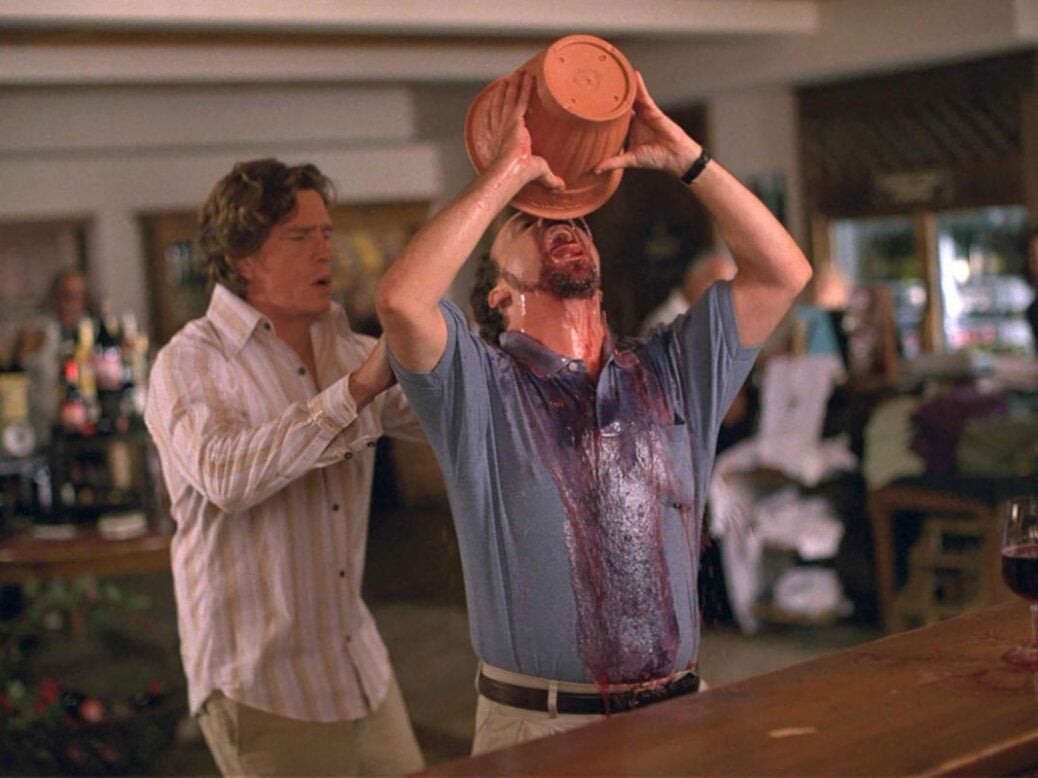
You remember the 2004 film Sideways, right? You know, the one about a chaotic road trip to California’s Santa Barbara wine country. The film where one of the two main characters, Miles (played by Paul Giamatti), has a thing against Merlot and finally gets all hot under the collar about it in a restaurant. ‘No. If anyone orders Merlot, I’m leaving. I am NOT drinking any f*cking Merlot!’
It had quite an impact, that film. It was nominated for five Oscars – winning one for best adapted screenplay – and is acknowledged to have caused an immediate dip in the sales of Merlot-based wines around the world, especially in the United States. Not only that, according to figures from the United States Department of Agriculture, plantings of Merlot vines in the US fell by 35 per cent between 2004 and 2023. By contrast, sales and plantings of Pinot Noir (Miles’s favourite grape) rocketed.
[See also: The best wine advisers]

Despite this so-called Sideways effect, Merlot has long remained king in its European strongholds of Pomerol and Saint-Émilion. Here on the Right Bank of Bordeaux it is responsible, or partly responsible, for such mighty wines as Château Pétrus, Château Angélus, Château Ausone, Le Pin and, of course, Château Cheval Blanc – a bottle of which Merlot-hating Miles knocks back from a paper cup in a diner at the end of the film, despite it being famed as a Cabernet Franc/Merlot blend. I’ve never quite understood that.
Related



Maybe Miles is finally reassessing and appreciating Merlot’s quality and style, moving on from his single-minded Pinot-mania, just as he’s reassessing and appreciating his life and moving on from his troubled past. Whatever the reason, draining a bottle of 1961 Château Cheval Blanc – even from a paper cup – ain’t a bad way to move on.
[See also: Alex Dilling: food so good robots would never understand it]
‘Merlot is truly special when it’s grown on great terroir,’ says Arjen Pen, the Dutch co-owner and winemaker at Château Branas Grand Poujeaux in Moulis-en-Médoc, a tiny commune set between Saint-Julien and Margaux on the Left Bank of Bordeaux. ‘When expressing an exceptional terroir, Merlot reveals a seductive and delicate character, with remarkable roundness and elegance, while simultaneously displaying power, concentration and length.’
And Pen should know. Marpaout, the 100 per cent Merlot he makes at Château BGP, is turning heads around the world as well-heeled wine lovers scramble over the 1,000 or so bottles he made in 2022 (the initial vintage), happily forking out £1,500 a pop. Folk who got in at the beginning should be delighted, for as word has spread, so the price has risen and continues to rise. Marpaout is both a wine lover’s and an investor’s dream.
Content from our partners



[See also: The enticing alchemy of The Macallan’s Sherry Oak single malts]
The Marpaout site sits on what Pen calls the ‘rooftop’ of the so-called Terrace No. 3 (T3) of the Médoc. Here, below four metres of deep gravel, lies a thick layer of blue clay which provides the grapes with the perfect amount of water, even in very hot months. The gravel is also rich in oxidised iron which aids photosynthesis and tannin ripening which, coupled with maturation in both new oak and terracotta amphorae, leads to exceptional complexity and vibrant freshness in the finished wine.
And Pen at Château Branas Grand Poujeaux isn’t the only one in Bordeaux to revel in Merlot’s magic.
[See also: From bold beginnings to global prestige: the legacy of Penfolds Bin 707]
Down the road in Margaux, at Château Lascombes, newly arrived head winemaker Axel Heinz is also showcasing the grape’s qualities. Long celebrated for his tenure at Super Tuscan Ornellaia, where he made the sublime Masseto entirely from Merlot, Heinz is now doing the same with La Côte Lascombes, a single-plot Merlot grown on blue clay, whose inaugural vintage in 2022 coincided with that of Marpaout and which also wowed connoisseurs and critics.
The old saw about Merlot on the Right Bank and Cabernet on the Left Bank is changing. Today, around 40 per cent of vines on the Left Bank are Merlot, and the variety has adapted to global warming better than many people expected. Marpaout and La Côte Lascombes are just two leaders in the charge to showcase Merlot outside its spiritual homes.
And as for that Sideways effect? ‘I think it helped Pinot more than it harmed Merlot,’ says Pen.
2022 Marpaout is available at Hedonism, Armit, Chelsea Vintners and Bordeaux Index for c£1,500 a bottle, and 2022 La Côtes Lascombes is available at Berry Bros & Rudd
This article first appeared in Spear’s Magazine Issue 99. Click here to subscribe