The name of an exclusive Swiss boarding school appears to have been scrubbed from a viral music video, in somewhat mysterious circumstances.
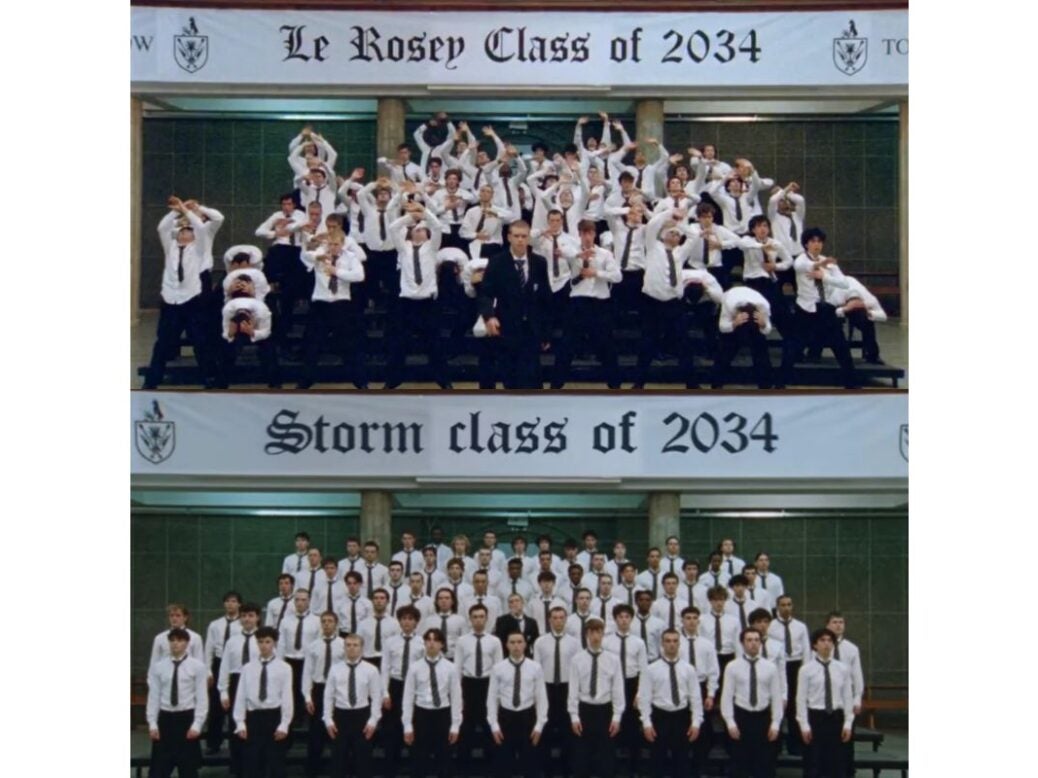
The video, for a track by the Swedish rapper Yung Lean, has attracted 11 million views online in just three weeks, thanks to a striking piece of choreography that features rows of dancers dressed as school students.
The original version of the video also included a banner bearing the name of the ultra-exclusive Swiss boarding school, Le Rosey. The school, which is based in Rolle, on the shores of Lake Geneva, charges annual boarding fees up to $207,200 and is known as ‘the school of kings’ thanks to an illustrious list of alumnae that includes King Albert II of Belgium, the Aga Khan IV and former King Juan Carlos I of Spain. It is also notable for operating from a winter campus in Gstaad from January to March each year, when weekday afternoons are reserved for snowsports.

[See also: Billionaire parents go to war with Le Rosey, the world’s most expensive school]
Related

However, the Le Rosey banner – which read ‘Le Rosey Class of 2034’ – has now disappeared from the version of the video posted on Yung Lean’s YouTube channel. In one scene it has been replaced with a banner that bears the name of the song, ‘Storm’.
The music video is set within a fictionalised boarding school, where Yung Lean appears as a student cast in the role of a bully, engaging in acts such as kicking other pupils’ bags, scrawling graffiti and drawings across the walls, fighting with classmates, smoking, and, at one point, forcing another student’s head into a toilet.
View this post on InstagramContent from our partners



While the video has been widely praised for its cinematic feel, striking visuals and large-scale choreography (with at least one private boarding school in Oxfordshire, Shiplake College even recreating elements of it on TikTok), its references to Le Rosey – and their removal – had previously gone largely unnoticed.
When the change in the video was raised with Le Rosey by Spear’s, the school declined a request to comment. A spokesperson for Yung Lean did not immediately respond to a request for comment.
Thomas Rudkin, a partner at Farrer & Co specialising in reputation and privacy law, told Spear’s that, although the use of the Le Rosey name may have been intended as a ‘tongue-in-cheek’ reference, it could still have raised reputational concerns. ‘Defamation may well be the basis on which it was removed (if indeed the school complained); most likely, it might have been suggested that the video was defamatory in associating the school with an environment rife with bullying,’ he said.
Rudkin added that any legal test would likely hinge on whether the reference could be construed as asserting something factual about the school – something he described as ‘pretty debatable’ in the context of a music video. He added it would be understandable that a production team might choose to ‘de-risk’ the situation if a complaint had been made.
It is possible for creators to make limited edits to videos already uploaded to YouTube without removing them. While the platform does not allow a video file to be fully replaced, creators can use built-in editing tools in YouTube Studio to trim or remove sections after publication, meaning certain content can be taken out without affecting views, comments or the original link.
The video, which functions more like a short film than a traditional music release, is a collaboration between Swedish star Yung Lean and French producer GENER8ION, directed by filmmaker Romain Gavras and was released on YouTube on 24 April.
Running at just over seven minutes and viewed over 11 million times at the time of writing, the video culminates in a large-scale choreographed sequence in which uniformed students move in precise and near-mechanical synchrony around Lean’s largely motionless figure – a clip that has circulated widely online and driven much of the video’s wider reach beyond its core music audience.
The clip prompted some controversy at Cardinal Mercier College in Belgium, where it was shot, with staff reportedly questioning scenes involving violence, smoking and drug use.
Director Gregory De Smet told Belgian magazine The Bulletin that the involvement of established creative figures helped reassure staff during the initial stages of approval, but added that, following the final edit, some scenes were ‘violent’ and ‘not images we want to see associated with a school’.