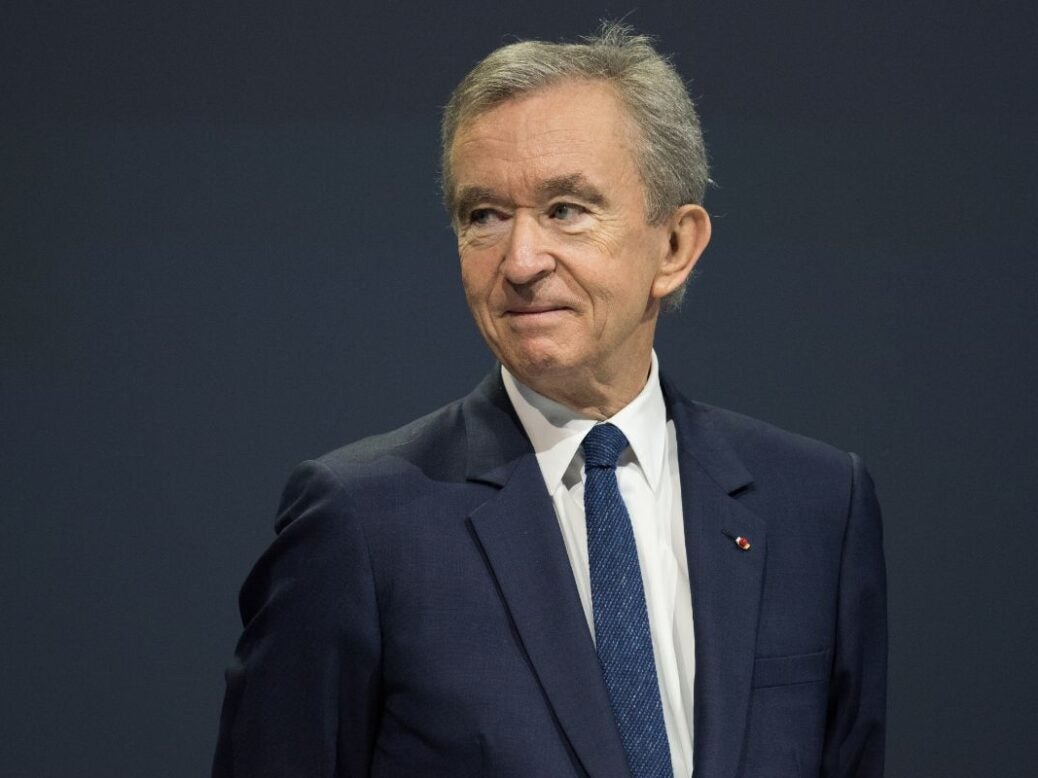
Britain has the Royal Family. La République Française has Les Arnaults. Who’s up and who’s down in the maison of the family which controls Louis Vuitton Moet Hennessy (LVMH), the world’s largest luxury goods group, is a must-follow business psychodrama.
The latest chapter exploded onto the front pages this week, thanks to an unexpected plot twist. Bernard Arnault, the 77-year-old CEO and chairman of LVMH and Europe’s on-off richest man, who for five decades had preferred to let his brands – more than 75 of them, including Dior, Tiffany and Fendi – do the talking, suddenly started talking.
His first ever post on X went viral this week. It was a repost of a three-page letter addressed to leadership at Le Monde – originally shared on the official X account of LVMH’s press office but signed by Arnault.
[See also: LVMH chief Bernard Arnault denies succession ‘rift’]
Related

J’ai été très sensible aux nombreux messages que vous m’avez adressés à la suite de ma lettre ouverte au Monde.
— Bernard Arnault (@BernardArnault) July 27, 2026
Je tenais à vous en remercier toutes et tous, directement et personnellement, ici, sur X.
Merci!
Bernard Arnault https://t.co/DQFSOmut2v pic.twitter.com/hqYcHJj6sV
He was responding to the newspaper’s six-part exposé published earlier this month which covered his business style, political influence, control of media holdings, art patronage, taxation strategies and, in the final piece published last Friday, the succession battle among his five children: Delphine, 51, and Antoine, 49, from his first marriage to Anne Dewavrin, and Alexandre, 34, Frédéric, 31, and Jean, 28, a trio he had with his current wife, Canadian-born concert pianist Hélène Mercier.
Arnault, who enjoyed a net worth of around €200 billion at its peak, rejected the allegations that he had injected ‘poison’ into the group by fostering rivalry among his children. ‘What, in an ordinary family, is called a Sunday is called an intrigue in ours,’ he wrote sarcastically. He also denied claims his children have formed Hunger Games-esque alliances among themselves to compete for succession and that LVMH shareholders are angry at the lack of clear succession planning.
Content from our partners



In his response, Arnault showed a new side to his character. He dropped his ‘Wolf in Cashmere’ persona to indulge in a little humour. He clarified that he does not require visitors to his office on Avenue Montaigne in Paris to remove their ties – if they are made by arch-rival Hermès. Rather, guests are offered ‘a second, more discreet tie for the elevator ride’. Addressing the observation that all LVMH staff appear slim and trim, he promised to ‘take the matter up with the company cafeteria on Monday’.
There is another delicious detail in the saga. Bernard Arnault’s ‘son in law’ Xavier Niel, long-term partner of Delphine, is a key figure at Le Monde. The billionaire boss of French telecom carrier Iliad SA part-owned the title before transferring his stake to a non-profit, the Fund for Press Independence, in 2024 but he still serves on the board.
[See also: What the Murdoch succession saga teaches elite families about wealth and power]
Fans of Succession have been quick to point out that Niel is the Tom Wambsgans of this drama. For non-fans, Wambsgans, played by Matthew McFadden, married Shiv Roy, the daughter of Logan Roy in the hit TV series about the media mogul who plays his four children against each other as he and they run the company. Wambsgans flits between loyalty to Logan, to plotting against him, and back again.

It’s tempting to enjoy the saga as simply the latest installment of palais intrigue but there is much at stake. Bernard Arnault has spent a lifetime creating Europe’s most valuable company – with a market capitalisation exceeding €400 billion at its peak.
He has consolidated his position at the top. In 2022 shareholders approved raising the mandatory retirement age for the chief executive and chairman to 80, from 75. In 2025 it got bumped again to 85. At the most recent shareholders meeting, Arnault reportedly assured stakeholders that the succession question could wait another ‘seven or eight years’.
But, at 77, anything can happen, and it can happen fast – as a sign in LVMH’s headquarters reminds senior executives. ‘We don’t have the luxury of waiting,’ it flashes.
[See also: Family dynamics pose greatest threat to succession plans]
Like many of the rich and powerful, Arnault seems intent on staving off this inevitability. He is obsessed with the pursuit of longevity, meticulous about his physical health and rumoured to keep a room reserved at the American Hospital in Neuilly-sur-Seine at all times according to the first Le Monde installment.
Whether he likes it or not – and in spite of his denials that it is an issue at all – the time is coming when Arnault will have to give way to the next generation. He will be keen to avoid the messy succession planning of another great patriarch of fashion, Giorgio Armani, who died last year, and whose will is so complicated – with instructions to sell portions of the business to various parties by various deadlines – that family members and board members are struggling to work out how to honour his wishes.
What do this week’s events mean for the future of LVMH, which, by a neat coincidence, is in the running to buy the Giorgio Armani brand?
[See also: The best generational wealth and family business advisers in 2026]
First, they signal that Arnault’s policy of using his thick skin to ignore bad press is over. He has followed the lead set by the likes of Elon Musk and Nvidia chief Jensen Huang and is trying to use social media to bypass traditional news outlets and speak directly to shareholders and customers. Shortly before the Le Monde investigation, he appeared on the podcast of Guillaume Pley, a YouTuber turned mainstream media personality, to discuss his life and business empire – for 1 hour and 41 minutes.
The reason for the shift is not hard to divine. Arnault wrote a memo to managers of his brands last year banning them from speaking to journalists at seven news publications: La Lettre, Puck, Miss Tweed, L’Informé, Mediapart, Le Canard Enchaîné and Glitz.paris. ‘I formally condemn… giving them information or comments,’ Arnault wrote.
These titles are a new breed of scrappy news websites across Europe and the US that are roiling the big luxury and fashion houses and wealthy business dynasties by reporting more independently on the industry than many larger, better known outlets. Suing these upstart startups risks a damaging David vs Goliath battle. Far better, Arnault has concluded, to go over their heads and the heads of established titles, such as Le Monde, to get his message across. It will be fascinating to see whether his younger, digitally native children do the same.
In his social media post Arnault said people betting on cracks to appear in his family will wait for a long time. He’s probably right – at least on a structural level.
In 2022, the Arnault family’s holding company, Agache, was transformed into a limited partnership, with Bernard Arnault as managing partner and the share capital held equally between his children. Each has a 20 per cent stake, and they cannot sell their shares for 30 years without unanimous board approval. No new partner in the company can be admitted from outside one of the five bloodlines for 30 years.
The Arnault family now owns just over 50 per cent of LVMH’s share capital and has almost 66 per cent of the voting rights, effectively guaranteeing long-term family control and making a hostile takeover all but impossible.
[See also: What family office principals can learn from Bill Ackman’s social media drama]
But that does not mean there won’t be vigorous debates on the future of the group which may leak to the press. Luxury is in a funk, roiled by war, tariffs, a slow down in demand in China and price increases which many consumers condemn as ‘gouging’.
On Monday, LVMH released its first-half 2026 earnings. The fashion and leather goods division, the group’s biggest and most profitable, grew by a meagre 1 per cent in the second quarter. Shares in LVMH have had their worst start to a year on record due to the impact of war. The stock fell 28 per cent in the first quarter. Sources close to the Arnault family say the return to growth in fashion and leather goods after seven consecutive quarters of falls, shows the company has turned a corner. The markets are less sure.
One thing is certain. LVMH needs a new direction and the questions are: what should it be and who is best to provide it? Arnault Snr? Or one or two or all of the Arnaults Jnrs? Perhaps @BernardArnault will enlighten us on X.