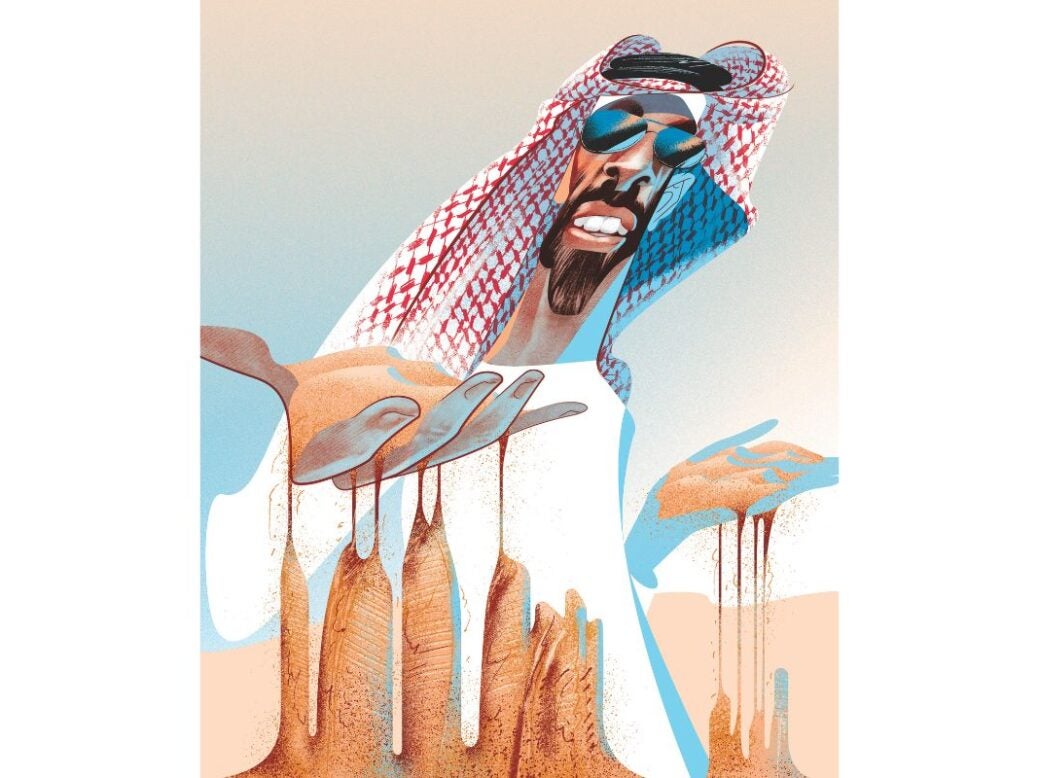
Bigger than McDonald’s. More valuable than Toyota. Closing in fast on Chevron. Yet outside Arab Gulf financial circles, the International Holding Company (IHC), Abu Dhabi’s biggest conglomerate, remained almost invisible to the broader world — until last week.
On Saturday, the company made headlines when it acquired a majority stake in Richard Caring’s hospitality empire. The deal values the portfolio of hospitality assets at around £1.4billion and gives the IHC control over some of Britain’s best-known restaurants and private members’ clubs, from The Ivy to Annabel’s and Scott’s. Caring, who made his first fortune in textiles and segued into high-end hospitality, has been called ‘the king of Mayfair’, but his carefully collected crown jewels are now in the possession of the man who controls the IHC, Sheikh Tahnoun bin Zayed Al-Nahyan.
The scale of the business he oversees was already staggering. Between 2019 and 2023, the IHC’s share price surged by 42,000 per cent, while its total asset base grew from $200 million to $72 billion. Now commanding a market capitalisation approaching a trillion dirhams ($275 billion), the company represents close to half of the Abu Dhabi Securities Exchange’s benchmark index – a concentration without parallel among listed equities anywhere in the world. Yet this colossus was not born in Silicon Valley or fuelled by a commodity supercycle. It began with fish.

In 1998, the UAE struck a deal to purchase French Mirage fighter jets. Under offset obligations, French defence contractors invested in Abu Dhabi’s civilian economy. The result was Asmak, an aquaculture venture addressing food security. From that modest starting point would emerge one of the most remarkable business metamorphoses in modern history: a global empire spanning technology, healthcare, mining, finance, infrastructure and real estate, employing more than 125,000 people across five continents.
Related

[See also: Abu Dhabi’s ‘first home-grown hedge fund’ targets multi-billion AuM in three years]
The transformation from fish farm to financial colossus is not just a corporate transformation, however. It is also the story of Abu Dhabi’s race to reinvent itself before the energy transition renders oil revenues obsolete.
To understand the IHC’s emergence, you need to understand Sheikh Tahnoun, the company’s chairman and arguably the most powerful figure in Gulf business today.
What distinguishes him from the typical sovereign-fund grandee is how much of his life was forged outside corporate deal-making. Born in 1968 as a younger brother of Abu Dhabi’s current ruler (and the UAE’s current president) Sheikh Mohamed bin Zayed Al Nahyan, he first entered public life in 1996 as director of his father Sheikh Zayed’s private department – an apprenticeship in governance that gave him direct access to the mechanics of statecraft.
Content from our partners



[See also: Abu Dhabi’s super-prime market: culture and lifestyle fuel rise as a global powerhouse]
His subsequent ascent through the UAE’s security architecture allowed him to accrue power and influence. When he was appointed national security adviser in 2016, Sheikh Tahnoun brought a holistic approach to national security – including food security, energy independence and technological sovereignty alongside conventional military deterrence. That work is now being put to the test, with the Iran war having placed his office under the spotlight.
Alongside his security role, Sheikh Tahnoun was also building one of the Gulf’s largest private conglomerates. The Royal Group – assembled from construction and real estate beginnings in the Nineties – had by 2014 grown into a sprawling enterprise generating more than $8 billion annually across more than 60 subsidiaries. His tenure at the helm of First Abu Dhabi Bank (now the UAE’s largest lender) further cemented his credentials as a financial architect.
[See also: Who are the UAE Royal Families?]
More recently, his March 2023 appointment as chairman of the Abu Dhabi Investment Authority – placing him atop one of the world’s most influential sovereign wealth funds – and his caretaker leadership of ADQ (the Abu Dhabi Developmental Holding Company, a sovereign wealth fund that was folded into yet another, L’imad, in January) have given him command over a constellation of sovereign capital exceeding $1.5 trillion in combined assets. The IHC is, in this sense, the crown jewel of a far larger empire.
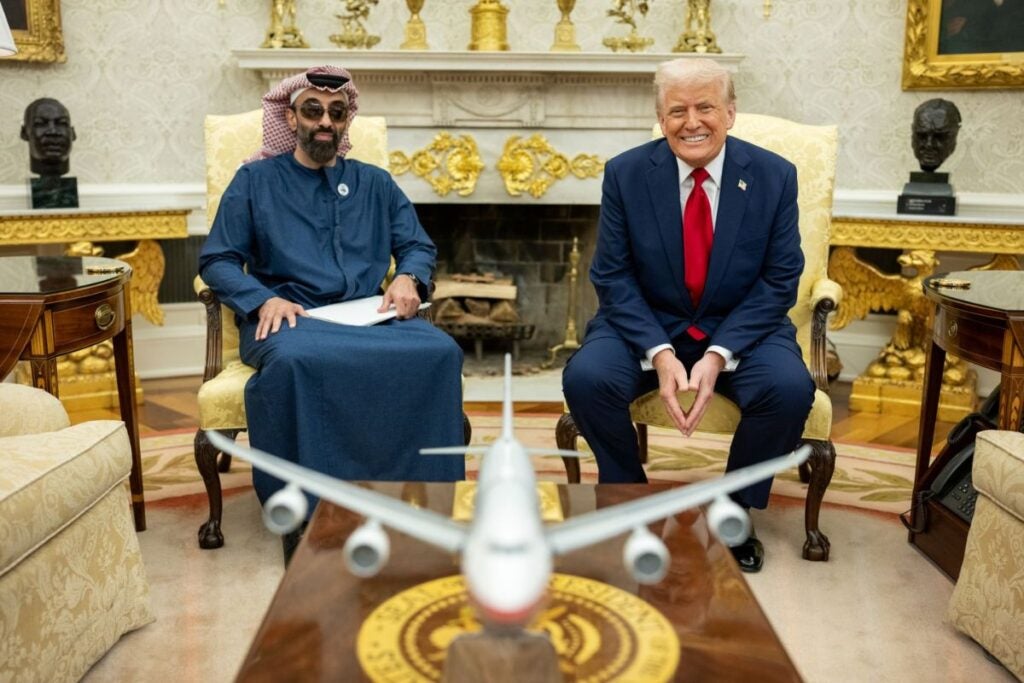
This matters because it explains the IHC’s singular competitive advantage: the intelligence premium. Sheikh Tahnoun’s simultaneous oversight of the UAE’s security apparatus, its sovereign wealth architecture and its largest listed conglomerate means that geopolitical risk assessments, diplomatic intelligence and market information flow through a single decision-making centre. Critics raise governance questions about conflicts of interest; admirers note extraordinary returns. Both have a point.
The IHC’s explosive transformation began in earnest after 2014, when Sheikh Tahnoun initiated an audacious consolidation of his Royal Group assets into the IHC, often at the nominal price of one dirham per company. The strategy recognised that in a relationship-based economy, access to the IHC ecosystem was worth far more to sellers than any immediate financial return from a conventional sale. Moreover, the IHC avoided tying up its balance sheet in large upfront payments, freeing funds to pursue its broader strategic acquisition agenda.
[See also: King Charles’ alma mater expands – school that shaped royals arrives in UAE]
The appointment of Syed Basar Shueb as group CEO in July 2019 turbocharged execution. An engineer, Shueb brought a meritocratic, operationally disciplined ethos to what could easily have become ungovernable. He has ambitious plans – last autumn he told the Financial Times he intends to spend ‘$36 billion every 18 months’ and is content to ‘go to the grave increasing the size of this company’.
The most strategically consequential chapter of Sheikh Tahnoun’s IHC reign involves technology subsidiary Group 42 (G42) – and a breathtaking geopolitical tightrope walk. G42 initially embraced Chinese partnerships enthusiastically, leveraging Chinese tech transfer and supercomputing infrastructure, and even acquiring a $100 million stake in TikTok owner ByteDance. The Covid-19 pandemic briefly accelerated this relationship, with G42 partnering on Chinese Sinopharm vaccine trials and deploying the UAE’s largest testing laboratory.
But as Washington’s alarm over Chinese tech access to Gulf infrastructure grew, Sheikh Tahnoun pivoted quickly and decisively. G42 sold its Chinese stakes, severed its ByteDance position and reoriented entirely toward Western alignment – culminating in landmark partnerships with Microsoft and participation in the Stargate AI infrastructure project. The new MGX Fund formalised this repositioning, evolving into a global AI investment platform bridging US tech with the markets of the Global South.
[See also: Most expensive Abu Dhabi home sells for $109m as emirate’s luxury market booms]
The pivot, however, was not born from the desire to bow to US pressure. It reflected sophisticated calculation: Abu Dhabi’s longterm interests lay in remaining indispensable to both superpowers rather than captive to either. By demonstrating credible Western alignment on technology while maintaining deep economic ties with Chinese partners through other channels, the IHC – and Abu Dhabi itself – preserved the strategic autonomy that is the hallmark of Sheikh Tahnoun’s entire approach.
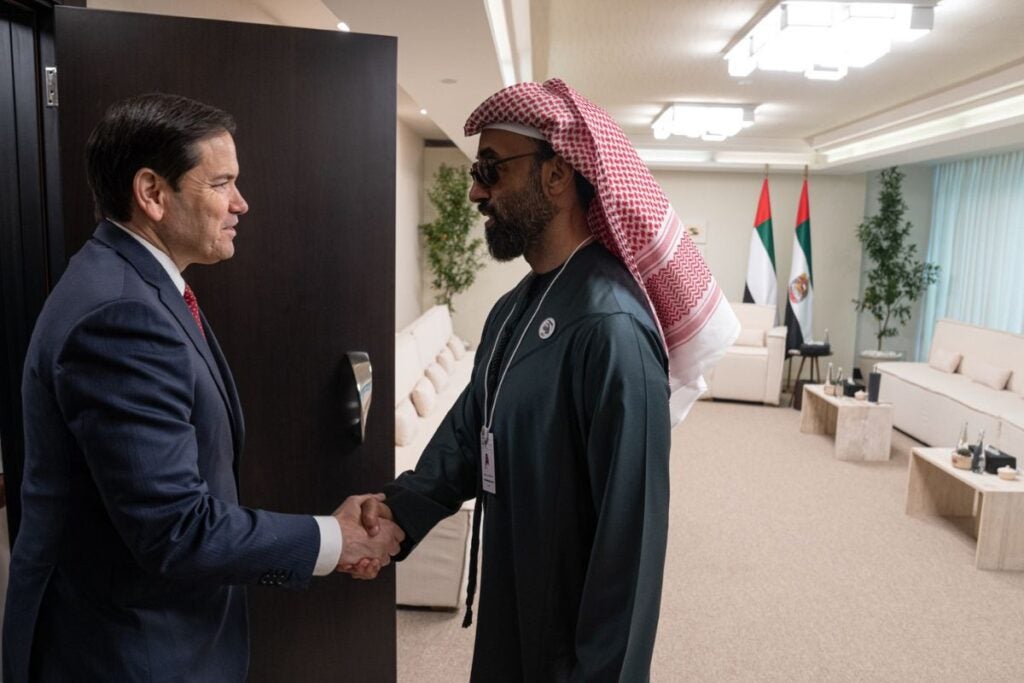
The IHC’s rise is an eloquent argument for the effectiveness of ‘sovereign capitalism’ – a model that blends East Asian developmental-state logic with the concentrated personal authority of what I call ‘advanced sultanism’. Unlike the thoughtless extractionism of despots or the quarterly-earnings myopia of listed companies in the West, this model deploys personalised control structures with rational long-term planning, enabling resource mobilisation at speeds and scales that democratic systems cannot match.
[See also: Why is Sotheby’s cosying up to Abu Dhabi’s elite?]
The one-dirham acquisition strategy, the seamless interplay between the IHC, ADQ, and other sovereign wealth funds and the ability to recalibrate G42 from Beijing to Washington in months – none of this would be possible under conventional governance.
The IHC’s global footprint now stretches from the Zambian Copperbelt to India’s renewable energy sector; from Greek hospitals to Rajasthan’s 60-gigawatt solar ambitions; from Serbian ski resorts to the stablecoin laboratories of the Abu Dhabi Global Market financial centre.
The IHC owes a great deal to the strategic vision of one man, but its story – and my new book, which sets it out – is about much more than him, and much more than the emirate of Abu Dhabi. Because the success the IHC engenders is an eloquent argument against the assumption that sophisticated economic development requires Western-style organisation. In an increasingly multipolar and geopolitically fragmented world, Sheikh Tahnoun’s sovereign capitalist model is proof that liberal capitalism has a formidable new competitor.
Abu Dhabi’s IHC: The Biggest Company You’ve Never Even Heard Of by Christopher M. Davidson (C Hurst & Co, £35) will be out in June 2026.
This article first appeared in Spear’s Magazine Issue 99. Click here to subscribe