The world is getting warmer. The past 10 years have been the warmest 10 years since records began, according to NASA data. And there is mounting evidence that climate change is having an effect on snowfall patterns too, with supplies of the white stuff being less abundant and less regular. In North America, 64 per cent of ski stations recorded less snowfall in 2023 than they did in the early 1970s, according to Climate Central analysis of snowfall in 2,041 locations.
For powderhounds (that’s skiers to you and me), this shortage alone would be something of a bummer. But when you consider that 2022/23 and 2024/25 were also the two busiest ski seasons in the US on record (2022/23 holds the top spot with nearly 65 million visitors, according to the US National Ski Areas Association), the dearth of good quality snow, and space to enjoy it in, becomes even more worrying.

The rich and famous aren’t keen on overcrowding at the best of times, so it’s little surprise that efforts to create VIP skiing experiences have stepped up a gear. As of 2025, several ski resorts have been privatised in North America. Three of them – the Yellowstone Club in Montana and Wasatch Peaks Ranch and Powder Haven, both in Utah – operate as private clubs where prospective members must purchase real estate.

[See also: Uncertainty around snowfall – the best ski resorts to buy property in]
Related
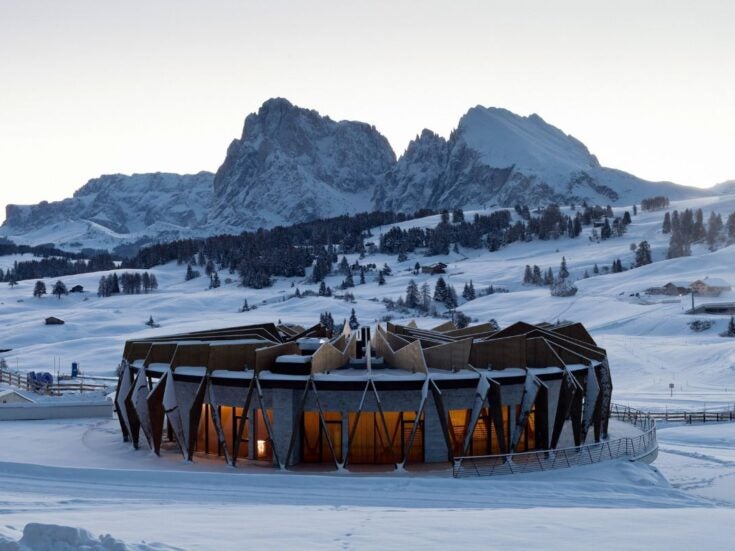
The Yellowstone Club reportedly charges an initial fee of £300,000 and annual dues of more than £30,000. That’s in addition to the mandatory property purchase that will set you back at least £3 million, though it could easily be considerably more. Mark Zuckerberg, Bill Gates and Justin Timberlake are reportedly among the club’s members.

A few hundred miles south lies Wasatch Peaks Ranch, which is still in development. Bare lots of land (where one can build one’s own lodge) are priced at around $10 million, membership is $500,000, and there is the opportunity to acquire an equity stake, for those who are happy to invest at least $5 million.

But money alone is not enough to access this snowy seventh heaven, which boasts 70 miles of slopes, high-speed ski lifts, a luxurious mountain village and a golf course for the warmer months. There is said to be an ultra-rigorous vetting process and restrictions on the publication of photos or GPS data of any on-mountain activity.
Access to private slopes like these offers the promise of privileged access to fresh powder, empty lifts and, like any good club, a strong sense of community. The owner of Powder Haven, Netflix co-founder Reed Hastings, tells Spear’s that he thinks of it ‘more as a golf club than a private resort’.
Content from our partners


[See also: Heading for the hills: Is Andermatt the new St Moritz?]
The billionaire had been a longtime visitor to Park City, the nearby resort that has been visited by the likes of Taylor Swift and the Kardashians. ‘But it got more and more crowded,’ he explains. ‘And of course, you want your family time to be magical, so I visited Powder Mountain and I thought, “This could be magical.”’
Hastings purchased Powder Mountain in 2023 by investing $100 million to secure a controlling stake in the resort, wiping out the debt it had accumulated. Powder Mountain officially opened as a ski resort in 1972 and now ranks among North America’s largest, with more than 8,000 skiable acres (it is around 12,000 acres in total size), more than 160 named runs, and more than 360 inches of average annual snowfall – almost double the natural snow that Aspen receives.

When Hastings gained majority ownership of the area, he decided to keep a part of the mountain public while turning the rest of the resort into Powder Haven, the latest ultra-exclusive residential ski club to open in the US. This private part of the mountain – which accounts for 2,700 of Powder Mountain’s skiable acres – is now accessible only to those who have purchased a multi-million-dollar lodge or empty lot in the Haven. Most of the five neighbourhoods that make up the private resort offer empty plots starting at $2 million, but one of them features modern townhouses (each 3,700 square feet with four ensuite bedrooms). These turnkey properties will be available from April 2026.
The private area also boasts restaurants and clubhouses, while the main 73,000 sq ft members’ lodge is set to open in 2027 and will offer amenities such as a premium gym, spa treatment rooms and thermal pools.
To become one of the 650 member families, the joining fee is understood to be around $200,000, with an additional fee of between $30,000 and $100,000 due annually.
However, Powder Mountain’s half-public, half-private business model – which Hastings says ‘no one else has ever figured out how to do’ before – has not been met with universal acclaim. The news of his acquisition of the resort saw him christened ‘Greed Hastings’ on the internet, amid local concern that much of a mountain once accessible to the wider community would now be reserved for just a few hundred elite guests.

‘There are two ways to look at it,’ Hastings says now. ‘One is that we are taking something away; the other is that we are giving back.’ He says he has put money into the public side of the mountain, using revenue generated by the private area to help fund those investments. This, he argues, has provided new lifts and facilities for an area that had long suffered from underinvestment and ageing infrastructure.
Perhaps the appeal of having access to one’s very own peaks and powder is obvious, but the setup on Powder Mountain tends to attract a specific type of wealthy person, Hastings says. And it’s not who the naysayers might like you to think.

‘It is not “luxury” in the classic sense,’ he says. ‘Of course, it is beautiful and safe, but it is not Aspen.’ By this he means Powder Mountain focuses on offering a ‘snowy and wild’ ski experience, rather than majoring on the retail therapy and other high-end lifestyle activities typical of the Colorado resort. For Hastings, private skiing adds ‘purity’ to the experience. ‘Powder Haven attracts rugged, adventurous people,’ he notes.
So far, these figurative velvet ropes have only been installed around North American mountains. And Jeremy Rollason, head of the ski department at property firm Savills, reckons the same model ‘just wouldn’t happen’ on this side of the Atlantic.

Egypt’s richest man, Samih Sawiris, controls much of the Swiss resort of Andermatt via his property development firm Orascom, which has struck various deals with the Swiss government. ‘In Europe, this is the closest it could get to a private individual purchasing a whole resort,’ says Rollason.
As things stand, there are often rules in place to restrict foreign buyers in Europe from even purchasing a single property – let alone a whole ski area. ‘There is a slight misconception from US buyers that they can just come and buy property in the same way it is possible for them to go and buy a slice of Utah,’ Rollason says. ‘In Switzerland or France, selling a ski resort to a billionaire would be like selling the crown jewels.’
In France, the majority of lifts are operated by some form of government body, and are often state-owned too. This makes it ‘inconceivable’ for them to be sold privately, Rollason says. In other countries like Switzerland or Austria, the land is usually owned by the state or the canton. Private acquisitions of resorts therefore wouldn’t involve the mountain itself, but rather the lift infrastructure and the rights to operate resorts.

While, so far, there are just three private ski resorts that require a real estate purchase as a condition of membership (all in the US), there are already around half a dozen places across North America that have privatised snow, such as Vermont’s Hermitage Club, where the initiation fee is $100,000 and annual dues run around $20,000. But the concept could become more popular.
Hastings is clear that he is focused on Powder Mountain, 5,000 miles away from Mont Blanc, but he’s not so convinced that the model he’s pioneering could never reach Europe. ‘I wouldn’t say never,’ he says. After all, he’s used to shaking up industries.