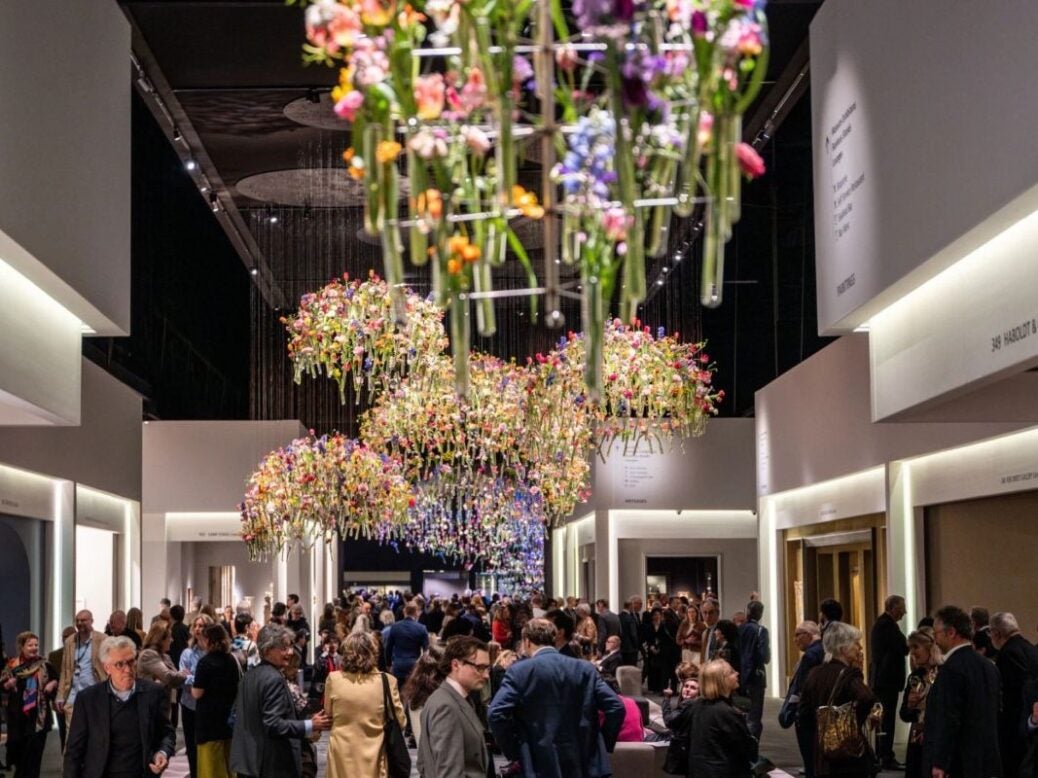
Last week, windows in Maastricht’s cobble-stoned city centre were pasted with stickers that read ‘Maastricht Embraces TEFAF’. Flags emblazoned with the same acronym also waved in front of the colourful brick buildings across the narrow streets. The visual outpouring was to celebrate the return of what is considered as the world’s largest fair dedicated to art, design, antiques, furniture, and jewellery. The European Fine Art Foundation (TEFAF) first began staging its fair in the southern Dutch city 39 years ago to provide a one-stop-shop for broadly diverse relics of human creativity made across a span of 7,000 years.
This year’s eight-day edition (which ran 14-19 March) once again occupied the gargantuan Maastricht Exhibition & Congress Centre (MECC), where medieval armour and Ming Dynasty plates were displayed on adjacent stands. A few aisles away, a Tracey Emin bronze sculpture stood near to a stand showing Brazilian modernist furniture. Old Masters appeared in abundance and ancient manuscripts, along with rare gem-studded jewellery, rubbed shoulders with Greco-Roman busts. Like previous years, the aesthetic potpourri of 2026’s TEFAF drew in many of the art world’s most-informed and top collectors to the medieval city. The lure? The ability to roam between centuries, geographies and artistic mediums, all with exquisite quality offerings, under one single roof.
‘It is important for us to have the best 17th century clock dealer and the best of the medieval glass dealers present,’ said TEFAF’s head of fairs Will Korner. Beyond the spectacle, the fair is Maastricht’s foremost global brand. In 2025, the show generated a direct annual economic impact of €32.3 million on its 126,000 local residents as well as a total financial contribution of €86.4 million to the Dutch economy.

[See also: The best art advisers]
Related
The 2026 iteration, which wrapped on 19th March, featured around 15,000 objects spread across stands run by 277 exhibitors — almost all of whom return every year and often claim the very same spot. The British contemporary art powerhouse White Cube always positions itself immediately at the main entrance, opposite from the Parisian antiques tastemaker, Galerie Kugel. White Cube’s associate director, Ben Hoare, cherishes the chronological overlap which helps his gallery to ‘situate significant modern and contemporary art within the wider continuum of 7,000 years of art history and visual culture’. Despite its reputation to exhibit the most cutting-edge at Frieze or Art Basel, the gallery often shifts its focus to mid-20th century period for this participation, such as this year’s 1962-dated Josef Albers painting, Homage to the Square.
The object expected to fetch the highest price was in fact priceless. Christ as Salvator Mundi, on view at Agnew Gallery’s stand, had its value left open to receive different offers. The oil on walnut panel painting, which was formerly in France’s de Ganay family collection, is believed to come from Leonardo da Vinci’s studio and dates back to 1505-1515. Mayfair’s Alon Zaikim gallery made eight figures with a €20 million deal on a pair of Claude Monet oil paintings, depicting the same view in Vernon in 1894 during different seasons. Another British dealer, David Aaron, stood out with the £450,000 sale of a 375-350 B.C. grave monument, titled Stele of Medeia, to an undisclosed American institution. An Egyptian granite vase from the first century AD, which was made for the Roman emperor Nero, was sold to another US museum for roughly £1.8 million by Stuart Lochhead Sculpture, another Mayfair dealer.
With high stakes come high responsibilities. The organizers each year host over 200 international museum professionals who vet each artwork on the fair grounds. A few days before the VIP preview, dealers exit their stands to let the experts examine each object for authenticity – importantly before their million-pound price tags are seen. The experts even use, if need be, a digital authentication machine borrowed from Amsterdam’s Rijskmuseum. The positive response to this year’s fair showed that they did their homework. Collector attendance grew by five per cent and visits made by representatives from around 450 global arts institutions grew by ten per cent. Between the aisles, Prince Constantijn of the Netherlands was among the attendees, as well as world-renowned museum directors, such as Max Hollein, of the Metropolitan Museum of Art in New York City, and Tristram Hunt from London’s Victoria and Albert Museum.
[See also: Art Basel CEO shows careful confidence in global art market]
Content from our partners


The fair’s main promise to its exhibitors is a distinctively diverse and eager-to-buy audience from international museums and an especially educated collector base. Ben Hunter, another London dealer whose eponymous Duke Street gallery specializes in modern and contemporary British art, enjoys encountering buyers who are ‘very focused on their conversations and their acquisitions’. The dealer, who shared his booth with his western art expert colleague Paul Coulon, returned to the fair to be able to showcase his material within its uniquely diverse setting: ‘The quality is higher than that of any other fair in the world, in terms of being able to see works of art from the Renaissance period and before, all the way to the present day.’
This year saw an overall attendance of roughly 50,000 guests, including 67 museum patron groups. What this non-profit giant of art fairs does so right is demonstrate its assurance of authenticity and quality across all the ingenious works shown, yet not at the expense of a generous dash of dazzlement. Fresh flowers, theatrically arranged each year, dress the building’s soaring entrance and usher guests into the aisles. Once inside, champagne is popped and oyster are shucked, carrying on the extravagance. For some, the real show is in the ways exhibitors push the limits of assembling a temporary hut. From a mini Swiss chalet to a Rococo palace and even a Zen sanctuary, dealers strive to make their display stand out without competing with their neighbours too much.
Beyond a show-stopper bonanza, TEFAF delivers informed transactions. From the most personal heirloom to an accidentally unearthed gem, the objects change hands within a nuanced context, supported by academic knowledge and market literacy. Initiatives such as the Curator Course, TEFAF Summit, and Museum Restoration Fund germinate educated discussions during the fair’s run and beyond.
On the cusp of the Great Wealth Transfer, the organization testifies for the critical role of the dealer. Korner trusts in the enduring position of the expert facilitator amid this worldwide transfer of wealth: ‘The dealer was at the beginning of a collection and perhaps will be there when the moment to close it comes.’ An underlining goal of the fair is to educate today’s emerging collectors towards the future. Laying out the program’s selection of approachable and adventurous finds is TEFAF’s app, named The Insider’s Collecting Guide, which is part cheat sheet, part secret map.
Today’s taste for restitution within the arts is keenly observed by the fair. Nowadays, a woman sculptor or a painter of colour born three hundred years ago is likely to enter a lauded museum’s collection with a fair placement and ‘get their time in the limelight’ says Korner. Take, for example, the Dallas-based dealer Gallery 19C’s sale of the French artist Virginie Demont-Breton’s 1887-89 painting L’homme est en mer to the Van Gogh Museum, at a range between €500,000 and €900,000). The acquisition made the painting, which Demont-Breton originally made for the Salon in Paris in 1889, the third artwork made by a woman in the Amsterdam museum’s collection.
[See also: Art market shows signs of recovery after sales slump]