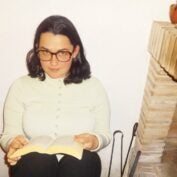
Countess Albina du Boisrouvray may have racked up over six million likes on TikTok, where she can be seen talking about her humanitarian work and speaking Arabic in front of far-right French leader Jean-Marie Le Pen to challenge his views. But the 86-year-old is not a typical social media influencer.
As the granddaughter of Bolivian tin magnate Simón Patiño, who was among the wealthiest men in the world during World War II, and daughter of Count Guy du Boisrouvray, she grew up in an aristocratic family.
But when her only son – François-Xavier Bagnoud, a helicopter rescue pilot – died during a mission in Mali in 1986, she chose to channel her grief into philanthropy.

[See also: Rothschild heir: ‘We have to start seeing philanthropy not just as charity, but as a legacy’]
The heiress sold three-quarters of her inheritance, raising around $100 million for charitable causes. Ever since, she tells Spear’s, she has always kept ‘one foot in silk and one foot in mud’, balancing her philanthropic work with her enduring ties to high society – she is, after all, the godmother of Charlotte Casiraghi, daughter of Princess Caroline of Monaco.
Related

@albinaduboisrouvray Three years ago, I shared my story in French through Le Courage de Vivre. The messages I received moved me deeply — so many of you told me how this story resonated with your own lives. I am grateful that today, this story can continue its journey in English, with Phoenix Rising, out on November 6. My publisher has kindly created the code PHOENIX10 for this community – for those who wish to pre-order the book. 📚 #PhoenixRising #Memoir #NewBook #AlbinaDuBoisrouvray #NomadPublishing ♬ Instrumental like background(839728) – Single Cirquit
She recounts her journey from the halls of New York’s Plaza Hotel to the barricaded streets of Paris in May 1968, and from Ugandan villages to the corridors of Davos, in her new memoir, Phoenix Rising, published this week in the UK.
The book describes how du Boisrouvray devoted her life to making a difference to others, but also faced disillusionment when she came to believe the world of humanitarianism was ‘as disgusting as the political world’.
[See also: Water charity CEO on swapping hedonism for humanity]
When we meet at Browns Hotel in Mayfair, she is elegantly dressed and speaks with an easy, open, and warm manner.
Content from our partners



Not long after the tragedy, du Boisrouvray received a phone call from her close friend Bernard Kouchner, the co-founder of Médecins Sans Frontières, who suggested she should join him on a humanitarian food mission during the Lebanese civil war.
Du Boisrouvray says the pain she felt when her son died made her feel like she didn’t ‘exist’ anymore. ‘So I thought the only thing I could do was start existing for others.’
[See also: Sainsbury’s heir: hitting rich people with a stick doesn’t work]
‘That first experience in Lebanon pulled me out of inexistence,’ she says now. ‘I felt solidarity with the rest of the world that was suffering, and felt close to Francois-Xavier’s passion for rescuing people.’
The experience marked the start of years spent moving between places where she could make a difference. It is also what prompted her to auction off jewellery, art and property from her inheritance, raising around $100 million to fund her humanitarian work.
In 1989, three years after her son’s death, du Boisrouvray founded the FXB Foundation, named after him, to promote human rights and public health across the world.
[See also: How the next generation of donors – and advisers – can shape the future of philanthropy]
The foundation established a university centre in his name at Harvard, as well as branches in Switzerland’s Valais, where he was born, and in Paris, where he grew up. Over three decades, FXB helped some 20 million people in more than 20 countries. In 2019, the original foundation was dissolved, with its work continuing through a new entity, the FXB Global, which remains active today.

Perhaps the most notable achievement of FXB has been the development of the FXBVillage model, which du Boisrouvray describes as a ‘revolution’ in humanitarian aid. First piloted in Uganda in 1991, the method was praised by former UN secretary-general Kofi Annan, who, in 2002, recognised FXB programs for their ability to enable orphans and children, ‘to benefit from the right to access education and grow up in safety.’
At the time, du Boisrouvray says, the dominant approach was the ‘microcredit’ model pioneered by Nobel Prize-winning Bangladeshi economist Muhammad Yunus, which offered small loans to people in poverty so they could start small businesses and repay the funds over time.
[See also: DKMS chairwoman Katharina Harf on her mother’s legacy and 12 million donors]
But du Boisrouvray saw that the AIDS crisis required a response adapted to the needs of people who might not have been able to repay any loan. Instead, her model provided families with the resources needed to start their own income-generating activities outright, to enable people to get out of extreme poverty.
‘Our idea is to let people become actors of their own economy and proud owners of their own business,’ du Boisrouvray explains. In its first year, each FXBVillage helps families to set up businesses and provides access to essential services. Over the next three years, support for nutrition, education and healthcare is gradually reduced, with the goal of helping them achieve economic self-sufficiency by the fourth year.
According to FXB, 86 per cent of participating families have been lifted out of extreme poverty, and remain so four years after the programme ends.
[See also: James Reed: Why entrepreneurs should make philanthropy part of their company’s DNA]
However, the FXBVillage model was not without its critics. ‘People kept saying I should just do microcredit. But then I met Muhammad Yunus, and he told me “go on doing what you are doing”’, du Boisrouvray recalls. Yunus has described du Boisrouvary as ‘one of the most inspiring people I have ever known’.
‘So the father of microcredit approved my transgression,’ she says with a laugh. ‘I definitely couldn’t stop then.’
According to du Boisrouvray, major organisations such as the World Bank and BRAC have since copied her approach, without, she claims, giving her any credit.
‘Everybody went to bed with my methodology,’ she says. ‘Of course, I think it’s great that the programme can be applied to scale and to help more people, but it makes me furious that they copied it without ever crediting my son’s name.’

She cites the Nobel Prize awarded to Esther Duflo in 2019 for her ‘experimental approach to alleviating global poverty’ as an example of this appropriation. ‘They said [my methodology] was their invention, but it is untrue,’ she insists. Du Boisrouvray did, however, receive recognition for her contributions, being named Officier de la Légion d’Honneur, France’s highest national order of merit.
‘This made me realise that the humanitarian world is as disgusting as the political world. It is made of treason, unloyalty, stealing and wrongdoings. And it might be even worse, because it is made of people who are supposed to promote good values.’
[See also: How philanthropy can unlock new opportunities for UHNW advisers]
Her frustration fills an entire chapter of the book, which she says she sees as a way to ‘set the record straight with the humanitarian world, and reclaim my story.’
@itsalbinaduboisrouvray My favorite era 🥰 #foreveryoung ♬ Forever Young – Alphaville
‘This book is a story of resilience,’ she now tells her more than 145,000 TikTok followers on her account. Other videos feature trends, flashbacks to her youth, explainers on philanthropy, and little anecdotes drawn from her many lives.
[See also: Super-rich are giving away more of their money than ever before]
Asked why TikTok is important to her, she says she ‘loves this young generation,’ describing the people she meets as ‘friendlier, funnier and braver’ than most of her peers.
‘I always read the comments and I feel very touched,’ she adds. ‘And then I remember how important it is. When you are young, you pledge solidarity; when you are older and in a position such as mine, you have to be faithful to your principles.’
She remains committed to rescuing others, but this time, her memoir is also a story of how she rescued herself.
Already released in du Boisrouvray’s native France in 2023, Phoenix Rising: A Woman’s Story of Love, Loss & the Will to Change the World will be out on November 6 in UK bookstores. (Nomad Publishing, £27.50)