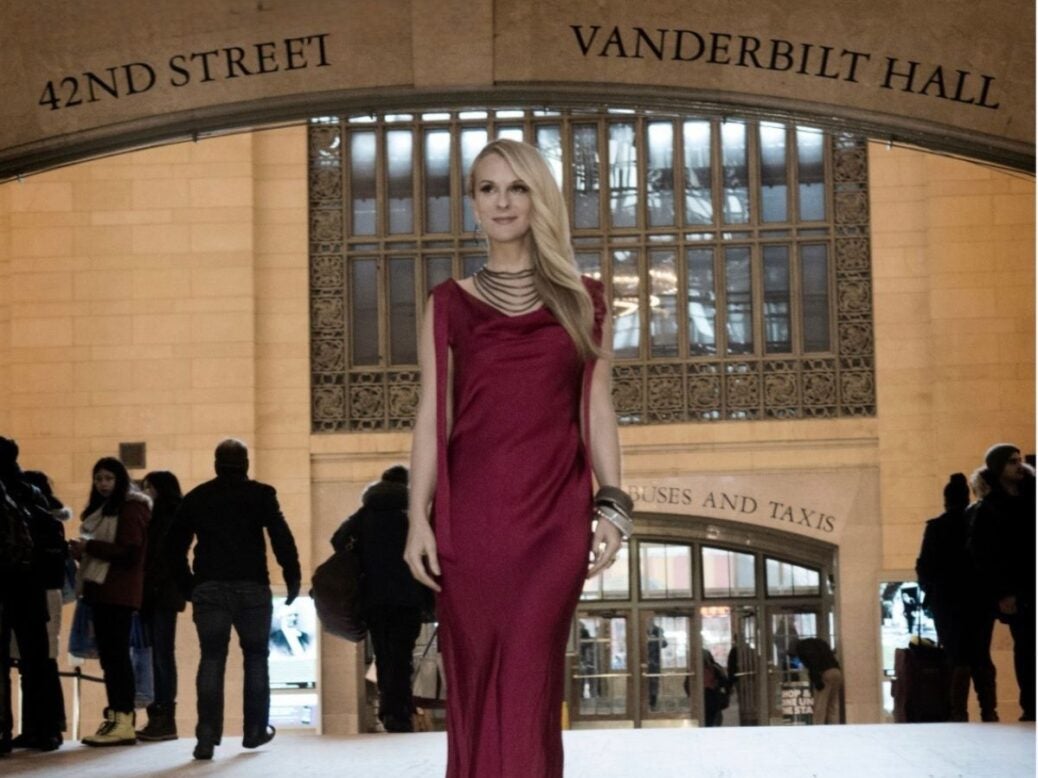
Consuelo Vanderbilt Costin, the great-great-great-granddaughter of railroad tycoon Cornelius Vanderbilt, is not keen on the moniker ‘heiress’.
‘I’d rather throw up,’ she tells Spear’s. ‘I think it’s excruciating,’ she adds, perhaps thinking the word conjures up images of ‘ladies who lunch’, attend tenuous charity galas and do little else.
This week, during New York Fashion Week, Vanderbilt Costin debuts Vanderbilt & Seewald Global Studio, a fashion investment and commerce platform co-founded with the media entrepreneur Michaela Seewald, publisher of the Czech-Slovak edition of Vogue.

The inaugural runway show will take place on 15 September inside Grand Central Terminal (built, as it happens, by Costin’s own ancestors) and will feature designers with a ‘click-to-buy’ system letting audiences purchase looks in real time. The platform grew out of watching freelance creative talent go unpaid and unseen without the backing of a major agency: ‘It was really built out of a need and a necessity to build a vetted place in the marketplace,’ she says.
Related


[See also: The best generational wealth and family business advisers]
It is also, by her own account, one piece of something considerably larger: House of Vanderbilt, the family office she launched earlier this year. She describes it as a financial and cultural ‘nexus’, in effect, for the more than 800 living descendants of Cornelius Vanderbilt, the vast majority of whom she has never met.
The framework takes inspiration from another legendary American dynasty. ‘I really look at the Rockefeller model and I think it’s absolutely brilliant what they’ve done,’ she says, noting it was never confined to the Rockefellers themselves but ‘expanded’ outward over generations.
Costin, 47, does not disclose the level of assets that House of Vanderbilt currently manages, nor her own net worth, nor the number of her many relatives that have signed up to work with the platform. Beyond her ‘immediate line,’ which she describes as ‘very supportive and very excited,’ broader family involvement, she says, is still something ‘we’re building out.’
Content from our partners



[See also: Heirs apparent: When legacy becomes reputational capital]
She is more forthcoming, though, on what the Vanderbilt name has taught her about money itself. ‘I don’t take anything for granted,’ she says, tracing that instinct to years spent building businesses and taking jobs to support herself rather than assuming that she would be provided for indefinitely.
Her relationship to wealth, she explains, is also entwined with philanthropy, which for her began ‘as a necessity’. Her account centres on her mother’s death from ovarian cancer, which pulled her, in her twenties, into advocacy work and lobbying trips to Washington. ‘It came completely out of sheer necessity to save my mother,’ she says. She now sits on the boards of Alzheimer’s and dementia organisations and her family’s own museum, and says she has no interest in launching a foundation of her own while so many existing charities need support.
[See also: ‘Don’t be scared’: how younger UHNWs should go about giving their money away]
That said, she is more guarded when it comes to politics, declining to comment on her view on Zohran Mamdani‘s proposals to tax New York’s wealthiest residents. ‘You’re talking to the most non-political human being in the world,’ she says. ‘I will always plead the fifth on this.’ She adds only that decisions about structuring her companies and holdings are made ‘individually’ within the family, rather than as any collective response to the tax climate.
The Vanderbilt story she wants to tell, ultimately, is not really about industrial fortunes but about the women who spent them well, such as Alva Vanderbilt’s engineering of her daughter’s marriage into the Churchill line, Consuelo Vanderbilt’s suffragette work and Gertrude Vanderbilt’s founding of the Whitney Museum. ‘I never believe there’s men behind the women,’ she says.
But what shape that 21st-century legacy will ultimately take seems to be, for now, still an open question.