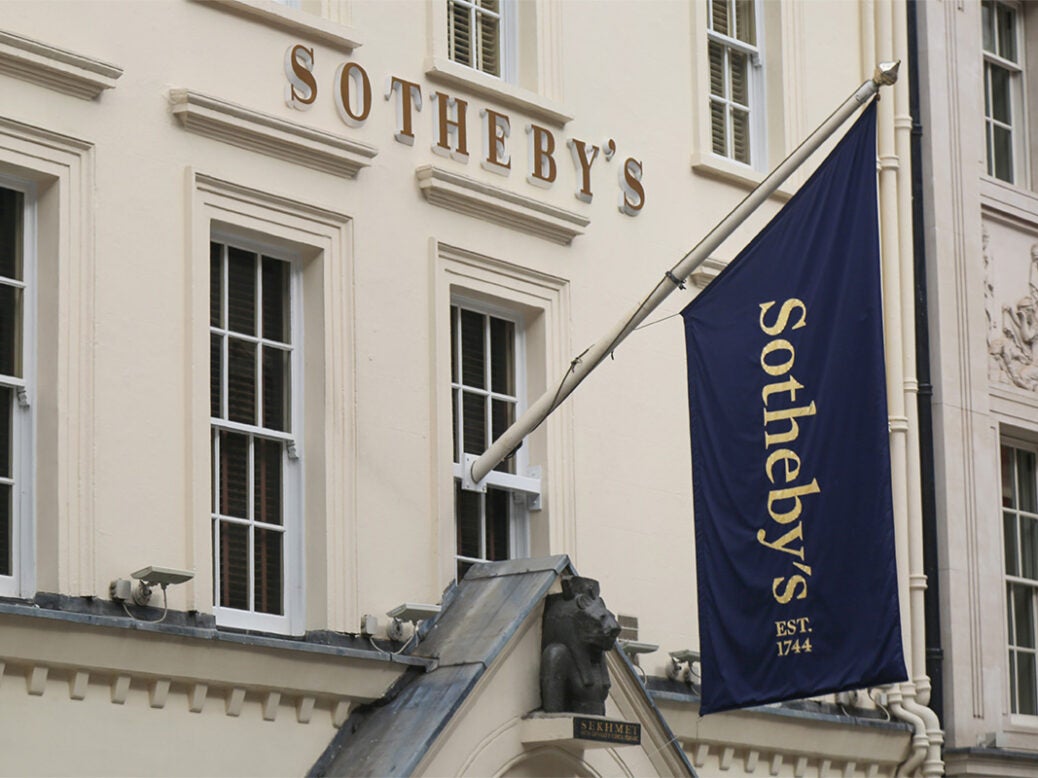
Sotheby’s is now giving sellers an option to delay the receipt of payment for their auctioned items and earn interest in return; however, the experts Spear’s spoke with say the auction house may struggle to attract large numbers of people to the scheme.
Sotheby’s is offering 7 per cent interest to those who choose to defer receiving payment for their consignments for at least six months, the Financial Times reported.
While this option could be of benefit to sellers at a time when UK interest rates are high, it is unlikely to have wide take-up, argues Rudy Capildeo, joint head of the art and luxury department of London law firm Wedlake Bell.

‘The difficulty that they’ll have is that sellers – certainly at auction – tend to prefer the certainty of liquidity,’ says Capildeo.
Related



Art finance expert Joe Charalambous, head of the asset advisory company Collectra, seconds Capildeo’s view.
‘Art collectors are often selling to seize another opportunity or solve a problem, so it’s unlikely that any delayed payment would be an attractive offering,’ he says.
There are many cases of auction houses negotiating delays on payment on an ad-hoc basis, Capildeo notes; however, he has never come across an established scheme such as this before.
‘Sometimes, for the bigger consignments, which are usually competitively fought over by the auctioneers, they may be more willing to give that sort of interest payment,’ he says. ‘This could be because they have large amounts of money being held back from being paid across, or because the buyers themselves need a bit of time and liquidity to be able to make those larger payments.’
Content from our partners



The standard waiting time to receive payment at Sotheby’s after selling an item is 45 days. Christie’s and Bonhams, two other giants in the auctioneering world, pay out after 35 days.
Capildeo notes that while Sotheby’s is a historic, blue-chip name in the art world and therefore extremely likely to be a stable lender, anyone lending money to a business that has a large amount of debt should think twice.
‘Sellers need to be careful with their consignment agreements. Delaying payment for six months puts you at greater risk in the case there is an insolvency event,’ he says. ‘Obviously, you would hope, given the hundreds of years that Sotheby’s has been in business, that this is a remote possibility.’
‘We pay our clients in accordance with agreed upon payment terms,’ said a representative of Sotheby’s. ‘These special situations are pre-determined, reflect a very small percentage of total transactions and are in keeping with industry standards and practices.’
The offer of 7 per cent interest may not appeal to a lot of people, argues art adviser Vanessa Curry, founder of Fine Art Source.
‘It does not seem to be a particularly high interest rate given that the overall sales figures could be in the tens of millions of pounds,’ she says. ‘I am struggling to understand why someone would agree to that.’
Curry emphasises that if she were buying on behalf of a client and using this scheme, she would want extremely stringent rules and timeframes regarding when the money is paid.
Patrick Drahi, the French Israeli billionaire owner of the auction house, increased Sotheby’s debts to over $1 billion after purchasing the business in 2019, the New Yorker reported.
‘Sotheby’s is in strong financial health with ample liquidity, having delivered outstanding results in 2025 and closed a record first quarter of 2026,’ said a representative from the auction house. ‘In 2025, the company generated $1.4bn in revenue, a 21% year‑on‑year increase, and has made significant progress reducing debt, which is now at its lowest level in six years, in keeping with our strategy, and further strengthening our balance sheet.’
The art market has fared slightly better over 2025 than it did in previous years. After the global art market shrank by 16 per cent between 2022 and 2024, the industry experienced 4 per cent growth last year, according to the Art Basel and UBS Global Art Market Report 2026. Auction houses have done better, with public sales increasing by 9 per cent in value in 2025.