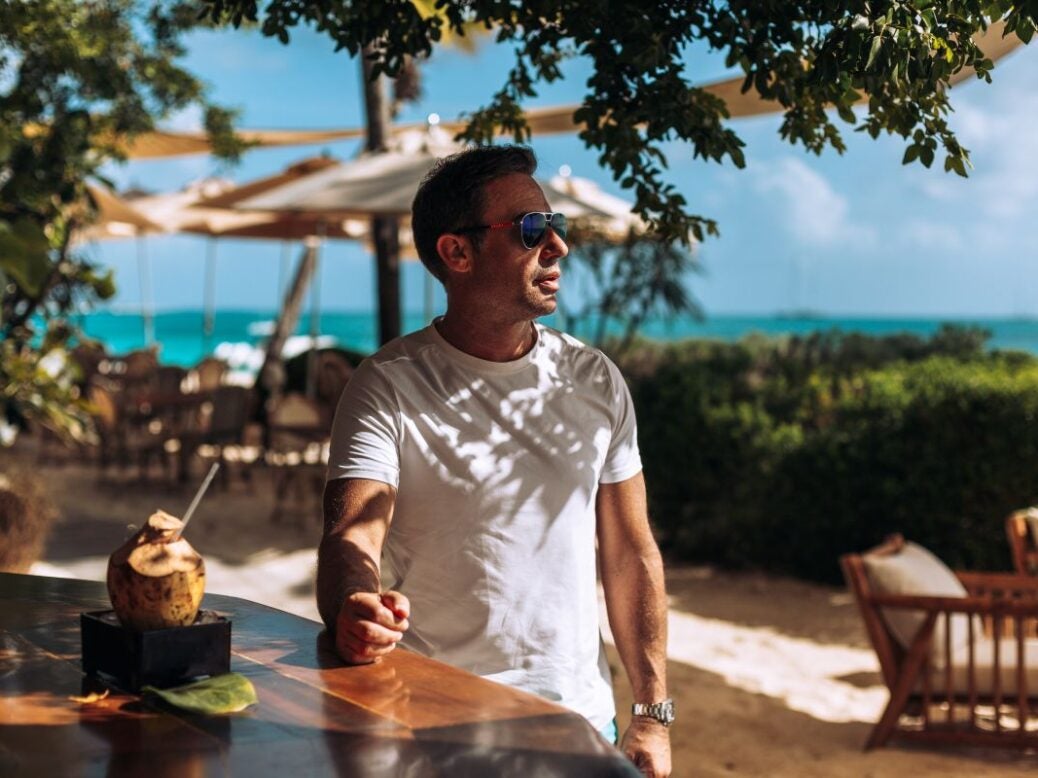
The helicopter journey from Antigua to its sister island of Barbuda takes around 15 minutes, just long enough for Daniel Shamoon to clear some emails and message Robert de Niro our arrival time. Out of the window, the mangroves and soft green hills of north-west Antigua are replaced as we travel northwards, over the flat plain of Barbuda and pink coral-enhanced sands of Princess Diana Beach, eventually coming to land by a building site that is set to become Nobu Beach Club.
It’s a journey that Shamoon has made many times, sometimes – as on this occasion – to meet Hollywood veteran de Niro. The pair, with Australian billionaire James Packer, are business partners in Nobu Beach Club, a hotel due to open this year offering 50 multi-million-dollar residences for sale. De Niro, alerted by the helicopter’s arrival, walks down the beach from his own property to greet Shamoon warmly, both of them dressed casually in shorts and T-shirts, bare feet sinking into the sand.
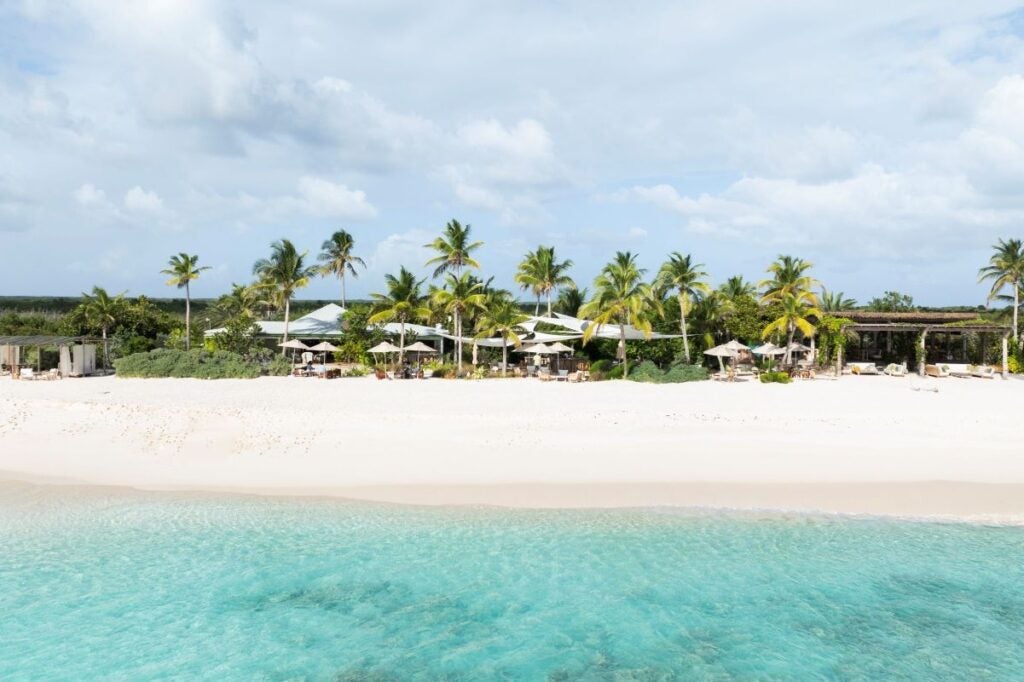
They’re here to meet London-based interior designers Ward & Co to discuss plans for the residences, followed by a waterfront lunch at the Nobu restaurant de Niro opened here in 2021, on the site of the former K Club, a favourite with Princess Diana. Afterwards, sitting on the sand, soft drink in hand (he waves away the wine at lunch, saying he is recovering from recent celebrations for his 50th birthday), Shamoon outlines his reasons for joining the project.

[See also: Introducing Spear’s Magazine: Issue 99]
Related


‘With everyone I work with, it’s about friendship first,’ Shamoon says. ‘I have amazing partners at our Nobu Hotels in Morocco and Ibiza, and with Bob and James in Barbuda. We’re friends who most of the time speak about the non-business-related things we have in common. Partnerships are never straightforward, but we’ve always made sure that we start with a firm relationship and a shared vision that allows us to get things done.’
British-born Shamoon is the managing director of family-owned property development and investment company Bursha Holdings and, with his sister Jennica, co-owner and director of international hospitality group Luxury Hotel Partners and boutique hotel collection Small Luxury Hotels of the World.
The siblings’ own portfolio of illustrious names includes Puente Romano and Marbella Beach Club in Spain, Hermitage Bay in Antigua and a stake in Nobu Hotels from Marrakech to the Caribbean.
His introduction to the hospitality industry came courtesy of his late father, David, who left Iraq in the Fifties, swapping an aeronautical engineering career for the allure of London’s swinging Sixties nightclub scene; he owned hotspots such as Speakeasy and Blaises, favourites with Jimi Hendrix and the Rolling Stones. By the Nineties David had expanded into Spanish real estate and hotels, investing in Costa del Sol’s neighbouring Puente Romano and Marbella Beach Club. Yet despite building great family wealth – the Sunday Times Rich List estimated that they were already worth £100 million by 1990 – David set a template of hard work and entrepreneurial flair for his two children, his son says.
Content from our partners


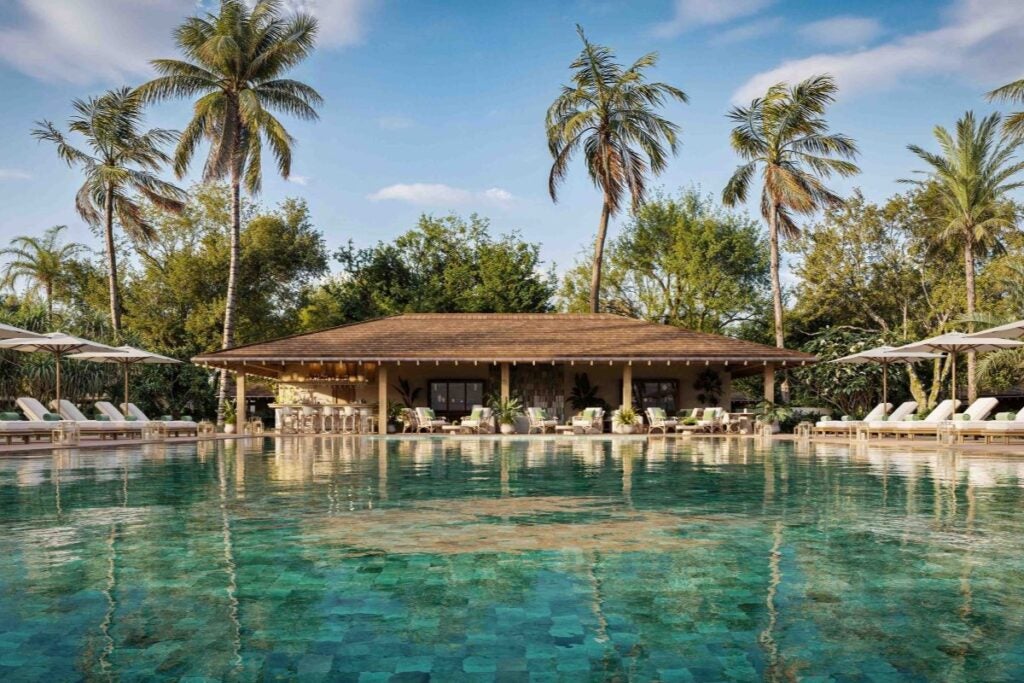
‘My father wasn’t one to let you have a nice summer holiday,’ he recalls. ‘From the age of 15 my summers were spent waiting on tables, working front and back of house, in the kitchens and bars, delivering room service. When I was 21 and at university, my father said I should spend the summer in the accounting department, which did not appeal at all.’
Instead, he made his father a proposition: if he were allowed to open a beach restaurant at Puente Romano in Marbella – and host a successful event – then he should be allowed to work there through the summer and steer clear of the accounts department.
The gambit was successful and, 30 years later, that very restaurant (now named El Chiringuito) is, Shamoon says, the group’s highest-revenue-producing restaurant in southern Spain.
‘It became the area’s first real beach club,’ he says. ‘At that time you would go for dinner, then go on elsewhere for drinks and then on again to a club, having to keep moving, which I thought was tedious. I’d heard my father’s stories of owning 1960s London nightclubs, so thought why not copy that and combine it all – dining, drinking and music – in one experience. It was unique, attracting up to 3,000 people a night and soon making over 30 per cent of the hotel’s revenue.’
Three decades on, Shamoon’s enthusiasm for innovation in the hospitality industry appears undimmed. He explains how he has adapted to the changing focus of the majority of his next-gen guests, moving away from the sybaritic nightlife of the past and into an emphasis on wellness and healthy living.
‘It’s a different world now. Today Puente Romano has 23 or 24 restaurants – I lose count – all full of music and life, just as in my father’s time,’ he says. ‘We realised people love that buzz, so when we were building a gym, we brought in nightclub designers and then got Technogym to design the workout experience. And now people come in at 9 in the morning and there’s a DJ and decks and a nightclub experience; it has become one of the most popular elements of the hotel. People love a fun, active environment, but they’re working out now, doing spinning classes or yoga and having ginger shots instead of tequila shots.’
Shamoon’s upbringing – his mother, Ruanna, is Swedish – and an education that included boarding school in Highgate, a business degree earned in Paris and Madrid and post-grad studies in marketing at NYU, are reasons he feels ‘truly international’. He has an easy-going manner and a mid-Atlantic accent that speaks of a peripatetic life, and homes in Marbella, Antigua and London. Shamoon and his wife Nadine have three daughters, aged four to 13, who are at school in London but travel with Nadine during school holidays to join him in Marbella in the summer and Antigua in the winter.
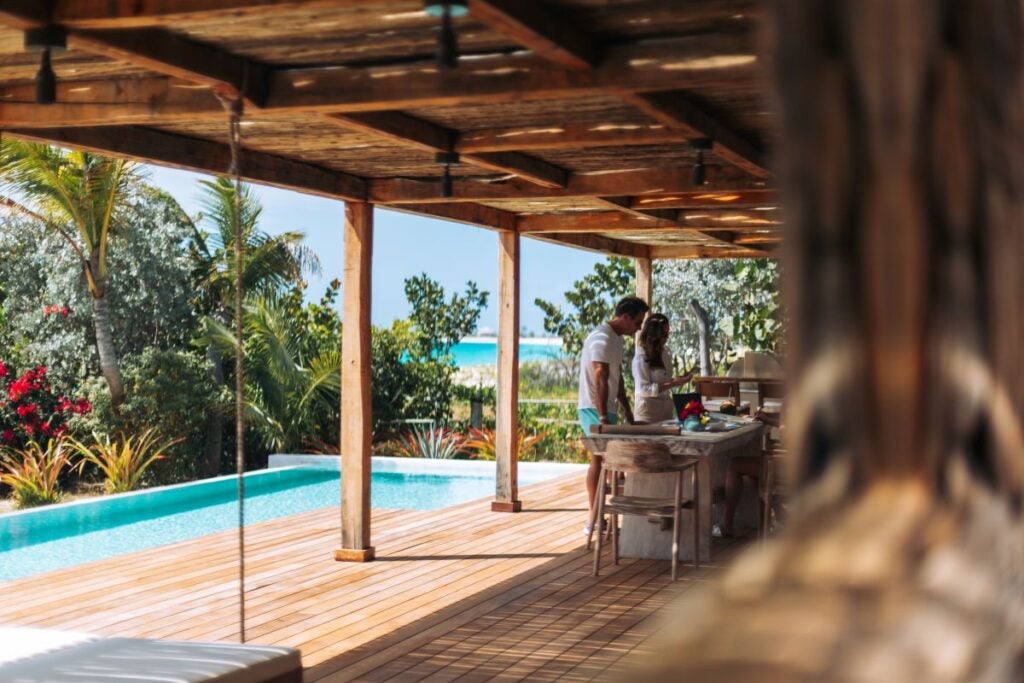
Although he travels extensively, Shamoon’s base is now Antigua, where the entire family were granted citizenship in 2024, in what he describes as a ‘rigorous’ six-month process. The efforts he made to ensure that Nadine liked the island on her first visit as much as he did imply her decision was critical in the relocation.
On our return flight to Antigua, the view of Barbuda gives way to the blues of sea and sky, and, once back at the heliport, Shamoon is in a reflective mood. ‘No one is in this industry solely to make their fortune,’ he says. ‘They’re here because they have a real passion. Starting up development and assembling a team is hard. Barbuda, for example, had no infrastructure whatsoever. We had to build the workers’ village, create the cement and concrete production and organise all the logistics. And that’s before you get to the epic struggle of the food and beverage side of the operation, where a million things can go wrong every day.’
He waves farewell with his water bottle as he heads over to his car. The bar business may be far simpler, he admits: ‘You buy a bottle of whisky, pour a glass and it’s job done.’ But, clearly, it’s just not as much fun.
This article first appeared in Spear’s Magazine Issue 98. Click here to subscribe