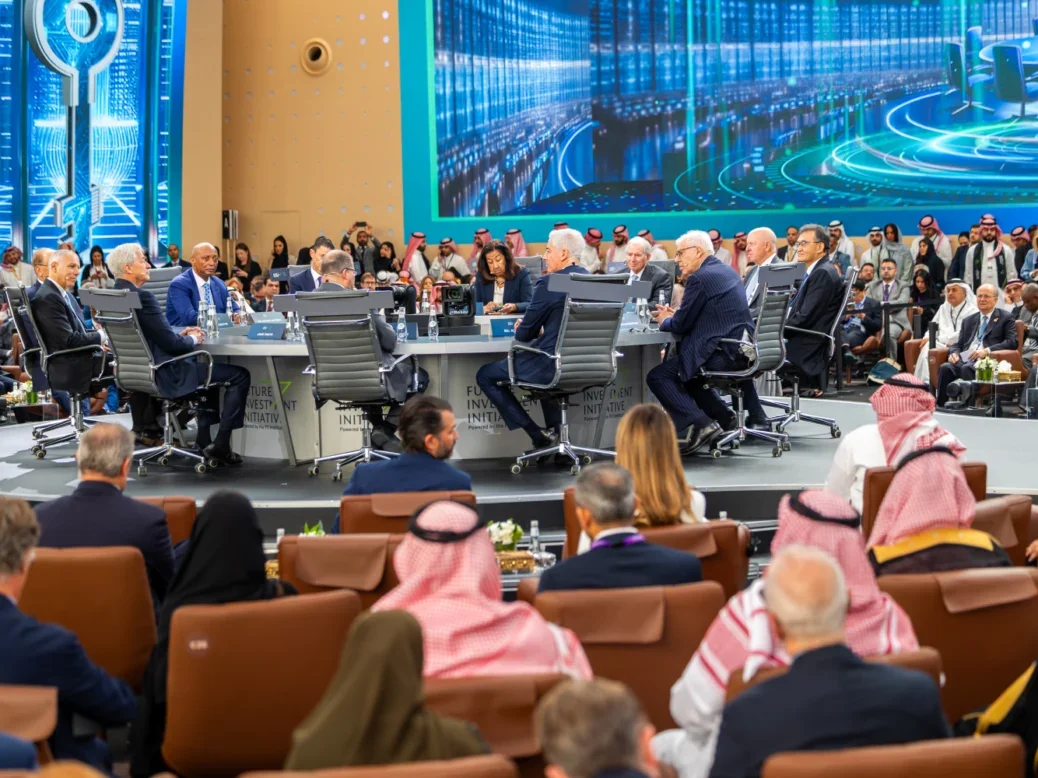
AI, energy and Saudi Arabia’s changing role on the world stage emerged as the key themes at the ninth edition of ‘Davos in the Desert’ this week.
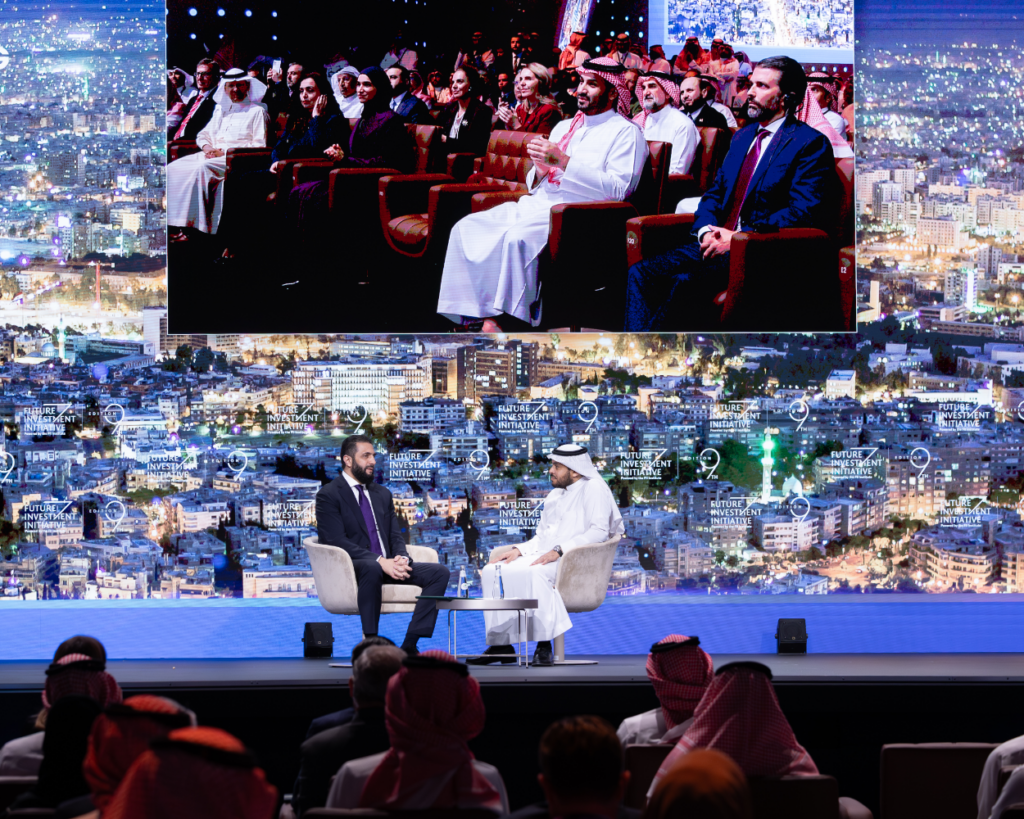
The conference, officially known as FII (Future Investment Initiative), has become a fixture in the calendars of top financiers, technologists and world leaders as Saudi Arabia struts on the global stage under the leadership of Crown Prince Mohammed bin Salman (MBS).
The chiefs of JP Morgan, Goldman Sachs, Blackstone and BlackRock – Jamie Dimon, David Solomon, Steve Schwarzman and Larry Fink, respectively – are among the financiers in attendance. They were joined by hedge fund titans Bill Ackman and Ray Dalio, alongside political figures from around the world, including UK Chancellor Rachel Reeves, China’s Vice President Han Zheng, Rwanda’s President Paul Kagame, sanctioned Russian presidential envoy Kirill Dmitriev, and Syria’s new leader, Ahmed al-Sharaa.

MBS is also in attendance, though he is unlikely to speak publicly before the conference concludes later today, preferring to let others take the stage.
Related
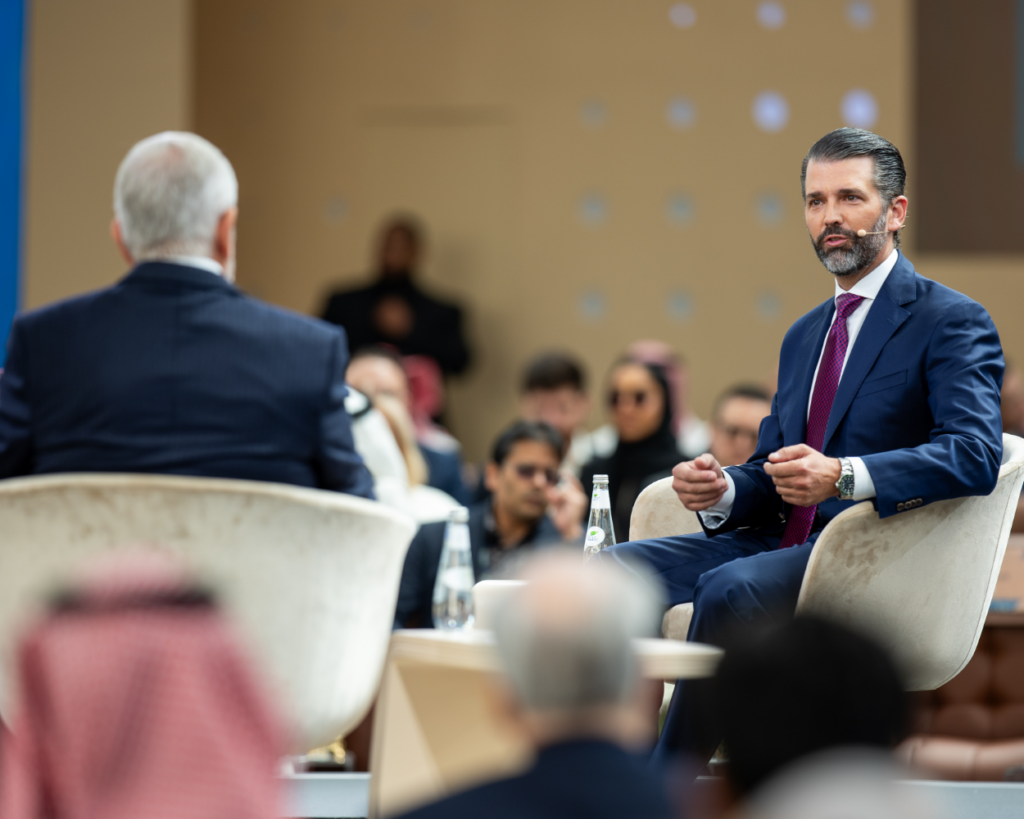
While Donald Trump is not at FII this year, traveling to the Asean Summit in Kuala Lumpur to meet with Xi Jinping, several Senior US officials are present, as well as the president’s eldest son, who appeared in his capacity as an investor. In an interview on the sidelines of FII, Donald Trump Jr. notably did not deny that he could one day seek to run for office himself.
Read more: CEO of $88bn MFO Alti Tiedemann on growth, AI and the strength of institutions
The Crown Prince’s vision
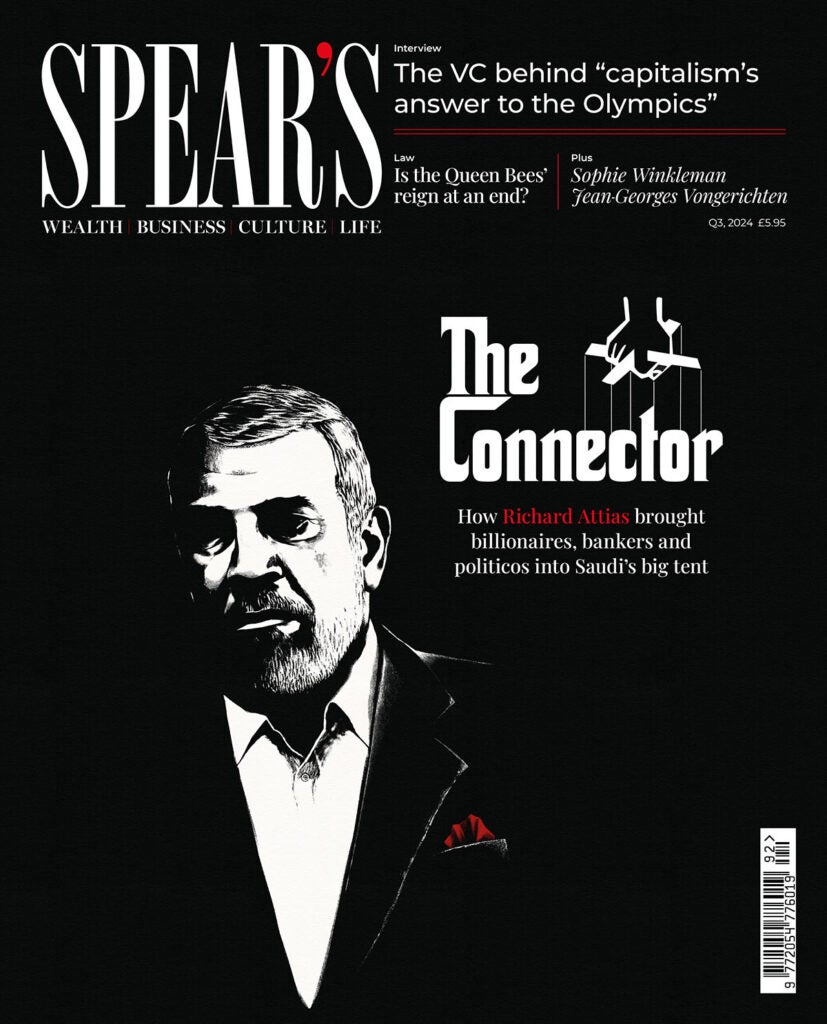
Since becoming Saudi Arabia’s de facto ruler in 2017, MBS has wasted no time in pursuing his global ambitions. That same year, he enlisted Davos veteran Richard Attias to launch FII, the first edition of which took place in Riyadh. The annual gathering has since become a key pillar of the kingdom’s efforts to deploy its $1 trillion sovereign wealth fund, the Public Investment Fund (PIF), to weave Saudi Arabia more deeply into the global economy.
PIF’s investments span everything from the breakaway LIV Golf league to Newcastle United Football Club, SoftBank, Uber, Blackstone, and even Russia’s smaller $10 billion sovereign wealth fund.
Content from our partners


Read more: The new face of Saudi Arabia
This year’s FII, however, opened against a less comfortable backdrop: a $65 billion government deficit. Heavy spending on Vision 2030 initiatives and weaker oil prices have forced Riyadh to bridge the gap through bonds, loans and foreign investment – a reminder of the urgency behind MBS’s push to diversify the Saudi economy away from oil dependence.
The AI opportunity
One of the central themes of this year’s conference was artificial intelligence, which dominated panel discussions and interviews.
In a session featuring some of the world’s most powerful financiers, Blackstone chief Steve Schwarzman described the single greatest investment opportunity today as being in “the data centre and AI complex” – and in the vast energy required to power it.
His remarks reflected a broad consensus that AI will indeed live up to the hype, catalysing a profound transformation of the global economy. Yet there was less agreement on how evenly the benefits will be shared.
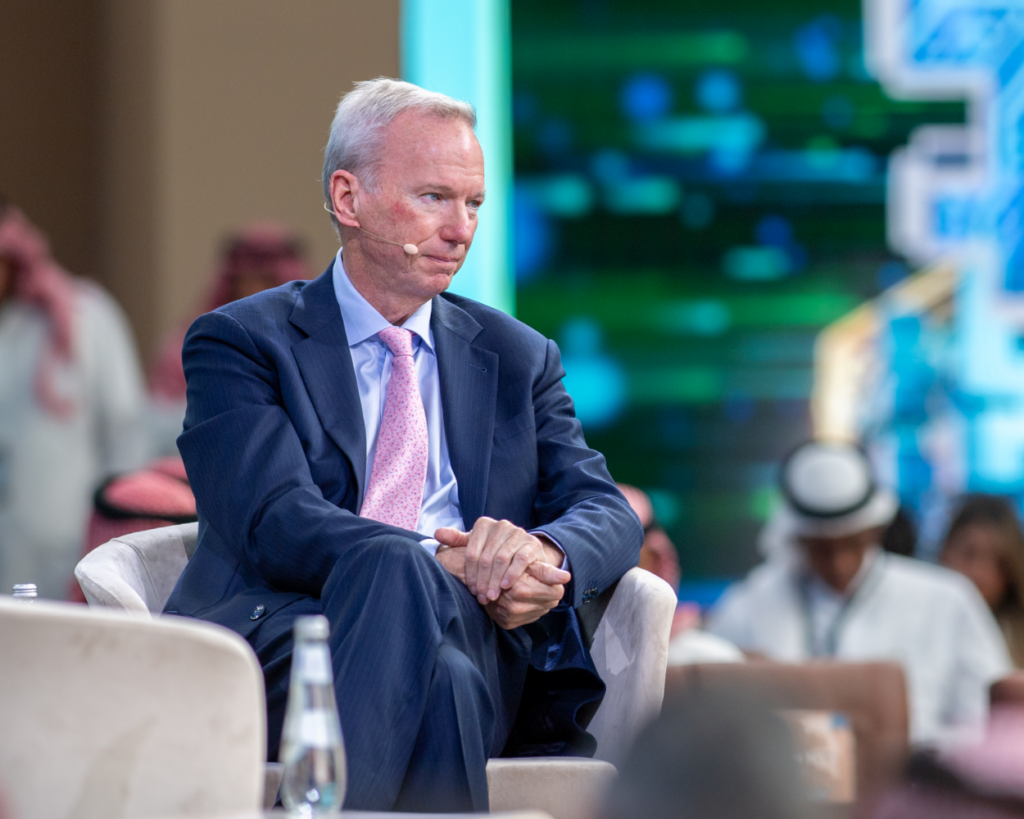
Former Google CEO Eric Schmidt told futurist Peter Diamandis he was sceptical of claims that AI-driven “abundance” would benefit most of humanity. ‘There’s no question that wealth will be created, because wealth comes from efficiency,’ Schmidt said. ‘But you could imagine a small number of companies – [and within them] a small number of people – getting all of those benefits.’ That, he added, would pose significant public policy challenges.
Powering the future
But there was unanimity on the growing need for energy to power the vast computing capacity (‘compute’) required by complex AI models. The International Energy Agency noted in a recent report that data centres accounted for around 1.5 per cent of global electricity consumption in 2024 – some 415 terawatt-hours. According to its ‘base case’, demand will more than double by 2030, when data centres worldwide will consume as much electricity as Japan does today. Some forecasts are considerably higher.
The global demand for compute could even spark armed conflict, warned Jonathan Ross, CEO of US AI firm Groq. ‘I’m a little bit worried there’s going to be a war over it,’ he said, noting that conflict over valuable resources has long been a feature of human history.
Several attendees noted that Saudi Arabia is well positioned to take advantage of the AI boom. The country – which is about nine times the size of the UK, but with a population just over half as big – has space for data centres to be built. It also has plentiful cheap energy and a regulatory environment in which permissions for building can be granted quickly.
On Tuesday it was announced Blackstone would put $3 billion into the PIF-owned, Saudi-based AI company Humain. In an interview, the company’s CEO Tareq Amin suggested that firms including BlackRock and KKR might follow suit.
After years of deploying capital abroad, MBS will hope that this deal – one of the world’s largest asset managers backing a homegrown enterprise – marks the start of a new phase in Saudi Arabia’s investment story.