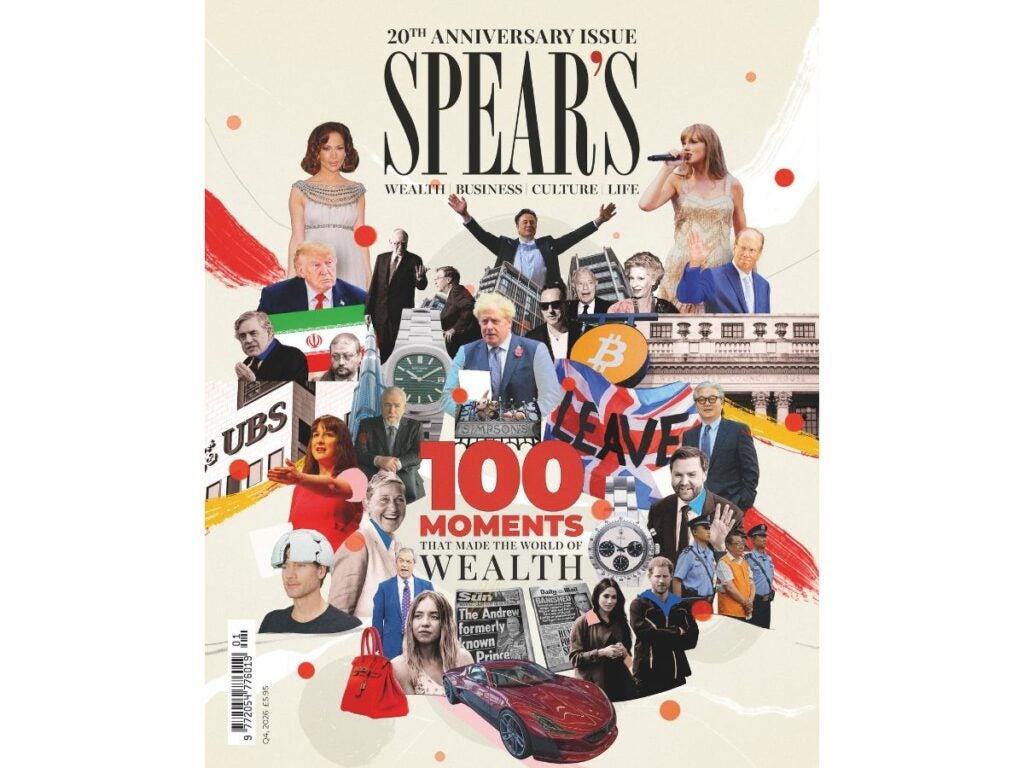
To mark the 20th anniversary of this magazine, let’s wind the clock back to 2006 – the year in which Spear’s was founded.
It was 10 years after I started YO! Sushi, the restaurant that became famous for allowing customers to select their sushi from a conveyor belt that wound its way round the dining area. The Apprentice and Dragons’ Den had both recently arrived on UK TV screens and – you could sense it – something was happening to Britain’s image of entrepreneurs.
Having been dismissed as spivs or fat cats for so long, entrepreneurs were suddenly being celebrated, splashed across the media and held up as sources of inspiration for a generation of kids and young people who would never before have thought of pursuing that kind of career.

Related

Even 20 years ago, starting a business meant navigating a world dominated by traditional financing. Funding was for those who could show assets or at least a credible track record. There was less regulatory complexity, but also much less support for new entrepreneurs. Failure carried stigma and risk-taking was not culturally celebrated as it is today.
Fast forward to 2026 and business creation has been democratised. With a bit of grit, determination and a decent WiFi signal, anyone can step onto the ladder and reach a global market.
However, bureaucracy has tightened rather than eased. Employment law has created more hesitation than clarity for both sides of the workplace, which prevents British companies from developing the confidence that characterises American business culture. Add to that the weight of taxation and inefficient regulation and it’s easy to see why many feel that, when it comes to government policy, common sense ain’t that common.
[See also: How Budget 2026 could affect your wealth: what the UK’s top advisers are saying]
Content from our partners



Rising costs, housing pressures and bureaucratic overreach have encouraged many talented entrepreneurs and professionals to seek greener pastures abroad, and who can blame them?
Nevertheless, opportunity is everywhere for fleet-of-foot entrepreneurs. Here in Britain, we’ve moved far beyond the old ‘nation of shopkeepers’ cliché and reclaimed our identity as a creative force – just as we once explored the world in the 18th century, reshaped it in the 19th and reinvented it in my era through rock ’n’ roll, fashion, film and businesses that travelled the globe.
Now is the moment for entrepreneurs and the broader business community, our strongest reservoir of talent, to call for change. We must attract the next generation of tech-savvy people into leadership and garner the support of those calling for radical change to drag our governance into a new and modern age.
The opportunity I see for our island nation, freed from the constraints of our continental cousins, is to reinvent itself as a model of governance and broad opportunity, powered by a renewed entrepreneurial spirit. As the glue of the old world melts, the pendulum is swinging so far in the other direction that reinvention is essential. Nothing less than revolutionary change will do.
My take is not that recent leaders are bad; it is simply that, in a complex democracy, it is no longer possible to control everything from the top. As the late, great British artist David Hockney so succinctly put it: ‘End Bossiness Soon’.
I believe that change should start with digital voting, where we the people can express our opinions not on political parties but on issues, and regularly. The way to implement those wishes is through an efficient executive, such as an elected cabinet of perhaps 40 capable people, well compensated and fully empowered to deliver results in the way successful organisational leaders do.
[See also: Is Britain’s wealth exodus about to accelerate?]
You may say I’m a dreamer, but I’m not the only one! A long-term, 30-year vision – rather than four-year resets that only allow fiddling around the edges – would enable more efficient investment, free of government micro-management. That would give schools and hospitals the freedom to let dedicated practitioners truly support their communities.
With today’s financial transparency, wealth‑based assessment, not income, could guide how major services like health and education are paid for, giving people the ability to contribute according to means and choose how and where they access those services. If that, technically, would constitute a ‘wealth tax’, then don’t worry: I’m not getting carried away. Under a new, radically rethought model, it would be possible to reduce taxes overall, while also giving freedom to institutions and the people they serve, making them far more efficient.
Perhaps next generations will look back in amazement at a time when we allowed governments to take more than half of what we earn… and celebrate how Great Britain led the world in creating a new model for democratic societies that puts business, freedom, efficiency and wealth creation at its heart.