Hedge fund billionaire Chris Rokos plans to leave the UK and become a resident of Greece, according to reports earlier this week.
Rokos is listed by the Sunday Times as Britain’s third-highest taxpayer, and reportedly paid £330 million in tax last year.
His relocation won’t surprise those who have watched UHNWs depart the UK en masse, but few might have predicted Athens, the Greek capital, as his destination.

Dubai, Switzerland, and more recently Milan, have been favoured choices of the super-wealthy in recent times, but does Rokos’ move indicate Greece may soon be one of the names at the top of the list?
Related


[See also: Inside Milan’s rise as a haven for the world’s wealthiest]
Rokos intends to open an office of his hedge fund Rokos Capital Management in Athens. Just days after the news emerged it was followed by reports that another major hedge fund, Izzy Englander’s Millennium Management, was preparing to open its own outpost in the city. One of its London-based portfolio managers, Rahul Chopra, was among those said to be considering relocating.
Other high-profile names that have moved to the country recently include tennis superstar Novak Djokovic, who moved his family there in 2025.

Stuart Wakeling, managing partner at Henley & Partners, tells Spear’s he considers Greece to be an ‘increasingly attractive proposition’ for UHNWs.
Content from our partners



[See also: World’s billionaires now worth more than $15tn]
‘Its advantage is a particularly compelling combination of European and Schengen access, residence optionality, an attractive regime for qualifying new tax residents, quality of life and real estate,’ he says.
‘In addition, the Greek government is looking at possibly implementing new tax incentivised schemes for structures or family offices that could attract even more HNWIs.’
Since 2020, Greece has had a flat rate tax deal of €100,000 on all foreign income for up to 15 years. This is available to all foreign residents who invest €500,000 in stocks and bonds within the country.
[See also: The tax trap waiting for rich expats leaving Dubai]
Separately, Greece’s ‘Golden Visa’ programme allows qualifying investors to obtain a renewable five-year residence permit through investments in Greece. The government recently has made changes to the programme, and introduced a €250,000 start-up investment route.
Another way to obtain the visa is to buy property in the country, with some specifications. Properties must be at least 120 square metres, with a minimum purchase price of €400,000, which rises to €800,000 in the most sought-after locations, including the major cities of Athens and Thessaloniki and the larger Greek islands.
‘It is clear from my client base that a significant number of HNW clients are actively seeking to relocate to Greece,’ says James Stewart, co-head of private wealth at Penningtons Manches Cooper.
[See also: Dan Neidle: The rich can still silence their critics with lies]
Stewart, who regularly visits Penningtons’ office in the Greek port city of Piraeus, adds that it’s not purely the economic reforms of the Greek government which is driving an increase in relocations.
‘Many relocations to Greece are not tax-driven, given the fact that the country is blessed with an amazing climate, natural beauty, lifestyle and culture. Property in Athens and elsewhere is very affordable, and from a wellness perspective, the quality of life is better than London.’
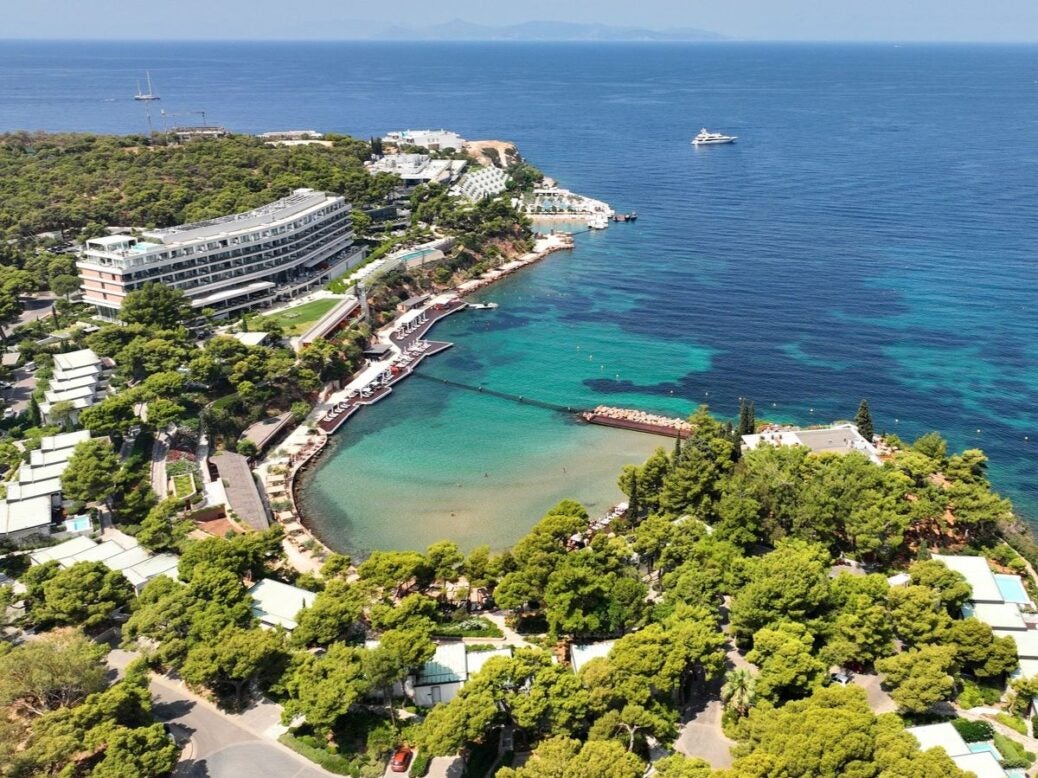
The most desirable areas of Athens for UHNWs mulling a move are south of the capital’s city centre, along the Athens Riviera. Athens is the only European capital with more than 40 kilometres of direct beachfront within its metropolitan boundary.
[See also: Wealthy investors drive record £24.2bn Capital Gains Tax bill]
A Foster & Partners skyscraper, the Riviera Tower, will become the country’s tallest building at 200 metres when completed in the first half of 2027.
Sotheby’s lists 73 properties on the Riviera, nine of which are valued at over €5 million, including a 1,000 square-metre eight-bedroom villa priced at €27 million.
Greece Sotheby’s International Realty’s H1 2026 data puts the median asking price on the Athens Riviera at approximately €10,200 per square metre, with branded off-plan developments on the Riviera extending materially higher.
Asked what requirements his HNW clients have, Savvas Savvaidis, president and CEO at Greece Sotheby’s International Realty, says: ‘The phrase I would use is “privacy without isolation.”’
[See also: Permira chair moves to Switzerland as wealthy executives rethink residency strategies]
‘UHNW buyers still want the sea, climate and space that brought them to Greece in the first place, but increasingly they also want immediate access to airports, schools, healthcare, restaurants, marinas and professional services,’ he adds.
Also located in the Riviera area is the Astir Palace Hotel (now the Four Seasons hotel), which opened in 1958 and hosted many glamorous twentieth-century names, including Jackie Onassis and Brigitte Bardot.
There are several private schools in Athens for UHNWs in London who wish to bring their families to Athens, including Campion School, which is 16 kilometres from the centre of Athens and charges fees of between $10,400 and $17,800.
[See also: Even rejected, Swiss wealth tax debate offers lessons for UHNW clients]
Wakeling adds that Greece is benefiting from the closure of Spain’s Golden Visa programme and Portugal’s removal of real estate as a qualifying Golden Visa investment.
Others highlight that while other countries have complicated their tax regimes for UHNWs in recent years, with repeated rule changes, Greece has taken a different route.
Miles Dean, head of international tax at Andersen, says: ‘Greece has become more popular because it’s a simple regime.’
‘If you contrast it to the UK non-dom regime, which became so overly complex where once it was the gold standard – and over the years, much to our detriment, it’s become obvious that we don’t want to attract or retain wealthy people,’ he adds.
Dean tells Spear’s he thinks other UHNWs, like Rokos, are mulling exits from the UK, many of them due to fears of a potential wealth tax or exit tax in the first budget under new prime minister Andy Burnham, which is set for October.
‘They will leave prior to the budget – the tax rules are very rarely retrospective – and then if the taxes don’t come in, they could come back two or three weeks later,’ he says.
However, Danae Tsakiris, a residential director at Savills Greece, says it’s not just Brits who are increasingly taken by the country.
[See also: Global billionaire population grows amid rise of AI fortunes]
‘We are seeing a lot of interest from places like Lebanon and Israel which are a bit closer to us compared to Dubai or Abu Dhabi for example, and we also have the cultural connection of being in the Mediterranean basin and having similar foods and vibrant, similar cultures,’ she says.
‘We have 250 days of sunlight and sunshine here. People from places in the Middle East, where the summer might be 40-plus degrees, can have a milder summer here.’
Tsakiris adds that in recent years, infrastructure has notably improved, with upgrades to roads across the country and to Athens airport.