Uli is a Zurich-based watch buff now in his fourth decade of serious collecting. For years, his path was orthodox: an early fascination with Rolex kicked off the hunt, until he graduated to Patek Philippe and other similarly rarefied and exalted makers. But more recently, having spent years ticking off the canonical marques and references, he began searching for more unusual pickings. And whereas plenty of collectors go delving into independent ateliers at this point, Uli landed on what had become, if not a forgotten name in watches, then a sleeping beauty: Piaget.
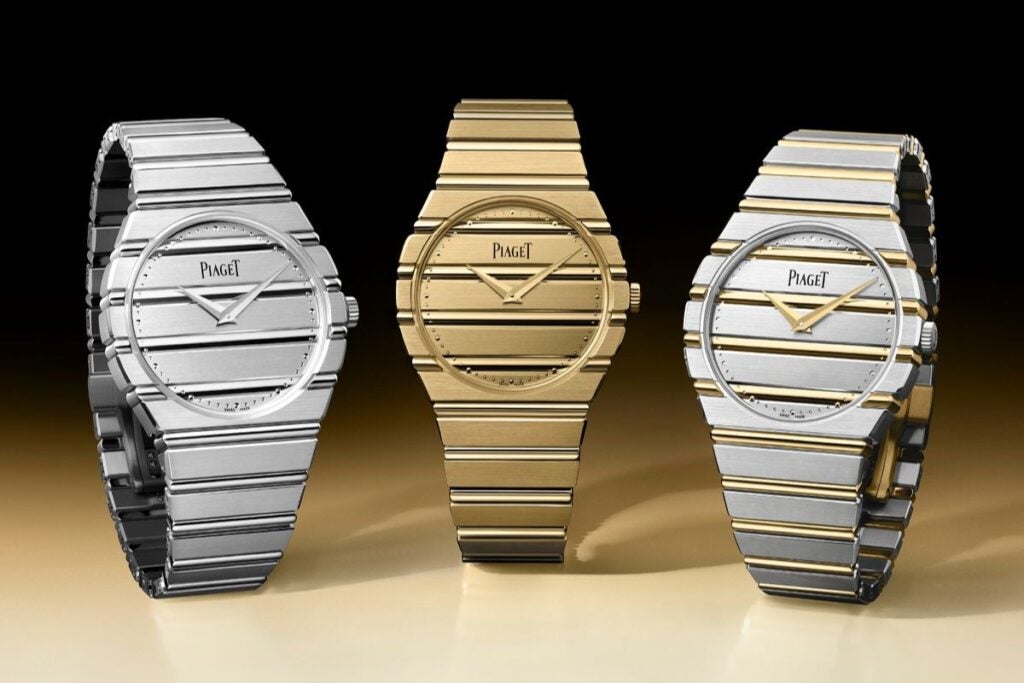
If you think Piaget is mainly in the business of dangling mega-bling jewellery upon A-listers, its latest watch release, a bi-metal version of its 1979 ‘Polo’ model, gives a taste of where its lounge lizard heart once lay.
The Polo’s single, magnificently postmodern feature was a sculpted golden bracelet that laddered its way right through the case and across the dial, in an endless motif of gleaming, fluted stripes. Piaget revived it in 2024 with a yellow gold remake identical to its forebear, save for the movement (an ultra-slim automatic in place of Seventies quartz). A white gold version followed last year, while this year’s two-tone newbie blends the two, with planes of brushed white gold punctuated by flutes of polished yellow. It is lavish, but also seriously funky, and should really come with its own Roxy Music soundtrack.

Uli has two of the original gold Polos, among a host of otherworldly bobby dazzlers from Piaget’s Sixties and Seventies heyday that he’s picked up on the vintage market. He’s wearing a white gold number when we speak, with a squarish ‘TV screen’ dial: every millimetre of its case, bracelet and dial has been etched with a technique Piaget calls ‘Décor Palace’ – thousands of tiny scores that give the surface a rippling iridescence.
Related


[See also: What you can learn from Wei Koh, the ‘Anthony Bourdain’ of watches]
‘They’re things of such beauty, and the hand-made sense is so strong,’ Uli enthuses. ‘Everything they made back then was done either as a one-off or in tiny numbers. As a watchmaker, they were a real manufacture, but they were using it in such audacious ways.’
This is true. Founded in 1874, Piaget spent nearly 70 years supplying movements to distinguished marques before becoming a brand in its own right in the 1940s. It made its name amid the Affluent Society boom of the late-1950s when it was in the vanguard of makers reimagining the wristwatch as a statement of modernist style and luxury for ascendant jetsetters. The company added its own goldsmithing studio and began making lavish use of dials cut from semi-precious stones like turquoise and malachite – which, being thicker, required as slim an underlying mechanism as possible – a rarefied discipline that Piaget, with its deep well of technical know-how, was able to make its trump card. So it remains to this day.
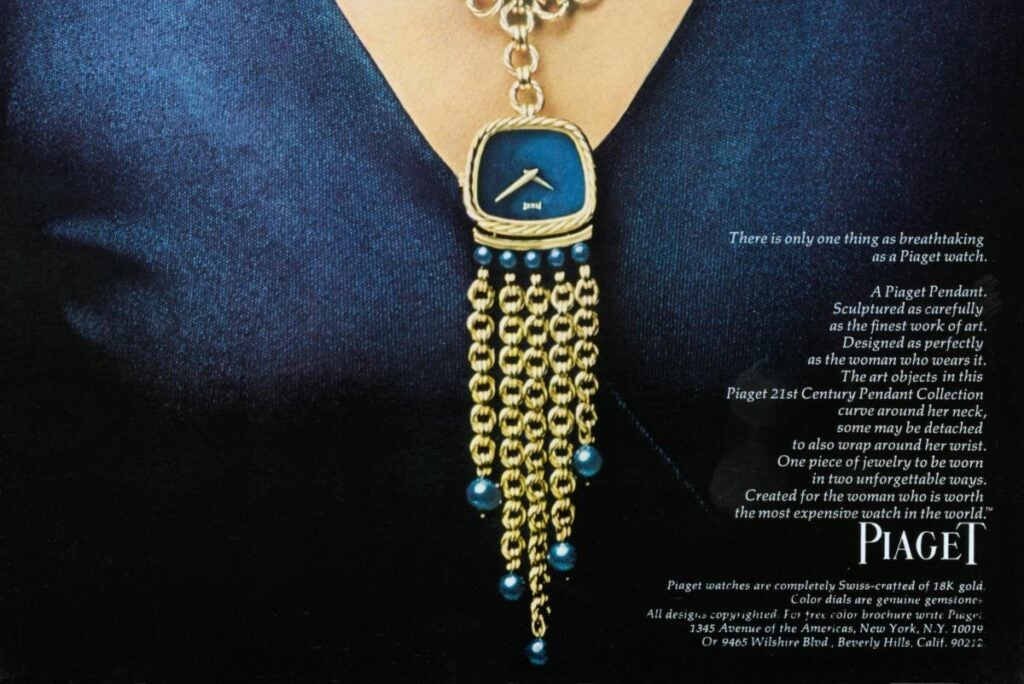
Dramatically sculpted jewellery cuffs and fabulous necklaces were formed around colourful stone watch dials, while dress watches for men and women took on fantastical decorative forms. Salvador Dalí collaborated on some designs; Jackie Onassis and Andy Warhol were clients. The Geneva showroom was a like private club where ‘Piaget Society’ clients could order bespoke creations to wear at the Hotel Byblos and St Moritz.
Content from our partners


‘The creativity was off the chart,’ says Uli. ‘They were more expensive and more exclusive than Patek Philippe.’
But that was then. In the mid-Eighties the company was sold to what would become the Richemont Group, the conglomerate that numbers Cartier and Vacheron Constantin among its revered ‘maisons’. Piaget branched out into high complications and set records for slimline watchmaking; but it was as a prestige jeweller that its reputation really soared, not least because it had such a rich aesthetic world on which to draw.
‘It’s that Slim Aarons world of the 1960s – endless holidays at Eden Rock, while wearing kaftans all day,’ the Times’s jewellery editor, Jessica Diamond, tells me. ‘There’s no such thing as quiet luxury at Piaget, and there never was.’
Jewellery makes up half of Piaget’s business now, but probably a rather larger slice of its reputation. Diamond says its goldsmithing and use of hard stones are second to none, but it’s the way it paints a picture of that enduring Piaget lifestyle – retro, sun-dappled, impossibly luxurious – that sets it apart.
[See also: Mapping the world of Rolex]
Which has left an increasingly urgent question: where has the louche, charismatic exuberance of ‘Piaget world’ gone in the watches? ‘Copy and paste design’ is what Uli calls the brand’s modern output. Along with repetitious examples of its ultra-slim Altiplano dress watch, the past decade has seen a ho-hum line of generic sports-luxe watches, called the Polo S, become its key timepiece. Its mainstream jewellery watches have shown little more flair.
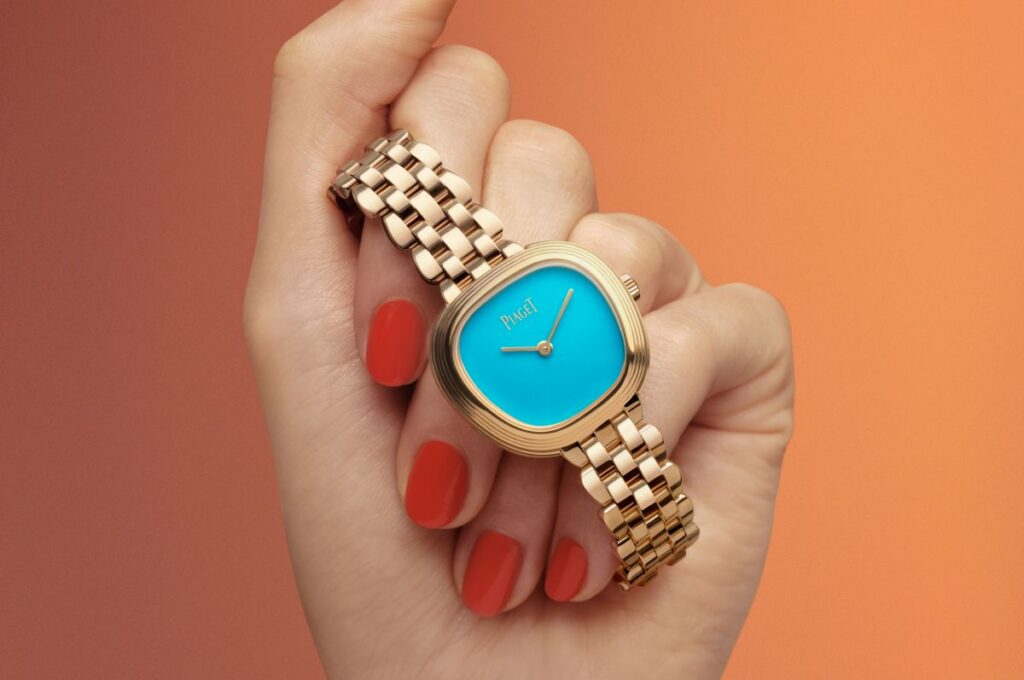
However, is the sun beginning to peek out again? The return of the ‘true’ Polo has been one very welcome sign; the launch last year of the Sixtie, a jazzy women’s design pairing a gold bracelet with an unusual trapezium form factor, is another, and gives Piaget a much-needed entry into the everyday-chic market that Cartier has made its own.
Not that those raise the pulse of a die-hard like Uli. But it was another almost lost icon from the Seventies, boasting both a sensationally suave design and some unimpeachable provenance, that did ultimately prick his curiosity, and that of a growing club of high-level collectors.
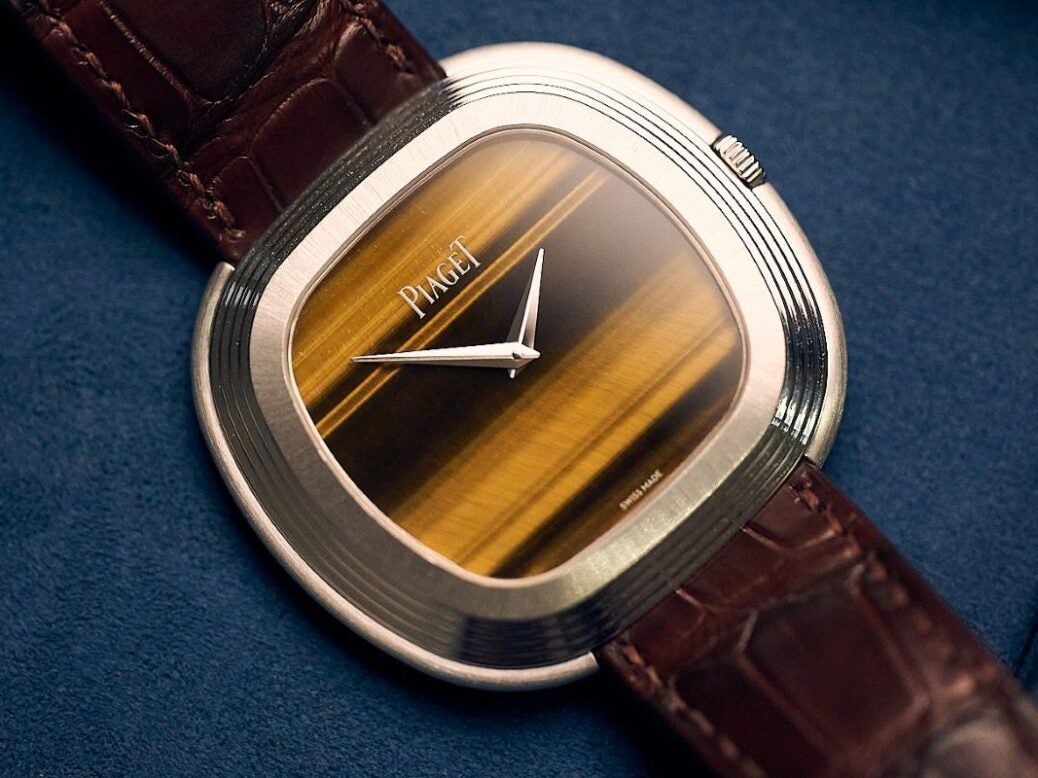
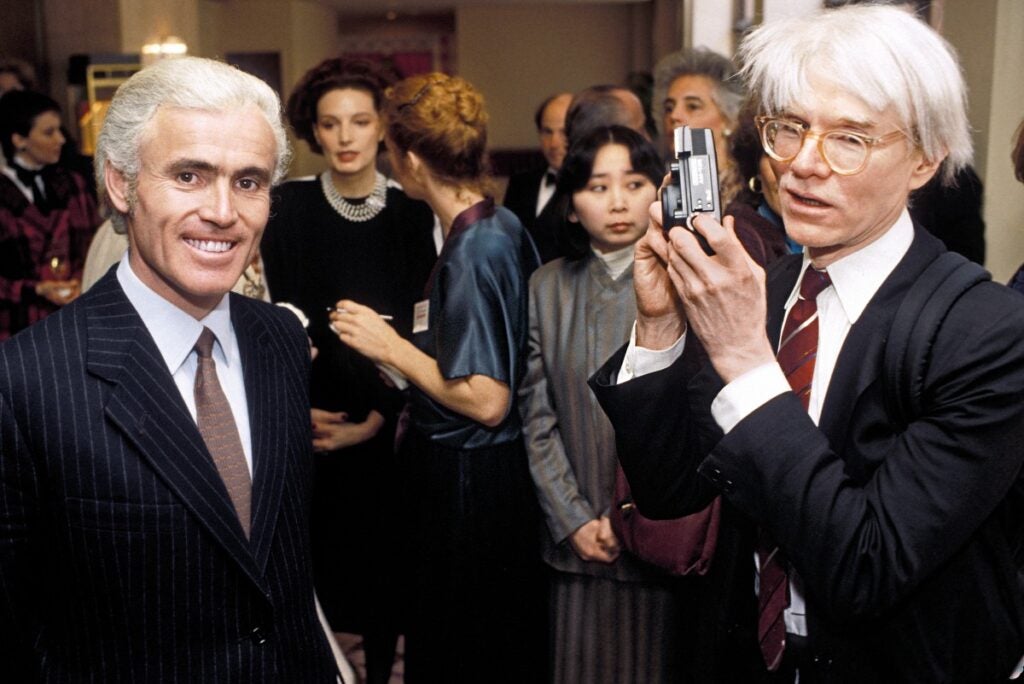
The provenance comes care of Andy Warhol, who owned several Piagets among hundreds of other watches, and hung out at swish New York parties with Yves Piaget, the watchmaker’s debonair president, in the Seventies. When the artist’s sprawling estate was auctioned off in 1988, Piaget bought back its pieces, among which was a model with a huge, square-form gold case formed in tiered steps around a spacious cut-stone dial. So fleetingly was this model made during the Seventies that in Piaget’s archives it had never even been given a name. But unlike many watches from the era, it is an audaciously large design, measuring 45mm across. It is so beautifully judged in its contours, slim in construction and distinctive in its style, that as a statement it seems both ineffably cultured and unashamedly loud.
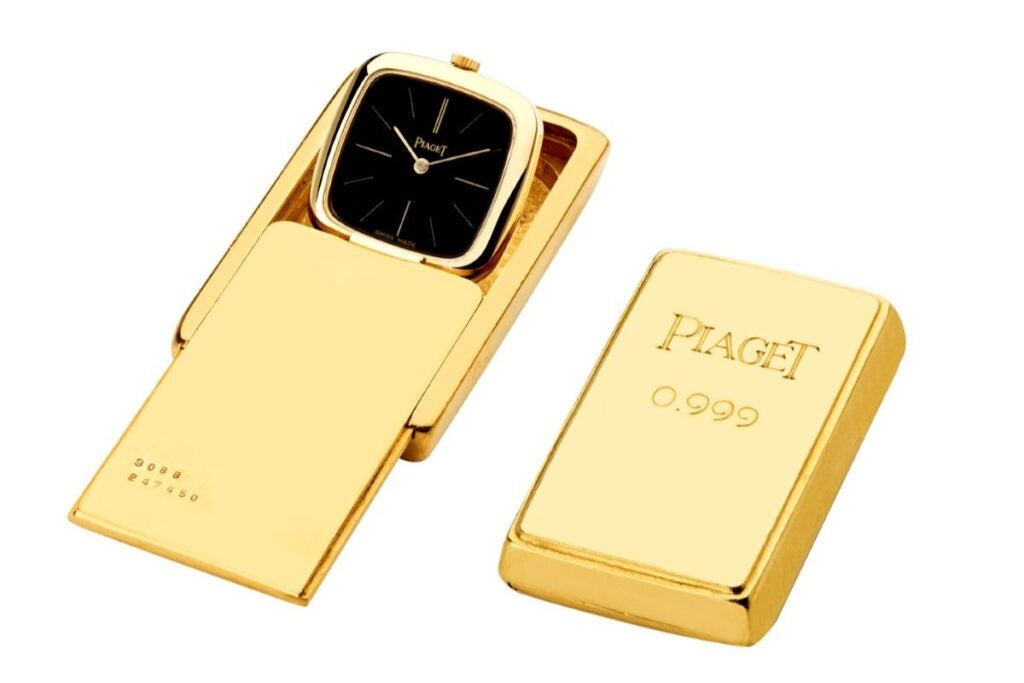
‘A guy in 1974 wearing a watch like this, he’s got to have big balls!’ comments Uli, for whom this mysterious beauty became the gateway drug to Piaget. In 2015 the brand had revived it, though it gave it little public attention: it was treated as a behind-closed-doors rarity, reserved for those with special access and bespoke tastes. A colleague of mine once stumbled into a closed-off room at Piaget’s booth during the Watches & Wonders trade show, to discover ten platinum versions, each with unique dials, commissioned by a single collector. But when Uli visited a boutique to ask about acquiring one, he was rebuffed: ‘The manager had no idea what I was talking about,’ he says. ‘But it’s the watch that dragged me inside Piaget history. And I realised so much of what they’d made was totally under the radar and forgotten about.’
To be fair, dainty, dandified men’s watches from the days of chest wigs and platform shoes have hardly been in fashion since the big watch boom of the early 2000s. The size of the Warhol watch enabled it to reach out across the decades, but its more delicate contemporaries are also suddenly finding much broader favour: for the hordes of Gen Z gents whose stylistic lodestar is apparently Hall & Oates in their mullet-’n-tash, soft jacket heyday, jewellery-ish timepieces once dismissed as gaudy or effete have come jingle-jangling back into collectability.
‘The stone dial trend has been huge, along with the reshaping of gender norms,’ says Christy Davis, co-founder of the online watch dealer Subdial, noting that where once Piaget watches were fleetingly listed and hard to shift, all manner of wondrous creations of yore are attracting ready buyers and rising prices. ‘You’re seeing men feel a lot more empowered to wear unusual, intricate jewellery-style pieces rather than over-hyped Rolex, for example, and collectors have realised just how cool and undervalued these pieces have been.’
Those collectors include Uli, who, along with his broader Piaget trove, has picked up no fewer than four original examples of the Warhol watch, each unique and each sensational. And he wasn’t the only collector champing at the bit to join the rarefied ranks of owners of newly made versions.
A couple of years ago, Piaget cut a deal with the Andy Warhol Foundation that allowed it finally to do the obvious thing: name the watch after its most famous wearer, and so bringing the watch out from under its bushel. It’s now offering customised versions more broadly, and there’s even an online tool to pick your case metal, dial material and strap. Prices start at around £50,000.
[See also: Vacheron Constantin makes it complicated again with its newest megawatch]
Or, for rather higher sums, you could go full-on bespoke and join a collector circle that has become a kind of Piaget Society all of its own. Last year, my journalist colleague Justin Hast got together with a bunch of collectors to curate a book of one-off Warhol watch examples, with the brand’s endorsement but not its involvement.
It includes a fantastically charismatic example that was, finally, made for Uli himself. It has a dial of flawless turquoise, a platinum case, diamond hour indexes and angular ‘dauphine’ hands. Instead of the words ‘Swiss Made’ on the dial, it carries the legend ‘One out of zero’.
‘It took a year and a half, and I was a pain in the ass for them,’ he chuckles. ‘It was very, very hard for them to find a turquoise stone that big that was totally flawless. But I said, “Please go find this for me.” And they’re Piaget; they understood that. And they did it.”
In the Warhol watch, along with the Polo 79 and the Sixtie, Piaget’s watchmaking is finding its way back to the sybaritic exuberance and craft sense that defined its brightest years. And with its vintage market bubbling away, the question now is whether it can filter that spirit into completely fresh designs. The signs are good, as is the renewed focus on bespoke watchmaking that, for collectors like Uli, remains the ultimate horological thrill.
‘After so much learning about watches and 40 years collecting them, I’ve seen everything – but this creative process was so satisfying and wonderful,’ he says. ‘It’s a real privilege. And if I wear it, it pops out like crazy and people are blown away. That’s what you should get with Piaget.’
This article first appeared in Spear’s Magazine Issue 99. Click here to subscribe