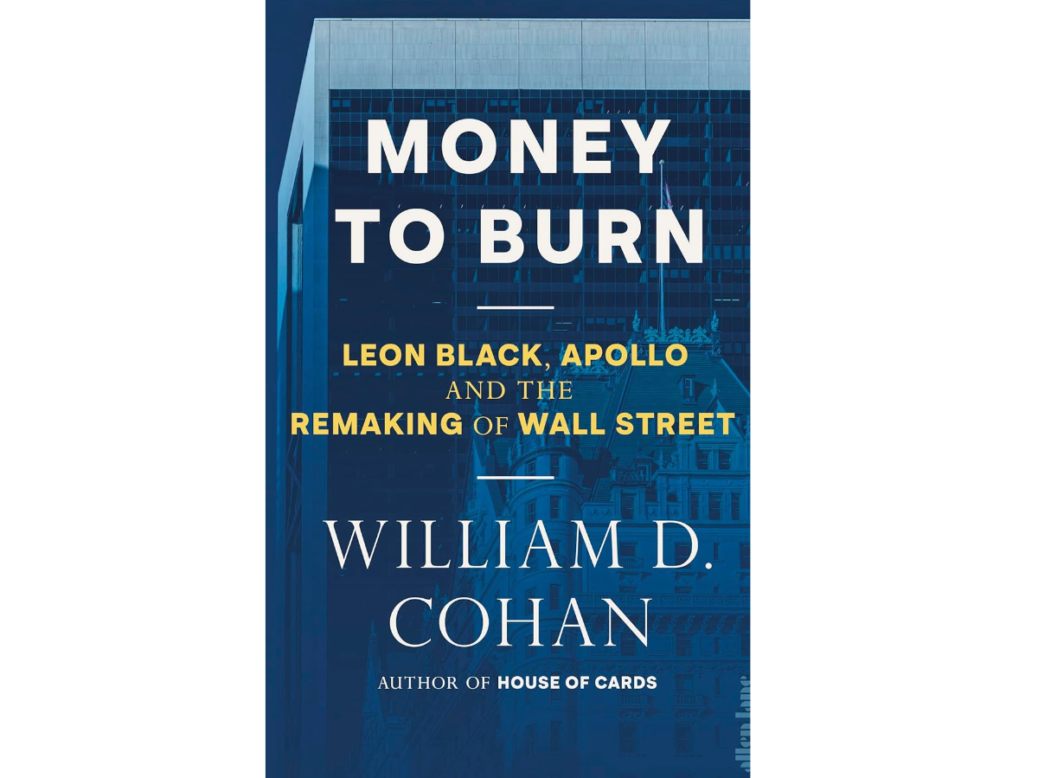
The first time I met Leon Black was on Carl Icahn’s boat in the Caribbean. Mutual friends suggested an evening cocktail with two of Wall Street’s bare-knuckled billionaires might be fun.
It wasn’t. Icahn grilled me about Fed monetary policy. Black, a hulk with a beetroot face, looked bored throughout.
Our second encounter at Apollo Global Management’s headquarters in New York in 2018 was more eventful. Black claimed the FT’s coverage of his firm was ill-informed and our attitude toward the buy-out business in general was suspect.

[See also: Why the super-rich are becoming cash-poor]
Related

Three years later, Black was out of a job, forced to resign as CEO after the release of an independent report commissioned by Apollo into his relationship with Jeffrey Epstein, the convicted paedophile. The report showed he had paid $158 million for financial advice over five years to Epstein, but found no evidence of wrongdoing by Black. It was an ignominious end to a 40-year career that made him fabulously wealthy but curiously unfulfilled.
In his mammoth biography, William D. Cohan, the ex-Wall Street banker and financial reporter, digs deep into Apollo’s ruthless deal-making and its soulless culture. But he never quite pins down Black, the charmless plutocrat driven by the suicide of his businessman father, Eli, who, suffering severe depression, jumped out of his 44th floor office in Manhattan.
Cohan tracks Apollo’s rise from junk bond merchant to private credit colossus, a trajectory that reflects deeper structural changes on Wall Street. After the 2008 global financial crisis, credit – and risk – shifted from a highly regulated banking sector to a ‘shadow banking’ system led by giant non-depositary financial institutions such as Blackstone, Brookfield Asset Management and KKR. The ‘apex predator’ is Apollo which, in Cohan’s words, has always found ways to make big money from the misfortune of others.
[See also: Crisis, what crisis? Inside private credit’s confidence problem]
Content from our partners



Black founded Apollo in 1990 after the implosion of Drexel Burnham Lambert, the powerful Wall Street firm led by the junk bond king Michael Milken who went to prison for securities and tax fraud. (He was later pardoned by President Trump). Not for the first time in his career, Black, then head of mergers and acquisitions at Drexel, escaped censure.
In the 1980s, Drexel was a massively disruptive force. Milken grasped that investors could make more money from buying bonds issued by companies with wobbly credit ratings than with safer bets on the bonds of AAA-rated companies.
For smaller companies that could not obtain credit from traditional sources such as banks, insurance companies and the stock market, Milken’s innovation was transformational. But Drexel also serviced corporate raiders such as Icahn who used junk bonds to finance takeovers or shakedowns known as ‘greenmail’, earning the wrath of the US business establishment.
[See also: Wealthy investors drive record £24.2bn Capital Gains Tax bill]
The Drexel DNA runs throughout Apollo’s story, not just in the scrappiness and the sky-high compensation for the senior team but also in the ability to court controversy and litigation. Indeed, one of Apollo’s first deals – the purchase of California’s Executive Life Assurance company in tandem with France’s Crédit Lyonnais – almost brought down the firm. Crédit Lyonnais later had to be rescued by the French state. But instead of being prosecuted and fined, Apollo walked off with the Executive Life portfolio and made billions of dollars in profit.
Over the next two decades Apollo rarely looked back. The leadership team crystallised around Black, Marc Rowan – the cerebral visionary who now runs the firm – and Josh Harris, the workaholic who coveted the CEO job but whom Black describes as a ‘psychopath’ and a man ‘without a strategic bone in his body’.
Black’s view was undoubtedly coloured by his suspicion that Harris mounted a coup against him when the first Epstein allegations surfaced. Harris, a buy-out specialist and now a successful sports franchise owner, was inconsolable after being passed over. A seemingly diffident Rowan played a longer game, building up a de novo life assurance company Athene, which had Apollo as its signature client.
[See also: Revolut and Apollo tie-up ‘clever publicity, but creates risks’]
Cohan – who persuaded Black, Harris and Rowan to co-operate with his book – relates the story of the Apollo succession battle with verve and killer detail. By contrast, the narrative sags as it wades through endless Epstein emails in search of proof that Epstein was providing Black with more than tax advice.
‘I was incredulous that he would have such a loosey-goosey fee arrangement with Epstein,’ says Cohan, ‘especially since he was Leon Black, one of the world’s toughest negotiators.’
Then there is Black’s relationship with Guzel Ganieva, a former Russian model. Ganieva later turns on her sugar daddy, breaking an NDA and walking away from more than $10 million of hush-money payments. In a RICO lawsuit filed by Black it was argued that her decision makes no sense unless linked to Harris’s coup, but the claims were dismissed by a federal judge as ‘glaringly deficient in fundamental respect’. Harris maintains he never met or knew Ganieva.
[See also: Dan Neidle: The rich can still silence their critics with lies]
Ganieva’s allegations of sadistic sexual abuse are documented in stomach-churning detail, though roundly denied by Black. A New York Times investigation into whether Black mistreated other women goes nowhere; nor is there any credible link established to Epstein, despite Ganieva’s tantalising hints.
The abiding question is how Black could fall so low, so fast. He was a pillar of the New York establishment, chairman of the Metropolitan Museum of Art, owner of a vast art collection and a reputed family man who comes from a long line of rabbis, including his own father.
Black’s explanation – similar to that of the likes of Microsoft founder Bill Gates or ex-Barclays chief executive Jes Staley – is that he knew nothing of Epstein’s offences.
[See also: What does Bernard Arnault’s tweet tell us about LVMH?]
However, the size of Epstein’s fees defies commercial sense. As Cohan notes, Black could have paid a fraction for top-drawer Wall Street advice.
An anonymous friend of Black’s offers a different explanation. ‘He’s slightly naive. Not all men are so naive socially and sexually. Because he was fat… Now, does a fat person get laid? Not so often. Is a fat person respected? Not so often…’
I could go on, as Cohan does at times. By the end, the reader is left with a feeling not so much of pity, but one of emptiness. Capitalism as creative destruction? Hardly. This is self-destruction on a monumental scale.
Money to Burn: Leon Black, Apollo and the Remaking of Wall Street, by William D. Cohan (Allen Lane, £40) will be on sale from 8 September in the UK.
This article has been updated to note that a lawsuit filed by Leon Black that made claims concerning Guzel Ganieva’s relationship with Josh Harris was dismissed by a federal judge.