Whether called fixed income, debentures, notes or bills, the bond market has long been seen as the stock market’s duller sibling. While the media routinely focuses on what the FTSE or Dow Jones is doing, bonds rarely get mentioned.
However, as many developing countries have long known – and certain developed ones have begun to notice – the bond market is the real force at the centre of the global financial system.
At nearly $200 trillion, it is by far the biggest component, but mere size understates its clout.

[See also: The Spear’s guide: new book releases]
Related

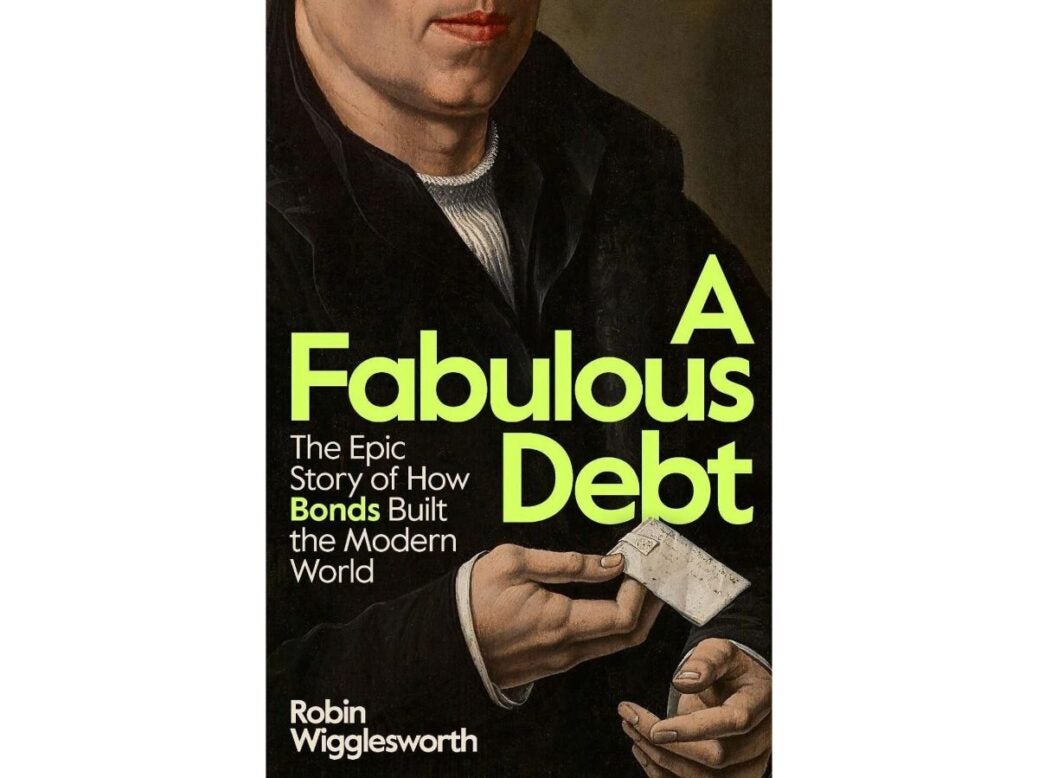
As I write in A Fabulous Debt, my upcoming book on the bond market, it is the sun that exerts irresistible and constant influence over every other body in its orbit. It is the bond market that, second by second, sets the cost of borrowing for everyone from the World Bank, Peru or Germany to American students, British homeowners and Danish wind farms.
In a world that runs on debt to an unprecedented degree, this is an awesome power. To understand how we arrived at this point it helps to understand how bonds were born, how they grew up and why the original ‘decentralised finance’ became ascendant in the financial system.
Nearly a millennium ago, the citizens of Venice brutally murdered their ruler on the city’s streets. His sin? He had lost a war against Constantinople, brought pestilence back with him and forced them to extend to the government a war loan that was unpayable.
[See also: Crisis, what crisis? Inside private credit’s confidence problem]
Content from our partners



The debacle of 1171-72 would have far-reaching consequences. The Venetians were quickly aghast at how badly they had treated Doge Vitale II Michiel, a good man whose only real flaws had been indecision and caution. They executed the man who had dealt the doge’s fatal blow and established a proto-parliament to guard against mob rule, a landmark in Venice’s uniquely republican politics.
Yet it was that mandatory war loan that would turn out to have the greatest legacy. Venice was initially unable to repay the loan, but this turned out to be a boon. The loan paid 5 per cent a year and the receipts were tradable. So anyone who wanted some silver coins could head down to Venice’s Rialto market and sell their claim to someone who wanted a steady income stream.
Merchants used these prestiti as collateral for trade deals. Soon enough, other Italian city states copied the innovation. Eventually it spread across Europe, and the world.
[See also: Everything we know so far about Anthropic’s ‘Claude for financial advisers’]
The Dutch became the first to fully harness the ability of bonds to pool many small sums of money into vast amounts for longterm investments – using them to win independence against the vastly larger and more powerful Spanish empire.
After the Glorious Revolution of 1688 the British improved further on Venice’s invention by making it the permanent obligation of a sovereign nation, rather than a fickle royal, Italian city or Dutch province. Alexander Hamilton then used bonds as the financial glue to bind 13 disparate colonies together into a federal state.
Historically, bonds have mostly been a tool of governments, but they also financed the Industrial Revolution. In the latter half of the 20th century, innovations like Eurobonds, junk bonds and securitised bonds extended the fixed income revolution into more corners of the financial system. Derivatives then made the market racier than ever.
[See also: Why the super-rich are becoming cash-poor]
By the modern era, the cleverest budding financiers usually aspired to be bond traders, not stock pickers.
But it was the cataclysm of 2008 that marked the bond’s ascendancy over other parts of the economy’s machinery of credit. Bond market madness was arguably just as culpable for the global financial crisis as banks, but it was the banks that suffered the main brunt of the subsequent regulatory onslaught. That forced them to retrench, even as the bond market was supercharged by the subsequent explosion of government borrowing.
Unfortunately, this has arguably left the bond market more fragile than ever. It is almost like we have squeezed risks out of the banking system, only to have shoved them into the larger, more opaque and fiendishly complex fixed income market.
[See also: World’s billionaires now worth more than $15tn]
The financial upheaval caused by the Covid-19 pandemic of 2020, the gilt market blow-up triggered by Liz Truss’ 2022 budget, the ructions unleashed by President Donald Trump’s ‘Liberation Day’ in 2025 – these are all unnerving signs of bond market brittleness.
Where might the next blow-up happen, how might it play out and can disaster once again be averted? It is impossible to say. Chances are that central banks will ride to the rescue, reluctantly or otherwise. The reality is that today, it is the bond market that is too big to fail.
A Fabulous Debt: The Epic Story of How Bonds Built the Modern World, will be published by Penguin on 24 September.